
.png)


A customer posts a photo of your product, tags you, and gets nothing back. Not even a reply.
That happens every week in most brands, and it is the cheapest marketing you will ever refuse. The customers already talking about you are willing to do more, and nobody has asked them.
An ambassador is not an influencer you rent. It is a customer who already buys, already recommends, and would happily do it on purpose.
Knowing how to build a brand ambassador program is mostly about making that easy, then making it worth their while.
What is a brand ambassador program?
A brand ambassador program recruits customers who already like your products, offers them a reason to talk about you, and tracks what comes back.
Three things define it. A clear expectation of what ambassadors do, a reward that matches the effort, and a way to measure the results.
The difference from a one-off campaign is duration. Ambassadors stay with you across seasons, which is what lets a relationship form in the first place.
Most ambassadors are not famous. They are customers with a few hundred followers, a genuine attachment to your brand, and more credibility with their circle than any paid post carries.

Why are brand ambassador programs crucial for modern marketing in 2026?
Paid reach keeps getting more expensive while trust in advertising keeps falling. An ambassador program sits on the other side of that trade: slower to build, far cheaper to run, and harder for a competitor to copy.
The willingness is already there. According to the Industry Report 2025 by Loyoly, conducted among 1,016 consumers, 59% of loyal customers recommend the brands they like to those around them.
What most brands lack is the structure. Recommendations happen informally, nobody tracks them, and the customers doing the work never hear back.
Ambassador programs also solve a content problem. A steady stream of authentic photos and videos costs a fraction of a studio shoot and performs better on social media.
The benefits of a brand ambassador program for your business
Growing your social media presence and reach
Ambassadors give you reach you do not rent. Each one talks to an audience that already trusts them, which is a different thing from buying impressions.
The compounding matters more than the size. Fifty ambassadors posting monthly reach further over a year than one large campaign, and they keep working when the budget stops.
Social media rewards frequency more than production value. A brand ambassador program delivers both, because ambassadors post from their own life rather than from a content calendar.
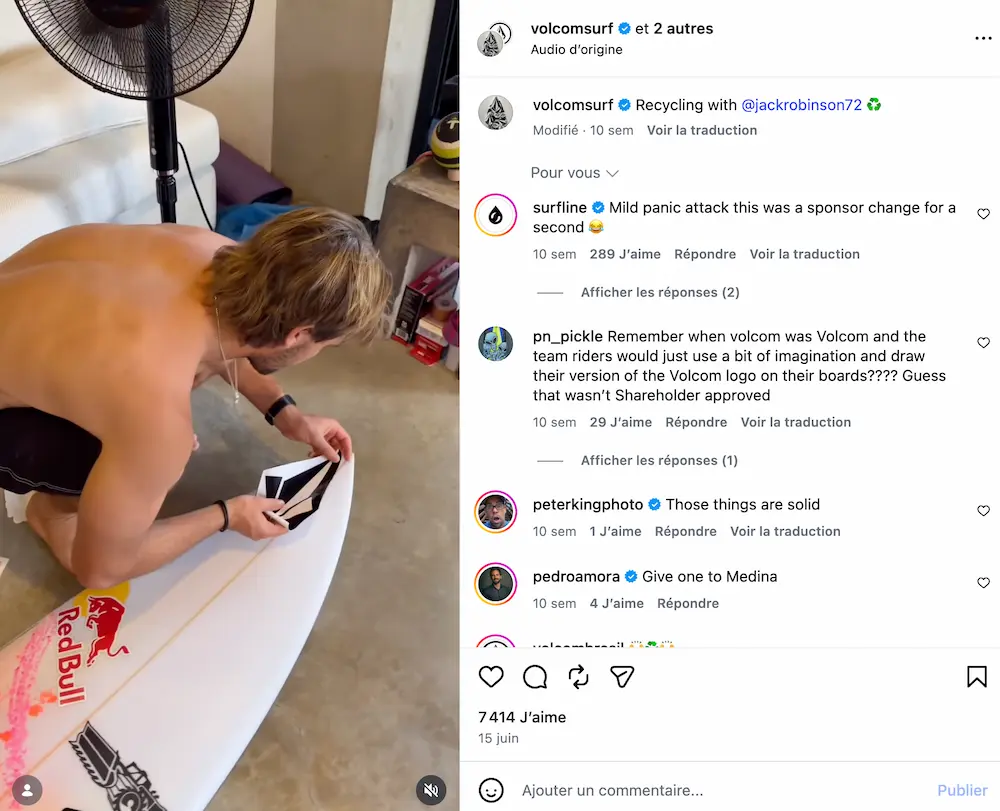
Receiving authentic content sources and user-generated content (UGC)
Content is the benefit brands underestimate. Ambassador photos and videos can be reused on product pages, in ads, and on your blog, which turns a marketing cost into a marketing asset.
Authentic content also converts better than studio photography on most catalogs. Shoppers recognize a real kitchen or a real wardrobe, and they trust what they recognize.
Settle this before the first campaign. Securing reuse rights at signup lets the program feed its marketing for a year; asking afterward gets half the answers it needs.
.webp)
Building brand trust and credibility
Trust transfers through customers, not through claims. A recommendation from someone who bought with their own money carries what no advertisement can buy.
Consistency builds credibility over time. A brand ambassador who posts every month reads as genuine; one who appears for a launch and disappears reads as paid.
Social proof is the mechanism underneath all of it. When customers share your products on social media, they are lending you credibility that a brand cannot generate on its own.
Saving money on marketing efforts and reducing customer acquisition cost
Ambassador programs lower acquisition cost because the reward is paid on results rather than on impressions. You spend when someone actually buys.
The math improves as the program grows. Fixed costs stay flat while the number of ambassadors rises, so the cost per acquired customer keeps falling.
Compare it against your paid channels honestly. Ambassador marketing takes more management time than a media buy, and it is still cheaper per acquired customer once the program runs.
Fostering a loyal community, advocacy, and measurable ROI
Ambassadors turn a customer base into a community. People who represent your brand talk to each other, help newer customers, and remain far longer than average.
The return is measurable when you set it up that way. Attributed sales, content produced, and referred customers give you three numbers to weigh against what the program costs.
Community is where the compounding happens. Ambassadors who know each other generate their own momentum, and a community that runs itself is the cheapest marketing asset a brand can own.
Give the community a place of its own. A private group where ambassadors share what worked turns a roster into a network, and the marketing value of that network grows without you.
Brand ambassador vs. influencer vs. affiliate vs. referral programs: understanding the differences
Brand ambassadors: definition, role, and commitment
Ambassadors are existing customers who represent your brand over time. They buy, they post, they answer questions from people who ask.
The commitment is ongoing and the relationship is personal. That is the essential difference: an ambassador is chosen for their attachment, not for their audience size.
Influencer marketing and ambassador marketing solve different problems. An influencer buys you a spike; an ambassador builds momentum, and most brands need both at different moments.
Influencers: definition, role, and typical engagement
Influencers are paid for access to an audience they built. The engagement is contractual, defined by a brief, a number of posts, and a fee.
The model works for visibility and launches. It rarely produces the steady, low-cost stream of content that an ambassador program delivers, and it stops the day the contract ends.
Affiliates: definition, role, and compensation models
Affiliates promote products for a commission on sales. They may never have bought from you, and their motivation is financial rather than personal.
Affiliate marketing scales well on volume and tracks cleanly. What it does not produce is trust, because the audience knows the recommendation is paid.
Referral programs: definition, role, and customer motivation
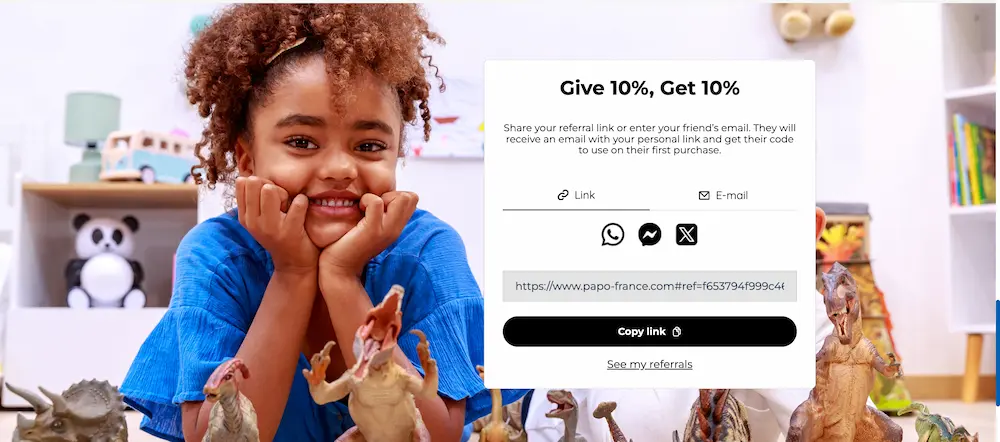
Referral programs reward a customer for introducing a friend, on both sides. The motivation is a mix of self-interest and genuinely wanting to help someone.
A referral software makes this countable: a unique link per customer, a reward for each side, and validation at the friend's first paid order. Loyoly's Loyalty Benchmark 2026 puts first-purchase conversion at 37.1% among invited friends.
How to build a successful brand ambassador program from scratch: a step-by-step guide
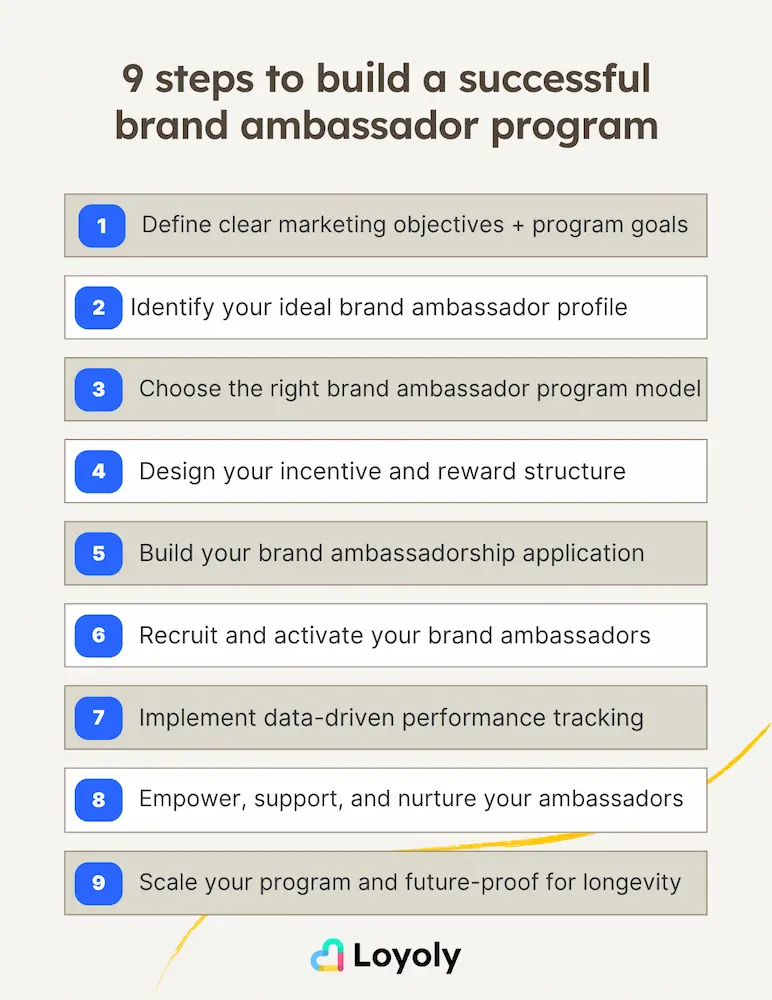
Step 1: Define clear marketing objectives and program goals
Write the goal as a number. "More awareness" is not a goal; "eighty pieces of usable content and two hundred referred customers this year" is one you can act on.
Pick one primary metric and two secondary ones. A program measured on everything gets optimized for nothing, and the team loses the thread by the second quarter.
Tie the goals to a business outcome, not to activity. Posts published is a vanity metric; referred customers and content reused in marketing are the results a program gets judged on.
A brand ambassador program works as a marketing strategy, not as a campaign. Campaigns end; a program compounds, and the brand that treats it as infrastructure gets what the brand running one-off campaigns never sees.
Step 2: Identify your ideal brand ambassador profile
Start inside your existing customers. Your strongest candidates already order regularly, already tag you, and already answer questions from other customers in your comments.
Look at engagement rather than follower count. Someone with eight hundred engaged followers in your niche is worth more than someone with fifty thousand who never reply.
Write the profile down before recruiting. Category, posting habits, tone, and minimum order history: a clear brief saves you from a roster nobody knows how to manage.
Look at your community first, then at creators outside it. An ambassador recruited from your customer base costs less to activate and stays longer than a creator who discovered the brand through a pitch.
Step 3: Choose the right brand ambassador program model
Three models cover most cases. Product-only, where ambassadors receive free products; commission-based, closer to affiliate marketing; and hybrid, which pays a small fee plus performance.
Match the model to your margin and your purchase frequency. Free products work when repeat buying is natural; commission suits higher-value catalogs where one sale justifies the payout.
The model also shapes who applies. A product-only program attracts genuine enthusiasts; a commission-based one attracts people building a side income, and both can work if you know which you are recruiting.
Step 4: Design your incentive and reward structure
Know what actually motivates ambassadors before you design anything. Loyoly asked 1,016 consumers what makes them refer: 61% cite the benefit for themselves, 45% the benefit for their friends, and 33% the simplicity of the process.
Mix the tangible and the intangible. Free products, store credit, and early access all work; so does being named on the site or asked to vote on the next range.
Keep the terms readable and the payout fast. An ambassador who waits six weeks for a reward stops promoting long before the payment arrives.
Make the reward visible inside the program. A dashboard that shows what someone earned this month does more for engagement than a larger payout nobody can see.
Step 5: Build your brand ambassadorship application and onboarding process
Make the application short. Name, social handles, order history, and one question about why they like the brand tells you more than a long form nobody finishes.
Onboarding is the essential step most programs rush. A welcome pack, clear rights over the content, and a single contact person turn a signup into an active ambassador.
Set expectations in writing. How often you hope they post, what you will send, who to contact with a question: a page of clarity prevents most of the drop-off that follows a signup.
Step 6: Recruit and activate your brand ambassadors
Recruit from where your customers already are: the order confirmation, the post-purchase email, the community group. Cold outreach converts far worse than an invitation to someone who already buys.
Activate within the first week. A first small task, an easy win, and a public thank you create the habit before enthusiasm fades.
Seed the first wave from your most loyal segment. Customers with several orders and a history of tagging you are the ones most likely to say yes and to keep going.
Step 7: Implement data-driven performance tracking and measurement
Give every ambassador a unique link or code. Without it you are guessing, and guesswork is how good programs get cut in a budget review.
Track three things monthly: content produced, referred customers, and attributed sales. A platform that holds the data in one place saves your team a spreadsheet nobody maintains.
Read the insights, not just the totals. Which ambassadors drive revenue, which produce reusable content, and which do neither: that split tells you where to spend your time next quarter.
Step 8: Empower, support, and nurture your brand ambassadors
Ambassadors need resources, not instructions. Product information, image rights, key messages, and a heads-up before launches let them create something in their own voice.
Share what is working across the group. A monthly note showing the strongest posts and what they had in common teaches faster than any brief, and it gives recognition at the same time.
Communicate personally as well as collectively. A line that names what one person did lands differently from anything sent to the whole roster.

Step 9: Scale your program and future-proof for longevity
Grow in cohorts rather than all at once. Twenty ambassadors you support well beat two hundred you never speak to, and the second group leaves within a quarter.
The right number is the number your team can answer within a day. That is smaller than most marketing plans assume, and it is the constraint that actually matters.
Review the terms every year. Rewards that felt generous at launch look thin after two years of price rises, and ambassadors notice before you do.
Plan for turnover. A share of your ambassadors will drift away every year for reasons that have nothing to do with you, so recruiting has to run continuously rather than once.
The steps above look sequential, and mostly they are. What changes with experience is speed: a second brand ambassador program launches in a fortnight, because the terms, the platform, and the marketing assets already exist.
Creating a brand ambassador program takes six to eight weeks of setup. Most of that time goes into choosing the platform, writing the rules, and picking the first ambassadors.
Best practices for managing a high-ROI brand ambassador program
Create helpful ambassador briefs
A good brief says what you want and leaves how to say it alone. Key message, must-avoid claims, hashtags, and a deadline fit on one page.
Over-scripting kills the thing you recruited them for. Content that reads like a press release performs worse than a clumsy post in someone's own words.
Give them the right assets and get out of the way. Product images, key messages, and the claims legal will not allow: everything else is their call.
Create ambassador challenges or multiple tiers of commission
Challenges create rhythm. A monthly theme, a small prize, and a public leaderboard turn an occasional post into a habit without raising your costs.
Tiers reward those who deliver. Higher commission or better perks at defined thresholds gives your most active ambassadors a reason to keep posting.
Campaigns still have their place inside a brand ambassador program. A seasonal push, a launch, or a challenge offers the community a shared moment, and the content produced feeds your marketing for months.
Build long-term relationships
Treat ambassadors as partners, not as channels. Remember what they order, ask their view before a launch, and invite them to events when you run them.
A good program feels like a club. That is what carries an ambassador through a bad quarter, and it costs nothing to create.
The successful programs look unglamorous from the inside. Consistent posting, rewards paid on time, and a community that answers its own questions: success here is the absence of drama.
Frequently asked questions about brand ambassador programs
Do brand ambassadors need a large social media following?
No. Engagement and genuine attachment matter more than reach, and small accounts convert better because their audience knows them personally.
How many brand ambassadors should I start with?
Between ten and twenty. That is enough to learn what works and few enough that one person can support them properly while you find your process.
Do brand ambassadors need to be paid?
Not always. Free products, store credit, early access, and recognition motivate many ambassadors, and a commission on referred sales can replace a fee entirely.
How much do brand ambassadors typically get paid?
Commission usually sits between 5 and 15% of referred sales, with product-only programs at the lower end of the cost range. Rates vary widely by category and by what you ask for.
How long does it take to see results from a brand ambassador program?
Content arrives within weeks. Sales attribution takes a quarter, and the community effect takes a year, which is why programs judged after two months get cut too early.
Can small businesses run effective brand ambassador programs?
Yes, and often better than large ones. A small brand knows its customers by name, which is exactly the relationship an ambassador program is trying to create at scale.
The programs that last are the ones where ambassadors feel seen. A reward paid on time, a reply to every post, and a place in the decisions: none of it is expensive, and all of it is rare.
At Loyoly, we help more than 600 ecommerce and retail brands turn their best customers into advocates, through loyalty, referral, and post-purchase engagement. If building an ambassador program is on your roadmap this year, it is worth a conversation: book a demo.




.webp)