

.png)


Every growth marketer knows it: referral marketing is one of the highest-ROI acquisition channels available to ecommerce brands. But running a referral program that actually converts requires more than a "refer a friend" button buried in your footer.
It requires the right referral marketing software.
The market has exploded. Between loyalty platforms that bolt on referral features, standalone referral tools, and all-in-one post-purchase engagement platforms, the choice is genuinely complex.
This guide cuts through the noise. We cover what referral software actually does, what separates a good tool from a great one, and which solutions are worth your attention in 2026.
What is referral marketing software?
Referral marketing software is a tool that enables ecommerce brands to create, manage, and optimise programs where existing customers recruit new ones in exchange for rewards. The software handles the mechanics: generating unique referral links or codes, tracking who referred whom, verifying purchases, and triggering reward distribution automatically.
Without dedicated software, referral programs become a manual nightmare. You'd need to track codes in spreadsheets, manually verify conversions, and manually issue discounts. Not scalable, and prone to fraud.
Good referral software automates the full loop: from the moment a customer shares their link to the moment both referrer and referee receive their reward.
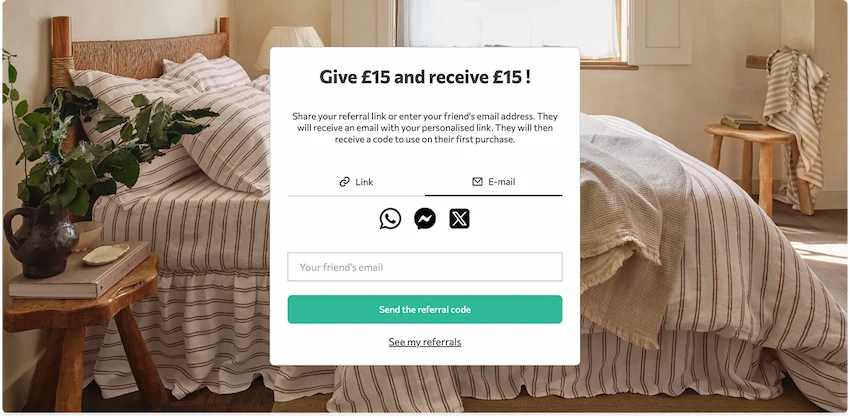
Why referral marketing deserves a dedicated tool
Word-of-mouth has always been the most trusted acquisition channel. But without the right infrastructure, it stays unpredictable and unmeasurable.
According to the Loyoly Industry Report 2025, 29% of consumers say a recommendation from someone close to them influences their decision to buy from a brand for the first time. That's a +4 point increase versus 2024. The trend is clear: peer influence is growing, not fading.
And when you look at what drives referral sharing, the data is equally clear: 61% of consumers cite a personal financial benefit as their primary motivation, followed by wanting to give their circle a good deal (45%). People don't share out of pure altruism. They need a structured incentive and a frictionless experience.
That's exactly what referral marketing software provides.

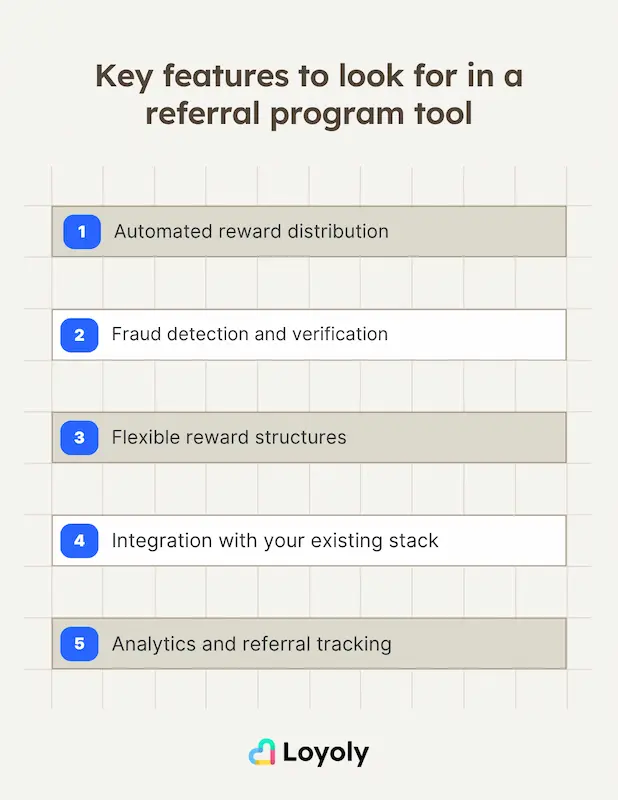
Key features to look for in a referral program tool
Not all platforms are built the same. Before evaluating specific tools, you need to know what actually matters.
Automated reward distribution
The best referral software triggers rewards automatically once a purchase is verified, without any manual intervention from your team.
This means no delays, no missed rewards, and a seamless experience for your customers.
Automation is especially critical at scale: if you're processing hundreds of referrals per month, manual management kills efficiency and creates errors that damage trust.
Fraud detection and verification
Self-referral fraud, fake accounts, and coupon abuse are real problems in referral programs.
A good platform detects suspicious patterns (same IP, same device, bulk sign-ups), flags anomalies, and lets you set rules to block abuse before it eats into your margins.
Some tools also require verified purchases before releasing rewards, which adds an essential layer of protection.
Flexible reward structures
Different brands need different incentives.
Some perform best with fixed discount codes (ideal for AOV below €50), others with credit vouchers that encourage higher spend (better for AOV above €50).
The right platform lets you define the reward for the referrer, the reward for the referee, and customise both independently.
The Loyoly referral tip: start with €10 for referrer and €10 for referee as a baseline, then calibrate based on your gross margins and LTV data.
Integration with your existing stack
Your referral software doesn't operate in a vacuum. It needs to talk to your CRM (Klaviyo, Braze…), your ecommerce platform (Shopify, PrestaShop), your review platform, and your customer service tool.
Without proper integrations, data stays siloed, automation breaks, and personalisation becomes impossible.
Analytics and referral tracking
You need to see, at minimum: number of referral links shared, click-through rate, conversion rate by referee, revenue generated via referral, and reward redemption rate.
The KPIs that matter most for a referral program are conversion rate (target: 30-41% depending on your sector per the Loyoly Benchmark 2026), share of new customers via referral (industry average: 1.5-2.5%), and ROI versus other acquisition channels.
The 7 best referral marketing software solutions in 2026
Here's an honest overview of the main platforms worth evaluating, with their positioning, strengths, and limits.
Loyoly
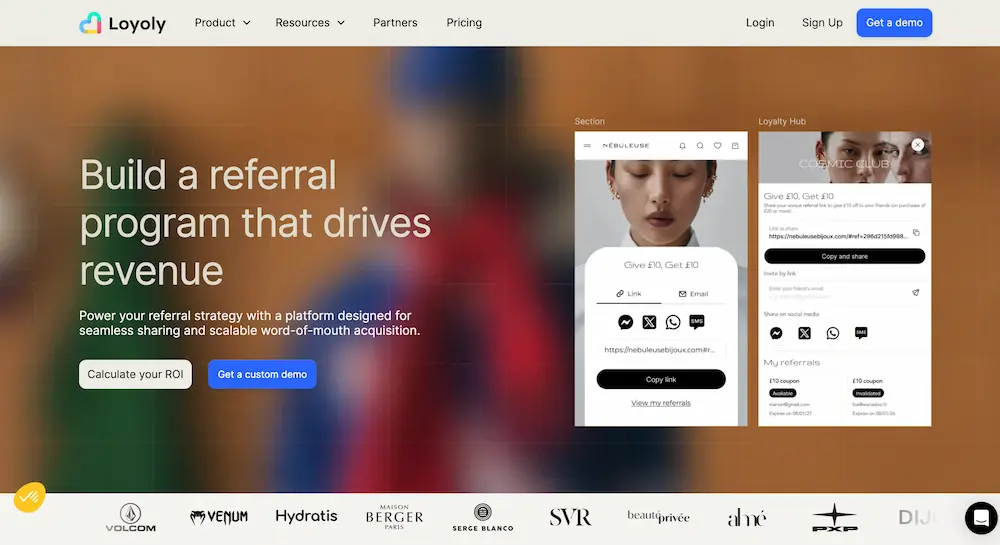
Loyoly is a post-purchase engagement platform built for ecommerce brands that want to go beyond transactional referral mechanics.
The platform combines referral programs, loyalty programs, UGC generation, social media missions, and a native Apple and Google digital wallet in a single solution.
Its referral module is natively connected to the loyalty engine, which means referral rewards can be expressed as points, VIP tier upgrades, or cash discounts, with automated follow-up flows triggered via Klaviyo, Braze, or any connected CRM.
Available on Shopify and PrestaShop, Loyoly serves 600+ ecommerce and retail brands across fashion, beauty, food, home, and health verticals.
Its average response time for customer support is under 2 minutes, and every account includes a dedicated account manager with strategic sessions and quarterly business reviews.
Key features
- 40+ engagement mechanics (referral, reviews, UGC, social missions, surveys, quiz, opt-ins)
- Native referral module integrated with loyalty engine and VIP tiers
- Automatic mission verification (no manual checks)
- Native Apple Wallet and Google Wallet with dynamic updates and geo-targeted push notifications
- Omnichannel earning and redemption (Shopify POS, Cegid, Fastmag)
- Full UI customisation via custom CSS, multi-language, multi-currency
- Checkout and product page extensions on Shopify
- 20+ integrations (Klaviyo, Gorgias, Recharge, Trustpilot, etc.)
- Native automation engine with conditional logic and triggered journeys
Pros
- The most complete engagement mechanics set on the market (40+ vs 10-20 for most competitors)
- Automatic mission verification eliminates fraud risk and manual workload
- Native wallet and push notifications for true omnichannel engagement
- Dedicated account manager with strategic sessions included on all plans
- Native PrestaShop support (rare among competitors)
Cons
- Only available on Shopify and PrestaShop (no Magento or BigCommerce)
- No free plan; mid-to-upper market pricing
- API still in development (planned Q2 2026)
Pricing
- Entry plan: from $99/month
- SMB: around $523/month
- Mid-market: around $823/month
- Enterprise: custom pricing
Yotpo
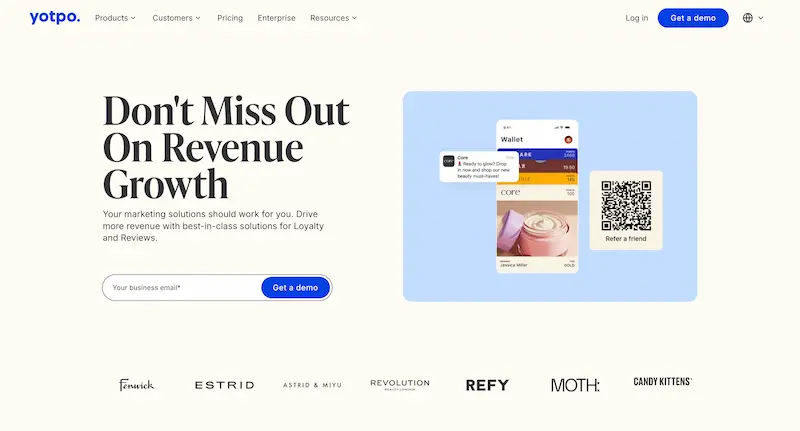
Yotpo is a broad ecommerce marketing suite that combines reviews, loyalty, and referral in a unified platform.
Its referral features are solid and benefit from deep integration with its review collection engine, which is one of the strongest in the market.
The platform supports 20+ engagement mechanics and allows significant programme customisation.
Its AI-powered campaign optimisation is a differentiator for mid-size to large brands running complex loyalty structures.
The main friction points are the complexity of onboarding (the feature set is large, which slows implementation), the absence of automatic mission verification, and limited omnichannel capabilities outside of Shopify POS. Support quality tends to drop significantly on non-enterprise plans.
Key features
- 20+ engagement mechanics with reviews integration
- AI-powered personalisation and campaign optimisation
- 100+ integrations with major ecommerce stacks
- Points, tiers, referral, and membership programme types
- Shopify POS integration for in-store earning and redemption
- Customer account module and checkout extensions
- Wallet passes via Novel partnership (not native)
Pros
- Best-in-class review collection engine combined with loyalty
- 100+ integrations, including API access
- Strong customisation and programme design flexibility
- AI campaign optimisation for complex programmes
Cons
- No automatic mission verification
- Heavy onboarding due to platform complexity
- Dedicated support only on top-tier plans
- No native Cegid or Fastmag PoS integration
- Wallet via third-party partnership, not native
Pricing
- Entry plan: from $79/month
- SMB: around $599/month
- Mid-market: around $899/month
- Enterprise: custom pricing
Smile.io
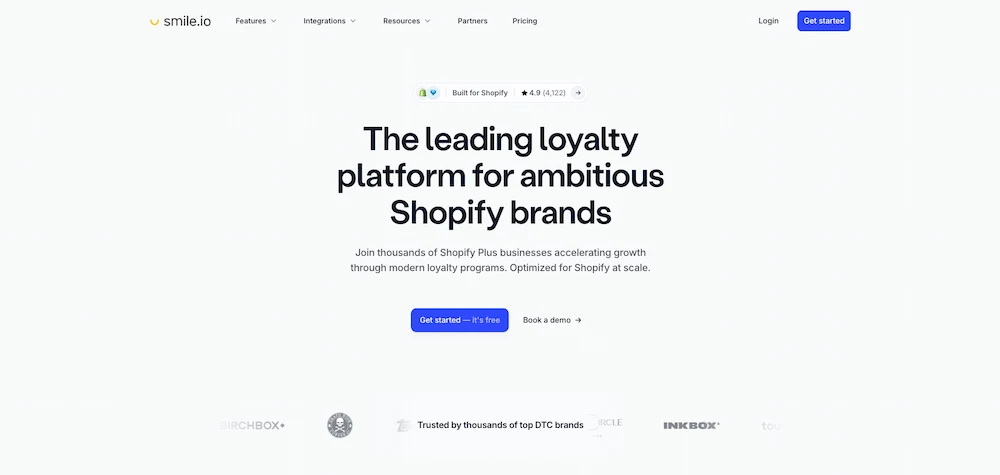
Smile.io is the default loyalty and referral app for early-stage Shopify merchants.
It is fast to set up, requires no code, and offers an affordable entry price that makes it accessible for brands running their first referral programme.
The widget is integrated directly into the storefront without redirection, which preserves the on-site experience.
Monthly engagement campaigns are a nice addition.
The reality is that Smile.io is built for simplicity, not depth: around 10 engagement mechanics, no automatic verification, no advanced automation, and limited customisation.
When your brand starts to scale and needs richer referral mechanics or deeper CRM integration, the platform quickly shows its ceiling.
Key features
- Points, tiers, and referral programme types
- Around 10 engagement mechanics (purchase, sign-up, birthday, reviews, social follows)
- No-code setup, live in minutes
- Floating widget integrated into the storefront
- Monthly engagement campaigns
- 30+ integrations
- Shopify POS for in-store redemption
Pros
- Fastest setup on the market, ideal for first programme
- Affordable entry price for early-stage brands
- Clean on-site widget experience without redirection
Cons
- No automatic mission verification
- No advanced automation or conditional logic
- Limited social and UGC mechanics
- Pricing escalates sharply with order volume
- No dedicated account manager or strategic sessions
Pricing
- Entry plan: from $79/month
- SMB: around $199/month
- Mid-market: around $999/month
- Enterprise: custom pricing
LoyaltyLion
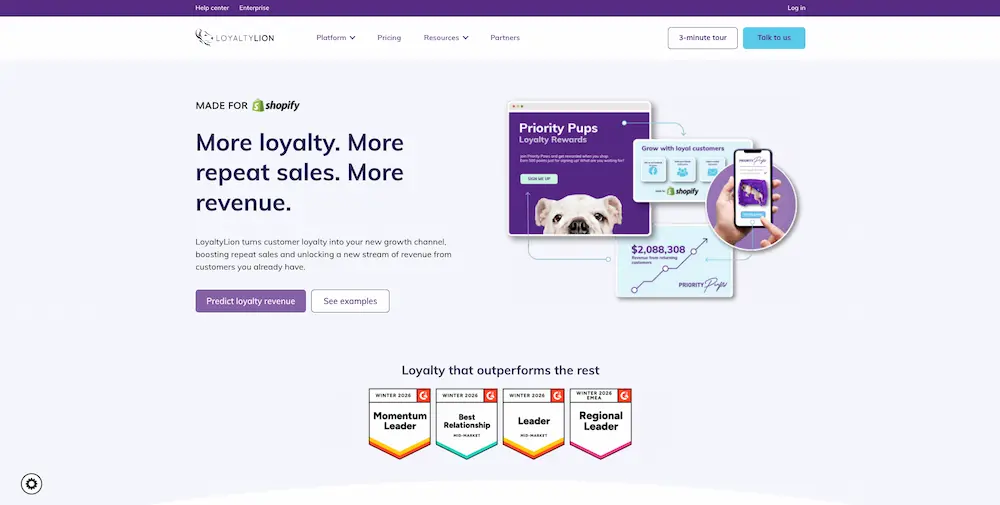
LoyaltyLion is one of the oldest loyalty and referral platforms on the market, with a strong focus on transactional loyalty mechanics and a wide integration ecosystem spanning Shopify, Magento, and BigCommerce.
Its analytics capabilities are among the most advanced available, which makes it a popular choice for mid-size to large brands with complex reporting needs.
The referral module is functional but lacks automatic mission verification and advanced social mechanics. Support quality has historically been inconsistent for non-enterprise clients, and several users have reported issues with mission verification reliability.
The platform does not offer a native wallet solution, relying instead on a third-party partnership with JeriCommerce.
Key features
- Points, tiers, and referral programme types
- Advanced analytics and reporting dashboard
- Wide integration ecosystem (Shopify, Magento, BigCommerce, custom via Headless API)
- PoS integrations: Shopify POS, ConnectPOS, Cin7 Core
- Apple and Google Wallet via JeriCommerce integration
- Customer account module and checkout extensions
- 20+ integrations, API available
Pros
- Best-in-class analytics for loyalty and referral performance
- Multi-platform support (Shopify, Magento, BigCommerce)
- Strong integration ecosystem with API access
Cons
- No automatic mission verification
- Inconsistent support quality on non-enterprise plans
- No native wallet (relies on JeriCommerce)
- Limited social and UGC mechanics
- No dedicated strategic sessions or custom development
Pricing
- Entry plan: from $199/month
- SMB: around $399/month
- Mid-market and Enterprise: custom pricing
Rivo
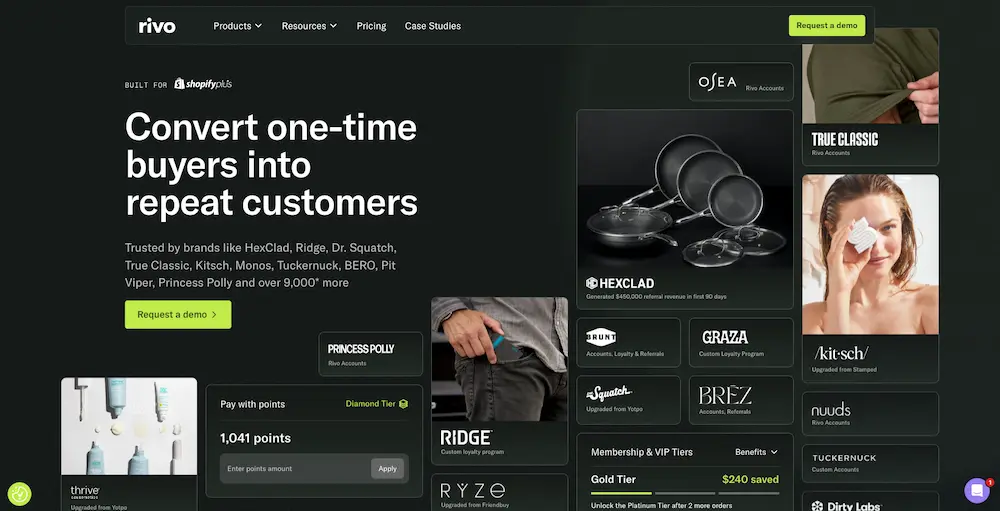
Rivo is a modern, developer-friendly loyalty and referral platform built natively for Shopify.
It earns the "Built for Shopify" badge and has positioned itself as the go-to solution for design-driven DTC brands that need deep visual customisation and technical flexibility.
Its open API and weekly product releases make it appealing to technical teams. The main limitation is geographic: Rivo is almost entirely focused on the US market, with very limited presence in Europe.
It does not support PrestaShop, and its advanced personalisation features require a steep learning curve on the Developer Toolkit. Automatic referral mission verification is not available.
Key features
- Points, tiers, referral, and membership programme types
- Open API and webhooks for custom builds
- "Built for Shopify" badge, fully native
- Deep UI customisation via custom CSS
- Weekly product releases
- 50+ integrations
- Customer account module and checkout extensions
Pros
- Most developer-friendly platform with open API
- High design customisation for brand-sensitive DTC brands
- Rapid product release cadence
Cons
- US-only focus, very limited EU support
- Shopify only, no PrestaShop
- No automatic mission verification
- Advanced features require Developer Toolkit with steep learning curve
- Inconsistent support quality at scale
Pricing
- Entry plan: from $499/month
- SMB, mid-market and enterprise: all custom pricing
Okendo
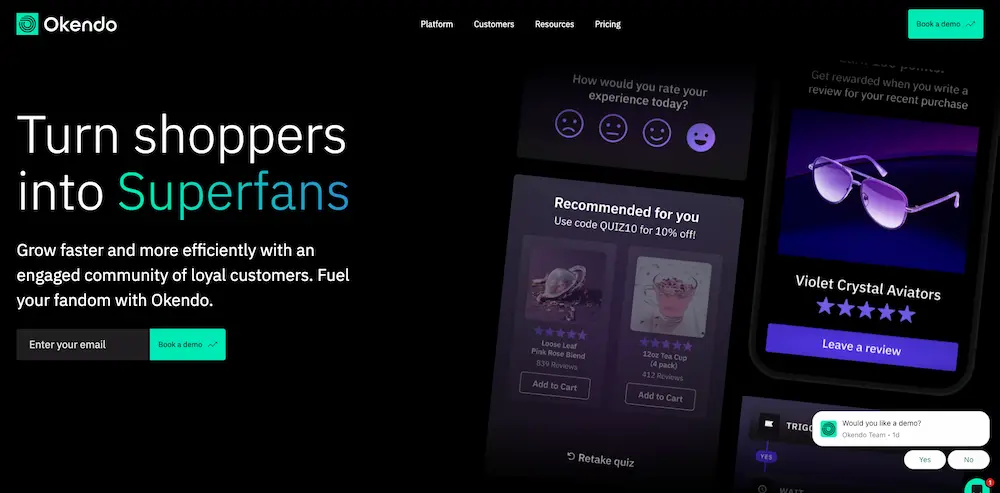
Okendo positions itself as a unified "customer marketing" platform combining reviews, loyalty, referral, and surveys in a single tool.
Its main differentiator is the tight integration between its review collection engine and its loyalty mechanics, which enables review-driven rewards.
With around 15-20 engagement mechanics, it sits between the simplicity of Smile.io and the depth of Loyoly or Yotpo.
The pricing model is competitive for entry-level access, but escalates quickly when you add integrations: the Klaviyo connector alone costs $299/month on top of the base plan.
No automatic mission verification is available, and UI customisation options are limited compared to more mature platforms.
Key features
- Points, tiers, referral, and membership programme types
- 15-20 engagement mechanics with strong review collection integration
- UGC collection tied to review submission
- Floating widget and reviews display widget
- Multi-language support
- 10+ integrations, API available
- Customer account module and checkout extensions
Pros
- Strong integration between reviews, UGC, and loyalty mechanics
- Competitive entry-level pricing for multi-feature access
- Both floating widget and reviews display widget available
Cons
- No automatic mission verification
- Pricing escalates fast with integrations (Klaviyo = +$299/month)
- Limited customisation options
- Dated dashboard UX
- No dedicated strategic sessions or QBRs
Pricing
- Entry plan: from $175/month
- SMB: around $417/month
- Mid-market: around $933/month
- Enterprise: custom pricing
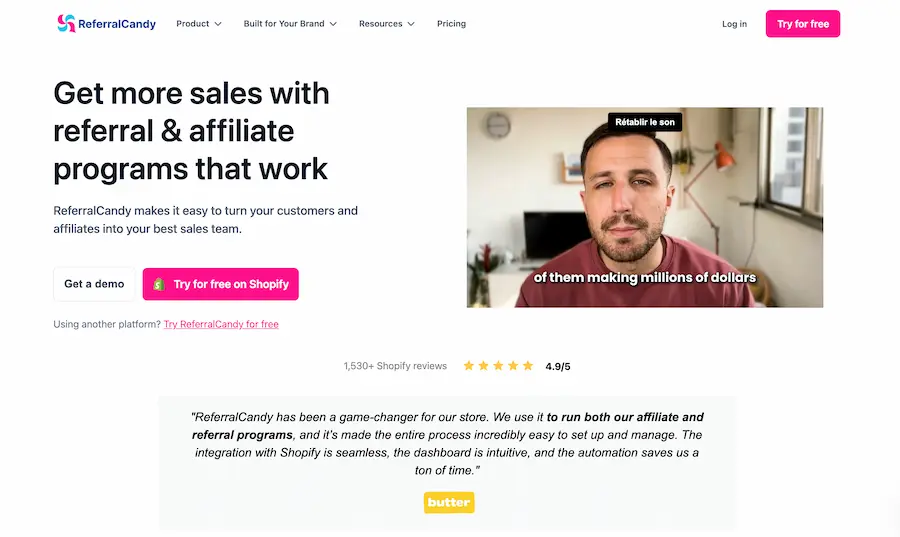
ReferralCandy
ReferralCandy is a standalone referral marketing software focused exclusively on referral programs.
It is one of the simplest tools to set up on the market, integrates natively with Shopify, WooCommerce, and Magento, and offers a clear pricing model with no hidden complexity.
It does referral well: link generation, tracking, automated reward distribution, and basic analytics are all covered.
Where it falls short is depth: no loyalty mechanics, no UGC, no social missions, no wallet, and no advanced automation.
If referral is just one part of your retention strategy, you will need to combine ReferralCandy with separate tools for the rest, which creates data silos and integration overhead.
Key features
- Referral programme creation with unique links and codes
- Automated reward distribution for referrer and referee
- Basic fraud detection
- Integrations with Shopify, WooCommerce, Magento
- Email notifications for referrers and referees
- Analytics dashboard for referral performance
Pros
- Simplest setup for a pure referral programme
- Multi-platform (Shopify, WooCommerce, Magento)
- Affordable entry price
Cons
- Referral only, no loyalty, UGC, or social mechanics
- No advanced automation or conditional logic
- Data silo when combined with other retention tools
- Limited customisation options
Pricing
- Entry plan: from around $59/month
- Growth plans: custom pricing based on orders
How to choose the right referral marketing software for your brand
Choosing a referral platform isn't just about feature lists. It's about fit with your business model, your stack, and your growth stage.
Match the tool to your AOV
If your average order value is below €50, discount codes work best as referral rewards: they're immediate, tangible, and create urgency.
If your AOV is above €50, vouchers (store credit) are generally more effective, as they encourage customers to spend more to unlock the full benefit.
Your referral software needs to support whichever reward structure fits your economics, and ideally both.
Consider your platform compatibility
Not all referral tools support all ecommerce platforms.
Shopify is covered by almost every player. PrestaShop is much more selective: Loyoly is one of the few platforms with native PrestaShop support.
If you're on BigCommerce, Magento, or a custom stack, your shortlist shrinks fast.
Always check platform compatibility before entering any demo process.
Decide between standalone referral and integrated engagement
Do you want referral as a standalone module, or as part of a broader loyalty and engagement strategy?
Standalone tools (ReferralCandy) are simpler to deploy but create data silos.
Integrated platforms (Loyoly, Yotpo) give you a unified view of customer behaviour across referral, loyalty, UGC, and reviews, which enables much richer personalisation and more effective retention automation.
Evaluate the ROI model carefully
The Loyoly Benchmark 2026 shows referral conversion rates between 29.5% (Sports & Fitness) and 41.5% (Fashion & Apparel).
That's the conversion of invited referees who make a first purchase.
Combine that with the share of new customers acquired via referral (1.5% to 2.5% across sectors) and the average ROI of 14 to 23x depending on the vertical, and you see why referral is among the most capital-efficient acquisition channels available.
But the ROI only materialises if rewards are calibrated correctly and the experience is frictionless.
Examples: how referral programs perform across ecommerce sectors
Data from the Loyoly Loyalty Benchmark 2026, based on 600+ ecommerce brands:

Fashion & Apparel
Referral conversion rate of 41.5%, the highest across all sectors.
Share of new customers via referral: 1.6%. Fashion brands benefit from strong social identity dynamics: customers actively recommend brands they feel represent their style.
The key to success in this sector is making the referral link easily shareable in social contexts (Instagram Stories, direct messages), and offering a reward that resonates with the fashion-conscious audience (product credit, exclusive access).
Health & Supplements
Referral conversion at 39.1%, with 1.6% of new customers acquired via referral.
The trust factor is especially strong in this category: people recommend supplements they've seen results from, and that personal validation carries high conversion weight.
The referral window matters here: triggering the referral prompt 30-45 days after first purchase (when customers start seeing results) is more effective than immediate post-purchase prompts.
Home & Decoration
Referral conversion at 38.7%, with 1.6% of new customers via referral.
Home and decoration purchases are high-involvement and heavily influenced by recommendation from people in similar life situations (new home, renovation project).
The engaged client LTV in this sector is among the highest: +117% versus non-engaged customers.
That means the economics of a generous referral reward are very favourable.
Food & Beverage
Referral conversion at 34.8%, with the highest share of new customers via referral: 2.5%. Food and beverage brands benefit from frequent purchase cycles that create more referral opportunities.
Recurring subscription models in this sector also amplify the LTV impact of referred customers, who tend to stick around longer than acquisition-channel customers.
To sum up: referral marketing software is the infrastructure that turns word-of-mouth from an unpredictable channel into a measurable, automated growth engine. The right platform depends on your AOV, your ecommerce stack, and whether you want referral as a standalone module or integrated with your broader loyalty and post-purchase strategy.
At Loyoly, referral is built directly into the post-purchase engagement engine, alongside loyalty mechanics, UGC, and wallet notifications. That means your referral program shares the same customer data, the same reward logic, and the same automation flows as your loyalty program, creating compounding retention effects rather than isolated campaigns. If you're serious about making referral a sustainable acquisition channel, it's worth exploring how an integrated approach performs versus a standalone tool.
FAQ
What is the difference between referral marketing software and affiliate marketing software?
Referral marketing software is designed for programs where existing customers recommend a brand to their personal network in exchange for rewards. Affiliate marketing software manages relationships with professional publishers (bloggers, influencers, media) who promote your brand in exchange for commissions. The audiences, incentive structures, and tracking methods differ significantly.
How do I measure the ROI of a referral program?
Calculate the total cost of your referral program (software fee + reward value) and compare it to the revenue generated by referred customers over a defined period. The Loyoly Benchmark 2026 shows average monthly ROI multiples of 14x to 23x across sectors. Factor in LTV, not just first-order revenue, since referred customers often have higher retention rates than customers acquired via paid channels.
What conversion rate should I expect from my referral program?
Based on the Loyoly Loyalty Benchmark 2026, referral conversion rates (share of invited referees who make a first purchase) range from 29.5% in Sports & Fitness to 41.5% in Fashion & Apparel. If you're significantly below these benchmarks, review your reward value, your referral prompt timing, and the friction in your referee onboarding flow.
Can I run a referral program on PrestaShop?
Yes, but your options are more limited than on Shopify. Loyoly is one of the few platforms with native PrestaShop support, alongside its Shopify integration. Most standalone referral tools focus primarily on Shopify, so PrestaShop users need to verify platform compatibility carefully before committing to a solution.
Should referral rewards be the same for the referrer and the referee?
Not necessarily. The referrer's reward drives the act of sharing, while the referee's reward drives the first purchase. You can optimise both independently. A common starting point is equal rewards (€10/€10), but brands with high AOV or strong brand loyalty often give more to the referrer to incentivise active sharing. Always A/B test reward structures to find what maximises your referral conversion rate without compressing margins.
Is it better to use a standalone referral tool or a platform that includes referral and loyalty together?
For brands early in their loyalty journey, a standalone referral tool can be a quick win. But as you scale, the siloed data becomes a real cost: you lose the ability to personalise referral prompts based on loyalty tier, purchase history, or engagement level. An integrated platform gives you a unified view of your customer and allows referral mechanics to reinforce loyalty, and vice versa, creating compounding retention effects.




.webp)