

.png)


Choosing the best ecommerce tools is not about stacking more software.
It is about building a coherent ecosystem that supports growth, efficiency and customer experience.
Most ecommerce businesses struggle for one reason. Their tools do not talk to each other. Platforms, marketing tools, analytics, payments, delivery. Everything is fragmented.
The result is lost data, wasted time and missed revenue opportunities.
In this guide, we break down the best ecommerce tools by category.Not to create the perfect stack on paper, but to help you choose tools that fit your business stage, your team and your growth ambitions.
How to choose the best ecommerce tools for your business
Before comparing tools, you need one thing. Clarity.
The best ecommerce tools are always contextual. What works for a small business launching its first online store will not work for a brand already generating thousands per month.
Start with your ecommerce platform. It defines your technical limits, your integrations and your costs.
Then look at your team. Tools should simplify execution, not add operational burden.
Finally, prioritise impact.
Analytics, CRM and email marketing tools usually deliver more value than shiny features.
The right ecommerce stack helps you save time, reduce friction and grow your ecommerce business sustainably.
Best ecommerce platforms
Your ecommerce platform is not just a technical choice.
It defines how fast you can launch, how easily you can scale and how much operational friction you will face over time.
Many online businesses struggle not because of marketing or traffic, but because their platform limits them.
Slow performance, rigid checkout, poor integrations or rising transaction costs eventually slow down growth.
The best ecommerce platforms provide a stable foundation.
They allow you to build an online store, manage products, accept payments and connect the rest of your tools without locking your business too early.
Shopify
Shopify is one of the most widely adopted commerce platforms worldwide.
It is often considered the best option for small and medium businesses that want to launch a store quickly and reliably.
Shopify removes most technical complexity.
Hosting, security and updates are handled for you, which lets teams focus on attracting customers and improving conversion rather than maintaining the website.
The platform also benefits from a large ecosystem of apps and ready-made themes.With a clear plan structure and a short free trial, Shopify works well for businesses looking for speed, stability and proven services.
Key Features:
- Fully hosted platform with automatic updates and security management
- Built-in SSL certificate for all online stores
- Drag-and-drop site builder with no technical skills required
- Conversion-optimised checkout out of the box
- Native support for multiple payment gateways and currencies
- Large app marketplace covering marketing, analytics and logistics
- Extensive documentation and responsive assistance resources
When to choose Shopify:
Shopify is ideal if your priority is to launch fast, reduce operational risk and scale without technical bottlenecks.

PrestaShop
PrestaShop is an open-source commerce platform widely used across Europe.
It gives merchants full control over their online store, both technically and financially.
Many core features are free, and the platform allows deep customisation through modules and themes.
This flexibility makes PrestaShop attractive for businesses with specific needs and more advanced customer journeys.
In return, setup and maintenance require more effort.
PrestaShop is better suited for teams ready to manage their own website and technical stack.
Key features:
- Open-source architecture with full access to code and database
- Advanced product, category and catalogue management
- Strong multi-language and multi-currency capabilities
- Highly customisable checkout and back-office workflows
- Large ecosystem of modules for marketing, payments and shipping
- No platform-imposed transaction fees
- Hosting, performance and security managed by the merchant
When to choose PrestaShop:
PrestaShop is best suited for businesses with specific requirements, custom workflows and internal or agency technical resources.

Learn more in our article on Shopify vs Prestashop
WooCommerce
WooCommerce is a commerce solution built on top of WordPress.
It is particularly relevant if you already run a content-driven website and want to add a selling layer.
The core plugin is free, and functionality is extended through apps and themes.
WooCommerce offers strong flexibility and near unlimited control over your store and customers.
However, performance and security depend on how your stack is configured.
WooCommerce works best for teams that want ownership and are comfortable managing the technical side of their platform.
Key features:
- Native integration with WordPress CMS and content
- Full ownership of data, hosting and customisation
- Large plugin ecosystem for payments, shipping and marketing
- Strong SEO capabilities thanks to WordPress structure
- Flexible product types, pricing rules and extensions
- Free core plugin with optional paid add-ons
- Suitable for small businesses wanting long-term control
When to choose WooCommerce:
WooCommerce is a strong option if SEO, flexibility and platform ownership are strategic priorities.

Best SEO tools for ecommerce
SEO is one of the few acquisition channels that compounds over time.
For an online retail business, it is not about generating visits, but about capturing high-intent searches directly linked to products, categories and buying decisions.
Without proper SEO tooling, teams optimise the wrong pages.
They chase traffic instead of revenue, content instead of commercial intent, and keywords instead of business impact.
The best SEO tools for ecommerce help you prioritise.
They structure large catalogues, guide content production and align organic growth with sales objectives.
Semrush
Semrush is built for teams that want structure and predictability in organic growth.
It is particularly effective for ecommerce websites with large catalogues, multiple categories or international reach.
What makes Semrush valuable is prioritisation.
Rather than drowning teams in metrics, the platform helps decide what to optimise first based on demand, competition and potential business impact.
With one platform, teams can analyse keywords, competitors and performance across the entire store, making Semrush a strong choice when SEO becomes a structured acquisition channel.
Key features:
- Keyword research focused on transactional and commercial intent
- Search intent analysis to separate inspiration from buying queries
- Competitive benchmarking against similar online stores
- Technical site audits to protect crawl budget and indexation
- SEO tracking for product pages, categories and editorial content
- Content optimisation based on top-ranking SERP pages
- Visibility monitoring to track long-term organic performance
When to use Semrush:
Semrush is ideal if SEO is a core acquisition channel, not an experiment.

Ahrefs
Ahrefs is known for the depth and reliability of its SEO insights.
It is often used by advanced teams and content-driven ecommerce brands that need accurate visibility on rankings and authority.
Ahrefs excels at competitive analysis.
It explains why other websites rank, which pages attract traffic and how links contribute to visibility.
This makes Ahrefs particularly useful when SEO decisions need to be justified with solid data rather than assumptions, especially in competitive markets.
Key features:
- High-quality keyword research with global and local insights
- Industry-leading backlink analysis to assess authority and trust
- Content gap analysis to identify missing pages and keywords
- Organic traffic estimation for competing stores
- Detailed site audits focused on technical health
- Historical data to analyse long-term SEO progress
- SERP analysis to understand ranking volatility
When to use Ahrefs:
Ahrefs is best suited when organic search is a strategic growth pillar managed by experienced teams.

Ubersuggest
Ubersuggest is designed for accessibility and speed.
It targets small online businesses that need clear SEO guidance without heavy configuration.
The platform offers a more lightweight experience, with simple keyword ideas, basic audits and competitive views.
It is often used at early stages, before investing in more advanced SEO tools or platforms.
Ubersuggest works well if you want to build foundations for an ecommerce store with limited resources and a clear learning curve.
Key features:
- Keyword suggestions based on real search demand
- SEO difficulty scores to prioritise achievable opportunities
- Basic site audits to identify major optimisation issues
- Content ideas aligned with search intent
- Competitor keyword and traffic overview
- Simple dashboards for quick decision-making
When to use Ubersuggest:
Ubersuggest fits teams that want to start SEO efficiently without dedicated specialists.

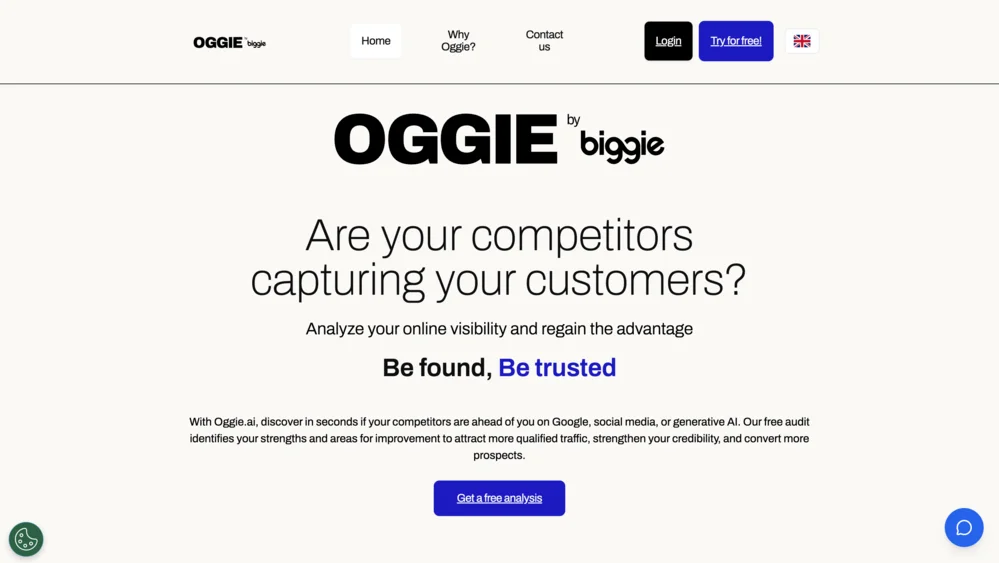
Oggie
Oggie.ai focuses on organic marketing automation for online retail.
It helps ecommerce teams move from manual SEO actions to scalable, content-driven growth.
Rather than optimising pages one by one, Oggie structures SEO at a strategic level.
It organises topics, keywords and content plans across the entire website, which is especially useful for brands managing large volumes of pages.
Oggie is particularly relevant when content production grows and SEO needs to stay aligned with business priorities.
Key features:
- Automated keyword clustering for product categories and collections
- SEO-driven content planning aligned with business priorities
- Structuring of topic hubs and internal linking logic
- Reduction of manual SEO and content research time
- Alignment between content strategy and commercial objectives
- Support for long-term, sustainable organic growth
When to use Oggie:
Oggie is relevant if your challenge is scaling organic growth without scaling headcount.
Best analytics tools for ecommerce
Analytics is where growth becomes controllable.
For an online retail business, data is not useful if it only explains the past. What matters is understanding why revenue moves and where to act next.
Many teams rely on surface-level metrics.
Traffic, clicks and dashboards look good, but decisions remain unclear. The result is slow optimisation and missed growth opportunities.
The best analytics tools for ecommerce connect behaviour, marketing actions and revenue.They help teams prioritise decisions, optimise budgets and improve performance across the entire buying journey.
Quanticflow
QuanticFlow is designed for ecommerce teams that want to move beyond descriptive reporting.
Its strength lies in predictive analytics, helping online businesses anticipate outcomes instead of reacting too late.
Rather than focusing on static dashboards, Quanticflow connects behaviour, transactions and performance signals across the platform.
This allows teams to identify patterns that influence revenue, retention and long-term business decisions.
Quanticflow is especially relevant when analytics needs to support strategy, not just reporting, for a growing store with recurring customers.
Key features:
- Predictive models to anticipate buying behaviour and demand
- Advanced segmentation based on real purchase patterns
- Identification of high-value segments and at-risk profiles
- Revenue-focused analytics instead of traffic-centric metrics
- Decision support for acquisition, retention and monetisation
- Built for teams aiming to scale intelligently
When to use Quanticflow:
Quanticflow is ideal if your priority is data-driven decision-making and forward-looking performance optimisation.
.webp)
Coupler.io
Coupler.io is not an analytics platform by itself.
It acts as a data integration layer that makes reporting and analysis possible at scale.
Many ecommerce teams still rely on manual exports between tools.
Coupler.io removes this friction by centralising marketing, sales and operational information into a single, reliable source.
By automating data flows between apps and reporting tools, Coupler.io helps teams save time and build more consistent reports for their business.
For instance, you can connect Facebook Ads to Power BI together with Shopify data to track ad spend alongside sales performance.
Key features:
- Automated data extraction from marketing and commerce tools
- Native connectors for platforms such as Facebook Ads
- Scheduled data refresh to keep reports continuously updated
- Compatibility with BI tools like Power BI and Google Sheets
- Reduction of manual reporting errors and time spent
- Improved cross-channel visibility
When to use Coupler.io:
Coupler.io is essential when your challenge is connecting data, not analysing it.

Whatagraph
Whatagraph focuses on reporting clarity and visualisation.
It is built for teams that need to explain performance, not just analyse raw numbers.
The platform turns complex datasets into structured, readable dashboards.
This makes it easier to share insights with stakeholders, clients or leadership without technical explanations.
Whatagraph works particularly well for businesses managing multiple channels and needing clean, decision-ready reports.
Key features:
- Centralised dashboards for sales and marketing KPIs
- Aggregation of data from multiple sources
- Visual reports designed for stakeholders and leadership
- Automated report generation and scheduled sharing
- Customisable templates for different business contexts
- Significant time savings on reporting workflows
When to use Whatagraph:
Whatagraph is best suited for teams managing multiple acquisition channels and stakeholders.

Umami
Umami is a lightweight and privacy-friendly analytics solution.
It focuses on essential insights rather than overwhelming teams with unnecessary metrics.
Umami is often chosen by smaller teams or early-stage projects that want a simple view of website activity.
Its privacy-first approach makes it especially relevant in environments where tracking constraints matter.
Umami fits businesses looking for clarity, speed and a free or low-complexity alternative to heavier analytics platforms.
Key features:
- Simple traffic and behaviour tracking
- Privacy-first approach without invasive tracking
- Fast setup and minimal maintenance
- Clean dashboards focused on core metrics
- Lightweight alternative to complex analytics stacks
- Suitable for small online stores
When to use Umami:
Umami fits teams that need basic, reliable insights without heavy infrastructure.

Best CRM tools for ecommerce
Growth in online retail rarely comes from acquisition alone.
It comes from retention, repeat purchases and long-term relationships. This is exactly where CRM tools make the difference.
Without a proper CRM, data stays fragmented.
Purchase history lives in one place, marketing actions in another, interactions somewhere else. Teams lack visibility and act in silos.
The best CRM tools for ecommerce centralise data and turn it into action.
They help you understand buyer behaviour, personalise communication and increase lifetime value at scale.
Hubspot
HubSpot is a widely adopted CRM platform used by many growing online businesses.
It is designed to bring structure when teams need better alignment between acquisition, sales and service activities.
HubSpot works particularly well as operations start to scale.
It helps move from scattered actions to a clear lifecycle view, with shared visibility across teams and consistent follow-up with customers.
With flexible plans and modular services, HubSpot fits businesses looking for a central system to manage relationships across their website, campaigns and sales processes.
Key features:
- Centralised contact records with behavioural and transactional data
- Lifecycle stages to track prospects, buyers and repeat clients
- Marketing automation for emails and workflows
- Segmentation based on engagement, attributes and interactions
- Integration with selling platforms and marketing tools
- Reporting on acquisition, retention and funnel performance
When to use HubSpot:
HubSpot is a strong choice if you need a scalable CRM foundation that supports both growth and internal alignment.

Metrilo
Metrilo is a CRM and analytics platform built specifically for online retail.
It focuses on what matters most for sustainable growth: retention, lifetime value and repeat behaviour.
Metrilo connects behavioural signals directly to revenue performance.
This makes it easier to understand which customers drive profitability, how cohorts evolve over time and where to focus retention efforts.
Metrilo is particularly relevant for businesses that want a clear view of performance at the store level, without juggling multiple disconnected systems.
Key features:
- Customer lifetime value and cohort analysis
- Behaviour-based segmentation across the buying journey
- Real-time sales and retention analytics
- Email marketing features connected to behavioural insights
- Churn and repeat purchase monitoring
- Revenue-focused dashboards for decision-making
When to use Metrilo:
Metrilo is ideal if your priority is retention and CLTV optimisation, not just contact management.

Best ecommerce email tools
Email remains one of the most reliable growth levers for online stores.
Not because it is cheap, but because it allows direct, personalised communication across the entire buying lifecycle.
Without the right setup, email becomes noisy.
Generic campaigns, poor timing and weak segmentation quickly lead to fatigue and declining performance.
The best email solutions for online retail focus on relevance.They connect behaviour, timing and content to drive repeat purchases and long-term value.
Klaviyo
Klaviyo is built for teams that want to turn behavioural signals into revenue.
It is widely adopted by growing ecommerce brands because it connects messaging directly to what happens in the store.
Klaviyo shines when personalisation matters.
It allows teams to move beyond basic newsletters and build automated journeys that react to real actions across the website, such as views, carts or transactions.
With a strong ecosystem of integrations and apps, Klaviyo fits businesses that see email as a core marketing and selling channel rather than a simple communication tool.
Key features:
- Real-time sync with store activity such as views, carts and orders
- Advanced segmentation based on behaviour and purchase history
- Pre-built flows like abandoned cart, post-purchase and win-back
- Revenue attribution to understand what actually performs
- Dynamic content using products and browsing behaviour
- Strong deliverability and performance monitoring
When to use Klaviyo:
Klaviyo is ideal if email is expected to drive measurable revenue, not just engagement.

EmailOctopus
EmailOctopus focuses on simplicity and accessibility.
It is designed for small teams that want an easy way to communicate with customers without heavy configuration or complex software.
The platform helps build solid foundations for email communication.
It covers the essentials needed to grow a list, manage contacts and stay in touch, often starting with a free or low-cost plan.
EmailOctopus works well for early-stage commerce projects that need reliable services without unnecessary features.
Key features:
- Easy campaign creation and scheduling
- Basic segmentation using subscriber attributes
- List growth and management features
- Simple automation for welcome and follow-up messages
- Clean interface suitable for non-technical teams
- Cost-effective pricing for early growth stages
When to use EmailOctopus:
EmailOctopus is a good fit if you need a straightforward setup to get started without friction.

Maestra
Email is part of a broader cross-channel system, from the same visual builder, teams orchestrate email, SMS, MMS, RCS, push, messengers, chatbots, and on-site personalization, all powered by built-in product recommendations and loyalty engines.
The platform integrates natively with Shopify, BigCommerce, WooCommerce, and other major ecommerce platforms.
Every Maestra subscription includes a dedicated CSM who configures segments, creates flows and campaigns, and improves deliverability through a shared Slack channel and weekly calls.
The platform offers transparent, all-inclusive pricing with no hidden costs, add-ons, or lock-in contracts. Month-to-month billing starts only once your CSM completes the full migration.
Key features:
- Drag-and-drop email builder with standard and custom layouts
- Dynamic content blocks personalized per recipient
- Omnichannel flows across email, SMS/MMS/RCS, push, messengers, on-site content, and more
- Advanced segmentation (RFM, nested logic, computed and custom fields)
- AI recommendations embedded directly in emails and other channels
- Loyalty programs, promo codes, and referrals plugged into email and other touchpoints
- Real-time CDP that powers triggered flows and up-to-the-minute updates
- A/B testing and detailed dashboards, including email health monitoring and revenue reporting
- Dedicated CSM for each account, at no extra cost
When to use Maestra:
Maestra is a strong fit for mid-sized ecommerce brands and enterprises that need advanced personalization across email and beyond, with complex flows and granular segmentation under one roof.

Manuscry
Manuscry focuses on behaviour-driven automation.
Instead of relying on static rules, it reacts to what people actually do across the site and after key interactions.
Manuscry helps brands communicate at the right moment, based on real signals rather than assumptions.
This approach improves relevance for each customer and reduces unnecessary message volume.
Manuscry is particularly useful for teams that want smarter lifecycle messaging without building complex automation systems or relying on heavy software stacks.
Key features:
- Triggers based on real actions rather than fixed schedules
- Automated lifecycle messages beyond standard flows
- Real-time use of behavioural signals for personalisation
- Reduced manual campaign management
- Focus on engagement and conversion quality
- Designed for teams seeking smarter automation
When to use Manuscry:
Manuscry is relevant if your goal is to replace generic sequences with contextual messaging.

Chat and service solutions for online businesses
Conversation is now part of the buying experience.
Before purchasing, people want reassurance. After purchasing, they expect fast and clear answers. This is where chat and service solutions play a critical role.
When conversations are scattered, teams lose context.
Slow replies, repeated questions and lack of visibility quickly damage trust and satisfaction.
The best chat and service solutions centralise conversations, add context and scale interactions without degrading quality.They transform assistance from a cost centre into a conversion and retention lever.
Gorgias
Gorgias is designed for online businesses dealing with growing volumes of conversations.
It centralises all interactions in a single workspace and links them directly to order and store history.
The real strength of Gorgias is context.
Teams can respond faster and more accurately because they instantly see what a customer bought, when the transaction happened and where the issue comes from.
Gorgias works well when support becomes a key part of the buying and post-purchase experience, especially for brands managing high volumes across their website and sales channels.
Key features:
- Unified inbox for email, live chat and social channels
- Instant access to order and profile details during conversations
- Automation rules for repetitive requests
- Response templates to standardise answers
- Performance tracking for service teams
- Built to scale conversation volume without losing quality
When to use Gorgias:
Gorgias is ideal when interaction volume grows alongside sales and speed becomes critical.

UperIA
UperIA focuses on AI-driven conversation automation.
It helps teams handle recurring questions efficiently without increasing headcount or operational pressure.
UperIA is particularly useful during peak periods, such as promotions or high-traffic campaigns.
By automating common requests, it reduces response times while keeping answers consistent and relevant for customers.
UperIA fits businesses looking for an easy way to scale service using smart software rather than manual processes.
Key features:
- Automated replies for frequent questions
- AI-powered chat capable of learning from interactions
- Multilingual conversation support
- Reduced manual workload for teams
- Faster response times across channels
- Easy integration into existing workflows
When to use UperIA:
UperIA fits organisations looking to scale conversations efficiently through automation.

Onepilot
Onepilot combines software with human expertise.
It offers an externalised service model adapted to fast-growing online brands that need flexibility.
This approach ensures quality interactions without internal scaling pressure.
It is often chosen when conversation volume increases faster than teams can hire or train new agents.
Onepilot is relevant for businesses that want reliable services and consistent brand tone without building a large in-house support organisation.
Key features:
- Multichannel conversation management
- Dedicated agents trained on brand tone and processes
- Flexible capacity during peak activity
- Quality monitoring and performance tracking
- Seamless connection with selling platforms
- Strong focus on satisfaction and consistency
When to use Onepilot:
Onepilot is relevant if you need high-quality interactions without building a large internal team.

Zipchat
Zipchat focuses on real-time engagement directly on the site.
It allows teams to interact with visitors while they browse, not after they leave the store.
Zipchat turns conversations into a selling and conversion lever.
It is especially effective for answering questions that block purchases or create hesitation during the buying journey.
Zipchat works best for brands that want to use live interaction as a proactive way to guide visitors and improve conversion.
Key features:
- Live chat embedded directly on websites
- Proactive triggers based on browsing behaviour
- Use cases covering sales and post-purchase questions
- Simple setup without heavy configuration
- Real-time interaction to reduce abandonment
- Suitable for conversion-focused teams
When to use Zipchat:
Zipchat is useful if your objective is to increase conversion through immediate interaction.

Best site search & merchandising tools for e-commerce
Product discovery is one of the most underestimated growth levers.
If people cannot find what they are looking for quickly, they leave. No friction, no patience.
Poor search and static collections create hidden losses.
Visitors browse longer, conversion drops and basket value stagnates, even when demand exists.
The best site search and merchandising solutions guide discovery intelligently.They surface relevant products, adapt to behaviour and continuously optimise what is shown.
Findmine
Findmine is built to automate merchandising decisions for online stores.
It replaces manual rules with algorithms that learn from browsing and buying behaviour across the site.
Findmine significantly reduces operational effort.
Teams no longer need to constantly curate collections or guess which products to highlight for different customers.
Findmine is especially useful when catalogues grow and merchandising needs to scale without adding manual workload.
Key features:
- Automated product recommendations based on behaviour patterns
- Dynamic collection creation without manual rules
- Personalised discovery across pages and touchpoints
- Continuous optimisation driven by performance signals
- Reduced manual merchandising workload
- Well suited for large and fast-changing catalogues
When to use Findmine:
Findmine is ideal if merchandising complexity grows faster than your team’s capacity.

Nosto
Nosto focuses on personalisation across the entire shopping journey.
It connects search, merchandising and recommendations into one adaptive commerce experience.
Nosto allows each visitor to see a different store.
Content, products and rankings adjust in real time based on intent, behaviour and context on the website.
Nosto works well for brands that want to personalise discovery and improve selling performance at scale.
Key features:
- Personalised on-site search results
- Dynamic category and collection merchandising
- Real-time product recommendations
- Behaviour-based segmentation and targeting
- A/B testing to optimise discovery strategies
- Strong impact on conversion and basket size
When to use Nosto:
Nosto fits brands aiming to personalise discovery at scale and optimise experience continuously.

Syte
Syte enhances product discovery through visual intelligence.
It enables people to search and explore using images, not just keywords typed into a search bar.
Syte is particularly effective in inspiration-led categories.
It reduces friction when words are not enough to describe intent or style.
Syte is a strong fit for brands where visual browsing plays a key role in guiding customers to the right products.
Key features:
- Visual search using images or screenshots
- Automated product tagging and classification
- Visual recommendations based on similarity
- Discovery tools for inspiration-driven browsing
- Reduced friction in product exploration
- Strong fit for fashion, home and lifestyle
When to use Syte:
Syte is relevant if visual inspiration plays a key role in the buying decision.

Best payment and checkout tools for e-commerce
Checkout is the most fragile step of any online purchase.
You can do everything right upstream, but one confusing or untrusted payment step is enough to lose the sale.
Friction at checkout often comes from small details.
Limited payment options, unclear fees, slow loading or lack of familiar brands reduce trust and increase abandonment.
The best payment and checkout solutions focus on reassurance and speed.They simplify the final step, reduce transaction friction and adapt to local payment habits.
Payplug
Payplug is designed for European online businesses that need a reliable payment gateway at checkout.
It focuses on security, simplicity and conversion at the most sensitive moment of the transaction.
Payplug is particularly relevant when local trust matters.
Recognisable payment methods, clear confirmation steps and smooth flows help reassure customers and reduce hesitation before completing a purchase.
Payplug works well for brands that want a solid, conversion-oriented solution for their store without adding complexity to the checkout experience.
Key features:
- Secure processing of online card payments
- Optimised checkout flow to limit drop-off
- Support for major card networks and local methods
- Advanced fraud prevention to protect transactions
- Clear interface to monitor payments and refunds
- Designed to integrate smoothly with existing store setups
When to use Payplug:
Payplug is a strong choice if your priority is trust, security and stable conversion in European markets.

JUST
JUST focuses entirely on the checkout experience itself.
Rather than adding payment methods, it redesigns how people complete their purchase.
JUST treats checkout as a conversion lever.
Every step is simplified to reduce hesitation and speed up completion.
Key features:
- Streamlined checkout flows with fewer steps
- Mobile-first optimisation for fast purchases
- Flexible integration with existing store platforms
- Faster loading times at the payment step
- Reduced cart abandonment rates
- Designed for performance-driven teams
When to use JUST:
JUST is relevant if checkout optimisation is a priority lever to unlock growth.

Alma
Alma specialises in deferred payment options.
It allows buyers to spread payments over time while paying instantly for the merchant.
This flexibility removes price resistance.
It often increases basket size without changing product pricing.
Key features:
- Split payment options directly at checkout
- Simple and transparent experience for buyers
- Increased purchasing power and average order value
- No complex onboarding or friction for users
- Smooth integration into existing checkout flows
- Strong focus on trust and clarity
When to use Alma:
Alma is ideal if your objective is to increase basket value without discounting.

Best e-commerce tools for delivery and returns
Delivery and returns are no longer back-office topics.
They are part of the promise you make at checkout and a decisive factor in repeat purchases.
Late deliveries, poor tracking or complicated returns create frustration.
Even strong products cannot compensate for a bad last-mile experience.
The best delivery and returns solutions help brands meet rising expectations.They bring reliability, transparency and operational consistency across markets and carriers.
Bigblue
Bigblue is a fulfilment partner designed for fast-growing online brands.
It helps companies outsource logistics while keeping control over experience and brand standards.
Bigblue aligns logistics with growth ambitions.
Warehousing, preparation and shipping are handled with performance and scalability in mind.
Key features:
- End-to-end fulfilment covering storage, picking and packing
- Warehouses optimised for high order volumes
- Fast shipping aligned with Amazon-level delivery expectations
- Integration with selling platforms and order management systems
- Real-time visibility on inventory and shipments
- Support for international expansion and cross-border delivery
When to use Bigblue:
Bigblue is ideal if order volume grows faster than internal logistics capacity.

Fastoche
Fastoche focuses on delivery orchestration rather than storage.
It helps brands manage carriers, shipping rules and last-mile execution more efficiently.
Fastoche brings structure where delivery becomes complex.
Multiple carriers, zones and promises are handled from one place.
Key features:
- Centralised management of delivery options and carriers
- Smart shipping rules based on location and order value
- Improved tracking experience for buyers
- Better coordination with carriers such as UPS
- Reduced operational friction for operations teams
- Support for scalable delivery strategies
When to use Fastoche:
Fastoche fits brands that want control and flexibility over shipping without building custom systems.

Baback
Baback is built around one idea.
Returns are not a problem to hide, but a moment to recover trust.
Baback simplifies returns for buyers while keeping costs and processes under control.
It transforms a painful step into a loyalty opportunity.
Key features:
- Simple and guided return flows for buyers
- Centralised handling of return requests and statuses
- Clear insights into return reasons and patterns
- Reduced workload for service and operations teams
- Better post-purchase experience aligned with brand promise
- Strong impact on repeat purchases and satisfaction
When to use Baback:
Baback is relevant if returns volume increases and experience consistency becomes critical.

Best subscription management tools for e-commerce
Recurring revenue has become an essential lever for e-commerce brands. Whether you sell food supplements, skincare products or everyday essentials, offering a subscription model helps stabilise your turnover and improve customer lifetime value (LTV).
To make it work, you need the right tools to acquire subscribers, retain them, and recover failed payments. That is precisely what subscription management platforms are built for.
Recharge
Recharge is the go-to subscription management platform on Shopify, trusted by over 100 million subscribers worldwide.
It integrates natively with Shopify Checkout and Shop Pay to deliver a seamless purchase experience, and offers a Concierge SMS feature that lets subscribers manage their subscription directly by text message, without logging in.
Recharge is suited to shops launching their first subscriptions as well as established brands handling millions of recurring orders.
Key features:
- Native Shopify Checkout and Shop Pay integration
- Fully customisable no-code customer portal
- AI-powered Concierge SMS
- Dynamic bundles and flexible subscription frequencies
- Churn prevention and failed payment recovery tools
- Robust API and SDK for developers

Loop Subscriptions
Loop Subscriptions is the best Recharge alternative and leading Shopify subscription app built specifically for high 7-9 figure brands. Used by over 2,000 brands like Nutripaw, OSEA Malibu, Four Sigmatic, and Primal Queen, Loop delivers enterprise-grade subscription management with a focus on advanced retention and payment recovery features.
Rated 5 stars on the Shopify App Store based on over 500+ reviews, Loop provides dedicated Slack support, free white-glove migrations, and costs 40% lower compared to other popular subscription apps on Shopify. The platform integrates seamlessly with Klaviyo, Gorgias, Attentive, and 40+ other marketing and analytics tools.
Key features:
- Personalised cancellation flows
- Failed payment recovery with customisable retry logic
- Mystery rewards
- Streaks
- Behaviour-based subscriber campaigns (Flows)
- Quick Action URLs for one-click subscription management from email
- Subscribe & Save widget
- Native bundle builder
- No-code customer portal
- Bulk subscription management
- Advanced analytics and real-time revenue dashboards

When building an efficient eCommerce stack, it’s also important to ensure that all these tools can work together seamlessly, which is where robust ecommerce integrations and APIs play a key role.
The best ecommerce tools are the ones that fit your growth stage, integrate seamlessly across your stack, and help you scale acquisition, conversion and retention without adding operational friction.
Most online brands optimise everything until checkout, then stop. That is where long-term value is actually created.
At Loyoly, we help brands activate post-purchase journeys that connect engagement, loyalty and advocacy to the rest of their stack.When every interaction after the sale is orchestrated, growth becomes sustainable, not accidental.



%20(1).webp)
.webp)