
.png)


The order is placed, the customer is already paid for, and the basket holds a single item.
That is where most ecommerce revenue quietly leaks. The acquisition cost is spent either way, so a thin basket is the most expensive kind of sale you can make.
Getting customers to spend a little more costs nothing in advertising, and every extra pound spent lands almost whole on your margin.
That is what average order value tracks, and why it moves faster than almost any other ecommerce metric.
What is average order value (AOV)?
Average order value is total revenue divided by the number of orders in a period. If you take £50,000 across 1,000 orders, your AOV is £50.
It captures what a customer spends in a single transaction, not across the whole relationship. That distinction matters, because AOV and lifetime value can pull against each other.
Every business measures it slightly differently, so define yours once and hold to it. Gross or net of discounts, with or without delivery: the choice matters less than the consistency.
Separate this from revenue growth. Revenue can rise because you sold to more customers; this one only rises when each purchase gets bigger.
Why increasing AOV is crucial for your business
A higher basket value multiplies across every order your store already receives, which is why increasing it pays twice. No other ecommerce metric gives you that leverage without a matching increase in marketing cost.
It protects profitability. Fixed costs per transaction (picking, packing, payment fees) stay flat while the basket grows, so each extra pound lands closer to the bottom line.
Rewards are one of the most effective levers here. The Loyalty Benchmark 2026 by Loyoly, based on 600 ecommerce brands, puts orders carrying a program reward at an AOV 21.1% higher.
One caveat matters. Increasing order value is not about pushing customers into items they do not want, which shows up immediately in returns and complaints.
💡 Our advice: track AOV alongside gross margin, not on its own. A basket that grows only because you discounted the second item is not growth.
Which strategies to increase your average order value?
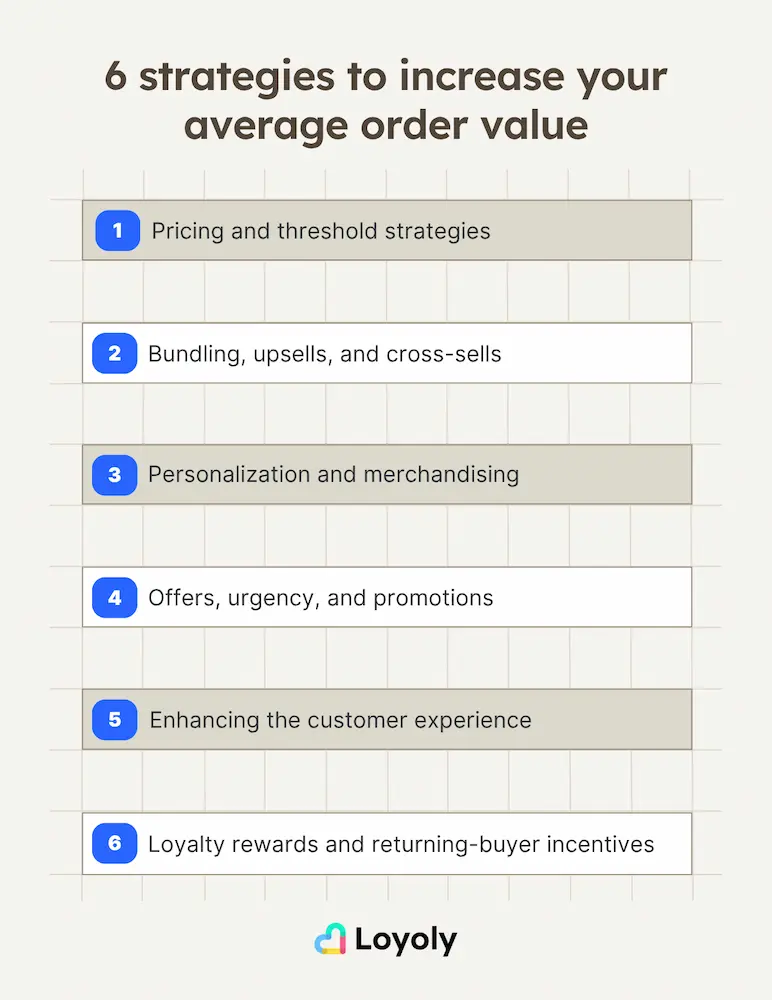
Pricing and threshold strategies
Free shipping bars are the fastest of these strategies to deploy. Set the bar roughly 20 to 30% above your current basket, so customers can reach it without feeling pushed.
Show the gap in the cart. "Only £12 to free delivery" helps far more than a passive banner, because it turns a rule into a specific next step that a customer can act on.
Handle delivery pricing carefully. Raising a delivery charge on an existing base costs more goodwill than the margin it recovers.
Tiered pricing works on consumables. Two units, save 10%; three units, save 15%: one of the simplest ways to lift a basket without touching what a single unit costs.
Consider price anchoring as well. Showing a premium option next to your top seller makes the mid-range product look like the sensible choice, and it lifts the average order value.
Pricing strategies work best when customers can see the gap. Show what they need to spend to reach the next tier, and the increase in basket value arrives without any marketing cost.
Bundling, upsells, and cross-sells
Bundles raise the basket by making a bigger purchase feel like a better deal to customers. A bundle priced below the sum of its parts still lifts the basket.
Cross-sell complementary products at the right moment. The same products convert better on the product page than at checkout, where any distraction costs you the sale.
Offer customers a larger format or a premium version before payment, not after. An upsell that appears once card details are open reads as a trick.
Keep every bundle simple: three products maximum, one clear benefit, and no conditions that need a second reading. Simple offers help more than clever ones.
Bundling helps in a second way that is easy to miss. It moves slow stock alongside your strongest lines, which improves inventory turns as well as your metrics.

Personalization and merchandising
Personalized recommendations help far more than generic ones, because they use what a customer already bought. Purchase history is the most useful data you have, and it costs nothing to collect.
Merchandising decides which products your customers see first, and it drives more sales than most teams admit. Putting your higher-priced products above the fold raises the basket of the whole category page.
Segment your product recommendations by customer type. A first-time buyer and a loyal customer respond to separate offers, and treating them alike wastes both opportunities.
Customers spend more when the recommendation fits. Someone who bought running shoes last month will spend on socks; the same offer sent to everyone raises nothing and costs the same to send.
Offers, urgency, and promotions
A gift with purchase is a better offer than a straight markdown. It raises the perceived value of the basket, and the benefits of that are obvious to any customer.
Loyalty points are an effective alternative to discounts. In the Loyoly study, immediate discounts drive activity for 71% of respondents, but reward points let you recognise big baskets without devaluing your catalog.
Free products beat percentage discounts in most catalogs, and the benefits are easier to communicate. A gift has a clear value to the customer and costs you its margin, not its price.
Create time-sensitive offers and promotions
Deadlines create urgency when they are real, and they encourage a hesitant customer to decide today. A weekend offer or a threshold that expires on Sunday works without training customers to wait for the next promotion.
Rotate the mechanic rather than repeating it every month, or it stops doing anything to increase the basket. Campaigns that run on a fixed date stop being urgent, and shoppers simply learn your calendar.
.webp)
Enhancing the customer experience
A faster payment page raises the basket as well as the conversion rate. Every extra field is a chance for someone to drop an item instead.
The post-purchase experience feeds the next order. A store that delivers well earns a larger purchase next time, which is where AOV and loyalty meet.
Customer experience decides whether the second item survives to checkout. Fast pages, clear stock levels and honest delivery dates all shape that experience, and all help a customer finish what they started.
👉 Note: a bigger basket does not always mean a happier customer. Watch your return rate next to AOV, because the two move together when the extra item was pushed rather than chosen.

Loyalty rewards and returning-buyer incentives
A rewards balance changes how a basket gets built. A customer forty points short of a reward adds an item to get there, which is the same mechanic as a free shipping threshold without the margin cost.
Store credit beats a discount code on basket size. A credit the customer already owns gets spent on a fuller order, where a percentage off simply lowers what you collect on the same items.
A customer loyalty software runs the tiers, the balance and the reward rules. Loyoly integrates natively with Shopify and Shopify Plus, and shows the rewards earned directly at payment on Shopify Plus.
Among the strategies on this list, rewards show up fastest in your metrics. A shopper close to a reward will increase the total without being asked, so the AOV gain arrives with no hit to profitability.
A digital loyalty card puts that balance in front of the buyer while they pay. That is the exact moment an extra item gets added or abandoned, and most stores leave the screen blank.
.webp)
Common AOV traps and how to avoid them
Ignoring product-page speed
A slow product page kills the second sale before it reaches the cart. A customer who hesitates on load time rarely browses further, and browsing is where baskets grow.
Test on mobile with a real connection, on the pages that matter most to online sales. Desktop timings flatter your site and hide the problem entirely.
Over-discounting core items
Discounting your core range raises unit sales and lowers profitability at the same time. Volume rises, margin falls, and customers learn to wait.
Selling more units at a lower margin is not the same as growth. Track margin per basket alongside AOV, or you will boost one metric while quietly damaging the other.
Apply discounts to the complementary product, not the core one. A saving on an accessory increases the basket while protecting the margin on the item people came for.
Hiding shipping costs until checkout
Late delivery charges are the single most common cause of abandoned carts. A customer who built a £70 basket and then meets a £9 charge usually leaves rather than cutting it down.
Show the delivery charge early, in the cart or on the product page. The honest figure costs you fewer sales than the surprise does.
Why AOV can be misleading without context
A rising average order value can hide falling order counts. If revenue is flat while AOV climbs, you are selling more to fewer customers.
Read it next to conversion rate, purchase frequency and LTV. AOV on its own tells you how big a basket is, not how healthy a business is.
Scale is the last trap. Tactics that increase online sales at a hundred orders a month stop working at a thousand, so revisit your bundles as purchases grow.
Measuring, testing, and scaling your AOV growth
Tracking key AOV metrics and performance
Segment results by channel, device and customer type, because the ways people shop differ by all three. The average across your whole store hides the differences that make a strategy worth running.
Watch items per basket alongside AOV. If it rises while item count falls, your pricing is doing the work rather than your merchandising strategy.
Track average order value next to revenue per visitor, not on its own. A rise in average order value that comes with fewer orders leaves total sales flat.
Implementing an A/B testing framework
Test one variable at a time: the delivery bar, the offer price, or the position of your recommendations. Changing three at once tells you nothing.
Run each test long enough to cover a full buying cycle. Two weeks of data on a category people buy quarterly is noise, not insights.
Include AOV in your weekly marketing review, where the insights are still fresh. Teams that only see it quarterly miss the impact of their campaigns entirely, and the insights arrive too late to act on.
Benchmarking and setting AOV goals
Set a business goal relative to your own baseline rather than to an industry benchmark. A 10% increase on last quarter is a goal you can act on; matching a benchmark from another business model is not.
Use sector benchmarks for context only, and treat them as one example among many. The gap between the best and worst performers in any category is wider than most teams expect, which makes your own baseline the more honest comparison.
There are several ways to raise the average, and the ways that work depend on your catalog. Bundles help with consumables, shipping bars with mid-range goods, and premium upsells for expensive, considered purchases.
⚠️ Careful: do not set a basket goal without a floor on order count. Teams that increase AOV alone tend to shed small buyers, and those buyers are next year's repeat customers.
Frequently asked questions (FAQs)
How is average order value calculated?
Divide total revenue by your number of orders over the same period. Use net figures after discounts, and exclude delivery if you want a figure that reflects what customers actually buy from your catalog.
What is a good AOV for my industry?
There is no universal figure, because a supplements business and a furniture store have nothing comparable. The useful benchmark is your own trend over twelve months, plus the AOV uplift your loyalty program generates against non-members.
How often should I track AOV?
Monthly for business decisions, weekly during a campaign or a test. Daily tracking mostly produces noise, since a single large basket can move the average on a small catalog.
Can pushing AOV hurt customer lifetime value?
Yes, and it is the most important trap in this whole subject. Aggressive upsells and high bars can raise the basket while losing repeat customers, so track LTV in the same report and treat a rising AOV with falling frequency as a warning.
What's the difference between AOV and average order size?
Average order value (AOV) measures money per order. Order size usually counts what sits in a basket, which is why the two can move in opposite directions when you raise prices.
How do you increase average order value on Shopify?
Start with a free shipping bar in the basket, add related product recommendations on the product page, and create bundles from products you already sell.
At Loyoly, we help more than 600 ecommerce and retail brands turn one-off buyers into repeat customers, through loyalty, referral and post-purchase engagement. If raising your AOV is on the roadmap this year, it is worth a conversation: book a demo.



%20(1).webp)
.webp)