.png)


A loyalty card used to be a paper punch card slipped into a wallet pocket. You filled it up, you got a free coffee. Simple, forgettable, and barely trackable.
Today, loyalty card marketing is a full-blown CRM and retention strategy. One that drives repeat purchases, generates first-party data, fuels referrals, and connects your online and offline channels into a unified experience.
The brands winning at retention are not just offering points. They are building a system. Here is how to do it properly.
What is loyalty card marketing?
Loyalty card marketing is the set of strategies used to promote, activate, and optimize a loyalty program built around a card-based identification system. The card, physical or digital, serves as the customer's access point to the program: it tracks purchases, accumulates rewards, and identifies the customer across every channel.
The marketing part is what most brands underinvest in. Having a loyalty program is not enough. You need an active promotion strategy, a solid communication plan, and a data infrastructure that lets you act on what you know about your members.
Done well, loyalty card marketing transforms a transactional relationship into an ongoing one. Customers who feel recognized spend more, buy more often, and refer others. According to Loyoly's Loyalty Benchmark 2025, based on data from 600+ ecommerce brands, engaged customers in the fashion sector generate 60% more LTV than non-engaged ones. In home and decoration, that figure climbs to 117%.
Physical card, digital card, wallet: understanding the differences
Not all loyalty cards deliver the same marketing value. Before choosing your format, it is worth understanding what each one can and cannot do for your strategy.
The physical loyalty card: reliable but limited
The plastic or cardboard loyalty card has been around for decades. Customers know how to use it, which reduces friction at the point of sale. But it comes with hard constraints: you cannot update it dynamically, you cannot send a push notification to a piece of plastic, and you have zero visibility on whether the card ever leaves the drawer.
For brands with high in-store traffic and an older customer base, a physical card can still play a supporting role. As a standalone marketing strategy, though, it is increasingly difficult to justify in a data-first context.
The digital loyalty card: a meaningful step forward
A digital loyalty card lives in your customer's account, accessible via your website or app. It eliminates the 'I forgot my card' problem and allows real-time updates. Points balance, reward history, and VIP tier are always current.
The digital card also opens the door to personalization. Because it is connected to your CRM and purchase history, you can tailor the experience to each customer, which is exactly what the most effective loyalty programs do.
That said, a card accessible only via your website or app still requires the customer to open a browser or launch an application. One more step. One more potential drop-off.
The wallet loyalty card: the current state of the art
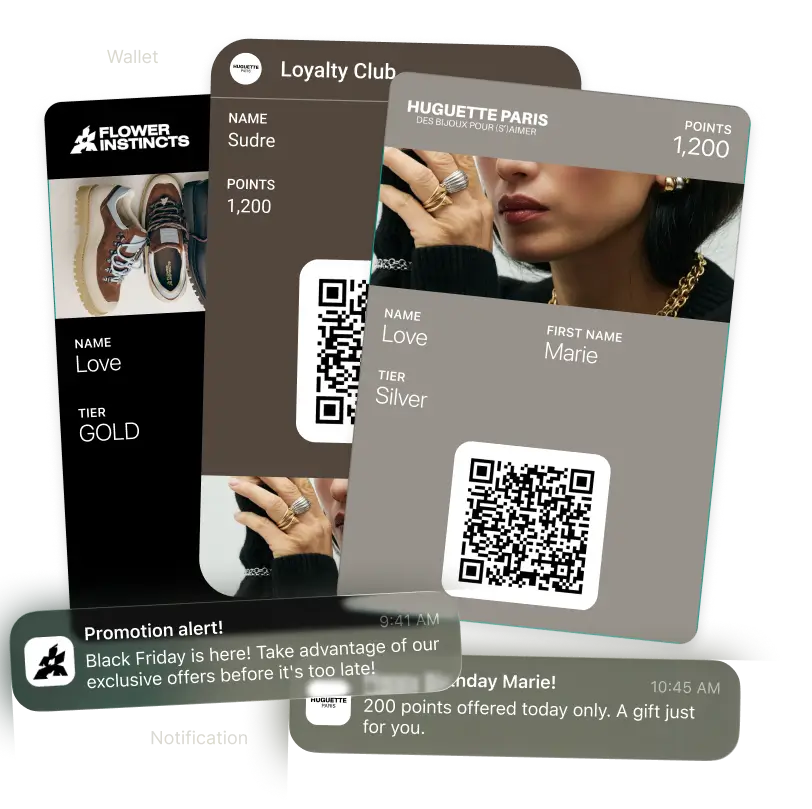
The wallet loyalty card is stored directly in Apple Wallet or Google Wallet on your customer's smartphone. No app to download. No login required. The card is always one swipe away, visible on the lock screen, and updated in real time.
This is where loyalty card marketing gets genuinely interesting. A wallet card is not just a static badge. It is a live, interactive communication channel between your brand and your customer, available 24 hours a day, without competing with an inbox.
The digital wallet: your most powerful loyalty marketing channel
The wallet deserves its own section, because it changes the entire logic of loyalty card marketing. Most programs treat the card as a retention tool. The wallet turns it into a direct marketing channel in its own right.
Here is what becomes possible once your loyalty card lives in your customers' smartphones.
Instant customer recognition in store
When a customer walks into one of your physical locations, the wallet card is already in their pocket. Your team scans the QR code directly on the lock screen to pull up the loyalty profile instantly: points balance, VIP tier, active rewards, last purchase date.
No app, no login, no 'do you have your loyalty card?' awkwardness at the register. The checkout is faster, the customer feels recognized, and your team has everything they need to make the interaction personal. For brands with brick-and-mortar locations, this alone is a significant operational advantage.
This also solves one of the oldest problems in omnichannel loyalty: recognizing the same customer online and offline, in real time, without any friction. According to Loyoly's Industry Report 2025, 30% of consumers say that the ability to earn and redeem points both online and in-store is a top driver of program engagement.
Targeted and geolocated push notifications
Push notifications sent via the wallet are among the most effective direct marketing tools available today. They appear directly on your customer's lock screen, without requiring them to have your app installed, and without the risk of landing in a spam folder.
Loyoly data shows that wallet push notifications deliver read rates five times higher than standard email marketing. If your average email open rate is around 20%, you are looking at a potentially tenfold improvement in visibility per message sent.
The use cases are significant. Send a push when a customer is physically near one of your stores, triggering a geolocation-based offer. Send one when a reward is about to expire. Send one when a new collection launches for your VIP members, or when it is their birthday. Each notification is contextual, timely, and non-intrusive, the exact opposite of the mass-blast email your customer scrolls past.
This is exactly the channel that makes loyalty feel alive between purchases, which is where most retention programs lose momentum.
To build and activate your full wallet strategy, the Loyoly Wallet Playbook is a complete operational guide worth downloading.
Dynamic, real-time card updates
Every time a customer earns points, unlocks a new VIP tier, or activates a reward, their wallet card updates automatically. They see the change the next time they glance at their phone, with no email, no manual refresh, and no action required on either side.
This real-time feedback loop is what keeps long-term engagement high. Customers do not forget they are in your program, because the program updates itself in their pocket. For brands building omnichannel loyalty programs, this is the missing link between digital and physical touchpoints.
Pssst... You might find this interesting!
Loyalty card marketing is strategic for your brand and we can probably help. Discover our platform!
Loyalty card marketing strategies that drive real results
Having the right card format is one thing. Promoting and activating it effectively is another. These are the strategies that consistently move the needle.
Make enrollment visible at every touchpoint
The number one reason loyalty programs underperform is low enrollment. Customers simply do not know the program exists, or they forget to join after their first purchase.
Your loyalty card offer should be visible on your homepage, your product pages, your checkout flow, your post-purchase confirmation page, and your packaging inserts. A mention in a transactional email saying 'you just earned 50 points on this order' is free enrollment fuel. The goal is to make joining feel like a natural extension of the purchase, not a separate task.

Activate members with personalized, data-driven communications
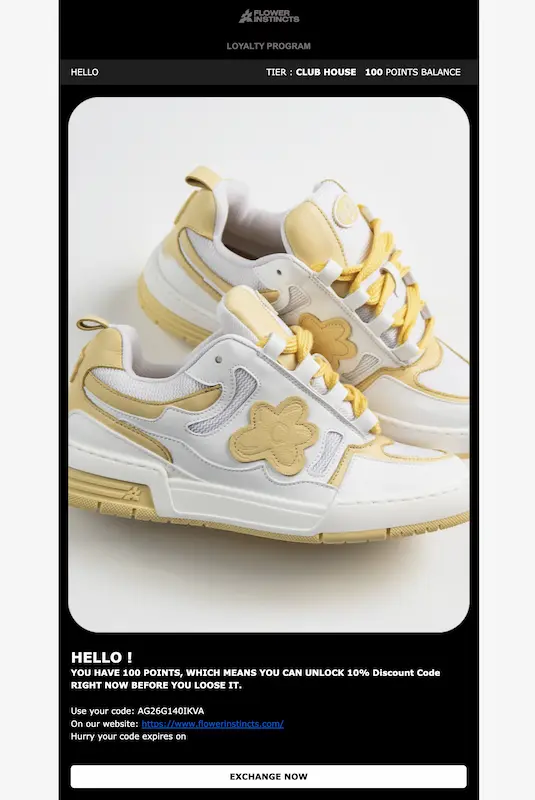
Enrollment is just the beginning. The real work is activation. According to Loyoly's Industry Report 2025, 71% of active program members cite immediate discounts as their top motivator. That means your first communication after enrollment needs to be concrete, not a generic welcome email.
Trigger a personalized message the moment a customer joins. Show them exactly how many points they have, how close they are to their first reward, and what they can unlock next. Segment your communication flows by purchase history and loyalty tier. A member who has never redeemed anything needs a different message than your VIP Gold customer who has been with you for two years.
Connecting your loyalty platform to your CRM (Klaviyo, Braze, or similar) lets you build automated journeys that respond to loyalty behavior in real time. This is where loyalty marketing becomes scalable and genuinely measurable.
Run bonus points events to spike engagement
Double points weekends, flash bonus campaigns, and category-specific earning boosters are among the most effective short-term levers in loyalty card marketing. They create urgency without relying on discounts, protecting your margins while driving purchase frequency.
One bonus event per month is enough to keep the program feeling active. Pair these events with wallet push notifications and email for maximum reach. Tiered loyalty programs make these events even more powerful by offering exclusive multipliers to higher VIP segments, rewarding your best customers without devaluing rewards for everyone.
Add a referral mechanic to grow your member base
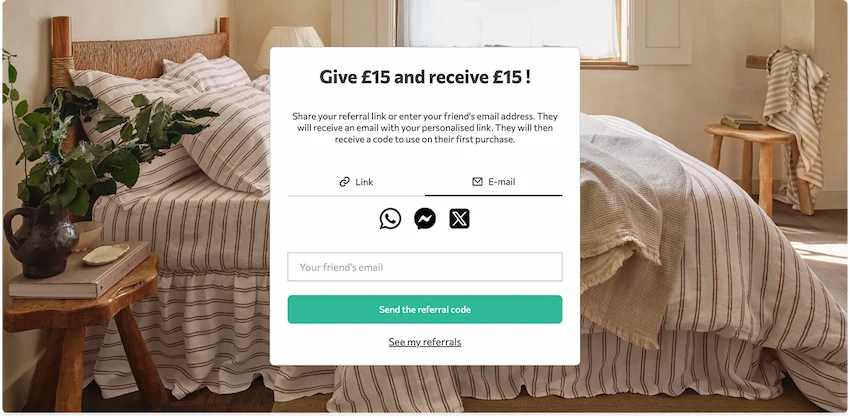
A loyalty card is most valuable when more people have one. Building a referral mechanic into your program is one of the most cost-efficient ways to grow your member base with qualified customers.
Loyoly's Industry Report 2025 shows that 59% of loyal customers are willing to recommend the brand to people around them. Of those, 61% are motivated primarily by a personal financial reward. A referral program structured around loyalty points or vouchers aligns perfectly with this behavior.
Referral conversion rates across Loyoly's benchmark sit between 30% and 41.5% depending on sector, meaning roughly one in three invited prospects completes a first purchase. For more on building this mechanic effectively, the complete guide to referral marketing covers the full strategy.
How to measure your loyalty card marketing performance
You cannot optimize what you do not measure. These are the metrics that matter most.
The activation rate measures the share of orders that include a reward redemption. Loyoly's Benchmark 2025 puts the cross-sector average between 3.3% and 5.7%, with beauty and wellness at the top. If you are consistently below your sector average, your rewards are either too hard to reach or not compelling enough.
The points redemption rate tracks the percentage of credited points that are actually spent. A low rate often signals that your reward catalog lacks desirability, or that customers have forgotten they have points. A high rate signals genuine program value and strong engagement.
Finally, LTV uplift compares the lifetime value of engaged loyalty members against non-members. This is the most honest measure of whether your program creates real business value. Loyoly's data shows an average 150% LTV increase among engaged users across 600+ brands. For a full breakdown of what to track, the guide on KPIs to measure customer loyalty covers 11 key indicators in depth.
To sum up: loyalty card marketing is the art of transforming a simple identification tool into a full retention and revenue system. The brands that get the most out of it treat their loyalty card not as a discount mechanic but as a direct communication channel, a first-party data source, and a long-term driver of customer value. The wallet format, with its push notifications, QR code scanning, and real-time updates, is the clearest expression of what that can look like in practice.
At Loyoly, we built the wallet feature entirely in-house, with native Apple and Google Wallet support, real-time dynamic updates, geolocated push notifications, and QR code scanning for in-store customer recognition. If you want to see what a complete loyalty card marketing strategy looks like for your brand, the Wallet Playbook is a good starting point.
FAQ
What is loyalty card marketing?
Loyalty card marketing is the set of strategies used to promote, activate, and optimize a loyalty program centered around a card-based identification system, physical or digital. It encompasses enrollment tactics, member communication, reward design, and performance measurement to drive repeat purchases and increase customer lifetime value.
How do you effectively market a loyalty card program?
Start with high-visibility enrollment at every key touchpoint: product pages, checkout, post-purchase emails, and packaging. Then activate members with personalized communications tied to their loyalty behavior, run regular bonus points events to maintain engagement, and pair the program with a referral mechanic to grow your member base organically.
What is the difference between a digital loyalty card and a wallet card?
A digital loyalty card requires the customer to log into your website or app to access their account. A wallet loyalty card is stored in Apple Wallet or Google Wallet, always visible on the lock screen, and can receive push notifications without any app installed. The wallet card removes friction on both sides.
Why are push notifications more effective than email for loyalty marketing?
Wallet push notifications appear directly on the customer's lock screen, bypass spam filters entirely, and benefit from read rates up to five times higher than email marketing. They are also contextual: you can trigger them based on location, purchase behavior, or loyalty status, making each message genuinely relevant.
How do you measure the success of a loyalty card program?
The three core metrics are the activation rate (share of orders with a reward redemption), the points redemption rate, and LTV uplift between enrolled members and non-members. Loyoly's Loyalty Benchmark 2025 provides sector-specific averages to benchmark your program's performance against 600+ ecommerce brands.
Can a loyalty card work both online and in store?
Yes, and the wallet format makes this seamless. The QR code embedded in the wallet card allows in-store teams to instantly access a customer's loyalty profile at the register, including points balance, VIP tier, and active rewards, enabling true omnichannel customer recognition with no additional hardware or app.