.webp)
.png)


You are about to choose a loyalty platform. You have shortlisted three names: Loyoly, Smile.io, and LoyaltyLion. Good choice, those are three of the most cited tools when an e-commerce brand starts thinking seriously about customer retention. The problem is that these three platforms do not serve the same type of brand, and picking the wrong one will cost you time, money, and frustrated customers.
This comparison cuts through the marketing fluff. We look at what each platform actually does, where it genuinely falls short, who it is built for, and what the numbers say. No filler, no vague promises.
What are Loyoly, Smile.io and LoyaltyLion, exactly?
Before comparing features, it is worth understanding the underlying philosophy of each product. These are not three versions of the same tool. They reflect three different visions of what a loyalty program should accomplish.
Smile.io: simplicity first, for early-stage brands
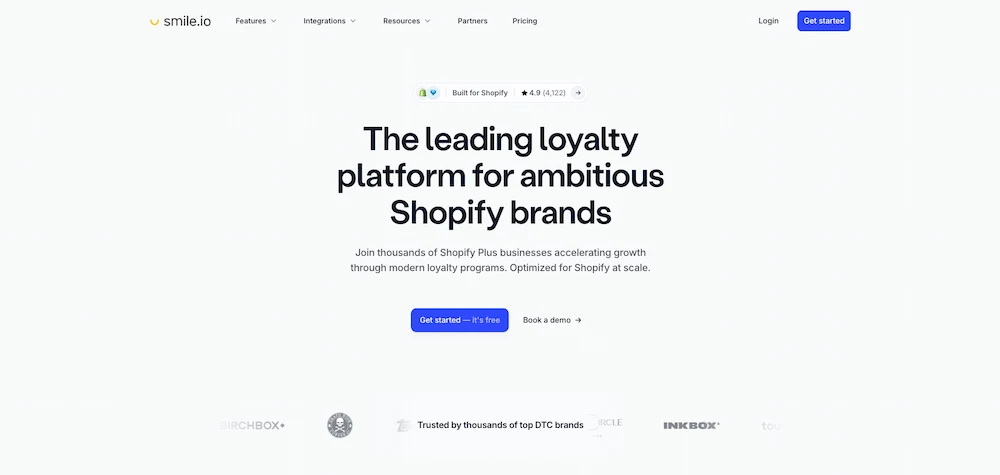
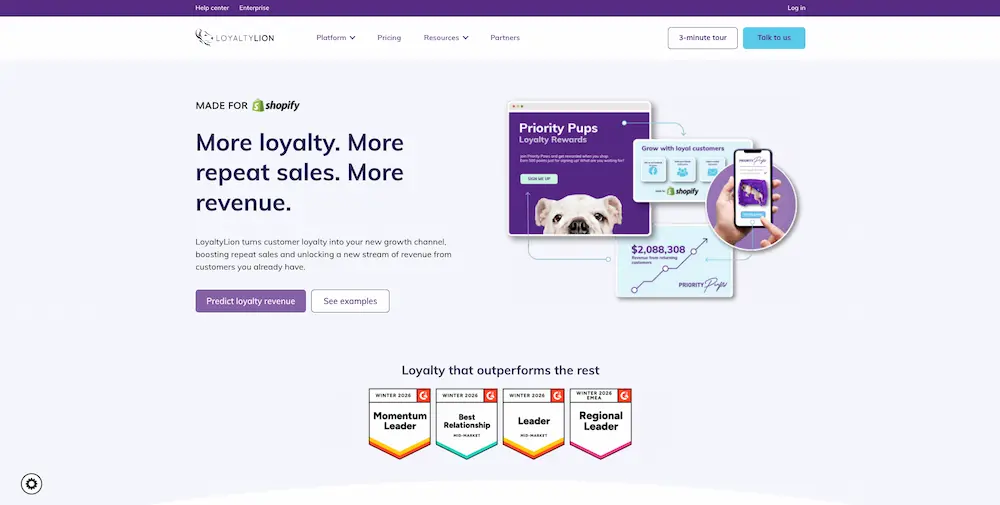
Smile.io is the most widely installed loyalty app on the Shopify App Store, with over 100,000 merchants using it. The pitch is simple: go live in a few hours, zero technical expertise required. Points for purchases, referrals, birthday rewards, social follows. That is essentially the full feature set.
The platform targets SMBs and first-time loyalty programs. It works well for getting started. It shows its limits quickly once your retention strategy matures: around 10 types of earning actions, no automated UGC verification, no dedicated loyalty page (just a pop-up widget), and referral links that are not individually tracked.
Pricing starts at $49/month but scales to around $999/month at mid-market volume, with per-order overage charges that catch many merchants off guard.
LoyaltyLion: the loyalty specialist for established brands
LoyaltyLion is one of the oldest platforms in the market. Its positioning is clear: transactional loyalty done right, with advanced analytics, deep Klaviyo integration, and multi-platform support (Shopify, Magento, BigCommerce, custom builds). That last point is a genuine differentiator for brands not locked into Shopify.
The platform offers strong segmentation, customisable earning and redemption rules, and predictive analytics. The trade-off is cost: entry pricing starts at $199/month, the most powerful features sit on upper-tier plans, and support quality drops significantly below enterprise level.
No native digital Wallet. No push notifications. Omnichannel relies on a third-party integration (JeriCommerce) for wallet passes, which is not the same as a built-in solution.
Loyoly: post-purchase engagement beyond the loyalty program
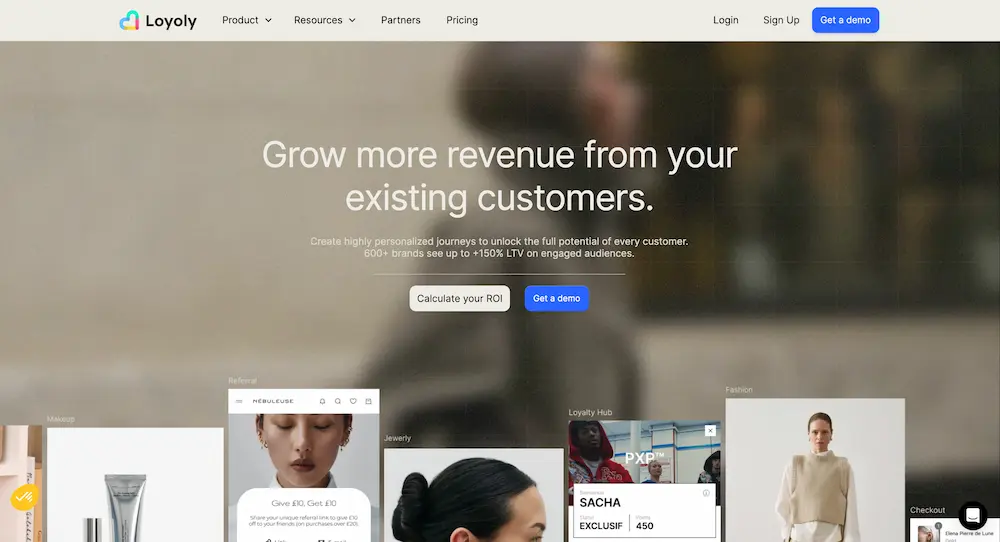
Loyoly positions itself as a post-purchase engagement platform, not just a loyalty tool. The scope is broader: 40+ auto-verified engagement mechanics (including UGC creation on Instagram, TikTok, and Reels), a native Apple and Google Wallet built in-house, geo-based push notifications, QR-based in-store redemption, and integrations with Shopify POS, Cegid, and Fastmag.
The platform is available on Shopify and PrestaShop. Pricing starts at $99/month. A dedicated account manager, strategic sessions, and custom development support are included on all plans, with an average support response time under 2 minutes. The API is in progress (Q2 2026).
Loyoly vs Smile.io vs LoyaltyLion: feature-by-feature breakdown
Three platforms, three positioning statements. Now let us get into what actually matters when you have to choose one.
Engagement mechanics: depth vs. convenience
Loyoly leads with 40+ engagement mechanics, all auto-verified. That means the platform actually confirms a customer completed a social action before awarding points, rather than trusting the honour system. Actions include publishing Instagram Stories, posting Reels, creating TikTok content, writing multi-platform reviews, and generating UGC that feeds directly into your content and ad strategy.
LoyaltyLion supports custom point rules and event-triggered rewards, but social mechanics are limited to basic follows and shares. No automated verification, no content rights management.
Smile.io offers around 10 action types, all template-based. You configure parameters, but you cannot build new rule types or conditional logic. Fine for a first program, limiting for anything more ambitious.
UGC and review generation: a real differentiator
This is a gap that matters directly for your CAC and social proof strategy. Loyoly is the only platform in this comparison that rewards customers for creating and publishing UGC (photos, videos, Stories, Reels, TikToks) with automatic content rights. According to the Loyoly Industry Report (2025), 27% of consumers are ready to like, comment or share a brand post in exchange for rewards, and 12% will send photos or videos to the brand.
That engagement, when properly incentivised and verified, becomes organic content that reduces your paid social dependency.
LoyaltyLion integrates with review tools like Judge.me, Stamped.io, and Yotpo, but does not generate UGC natively. Smile.io has no UGC capability at all.
.webp)
Automation engine: where the real gap lies
This is where the three platforms diverge most sharply. Loyoly is the only tool in this comparison with a native automation engine for loyalty: triggered journeys, conditional logic, personalised reward flows based on actual customer behaviour and engagement level.
LoyaltyLion gets closer with event triggers and integrations, but complex multi-step workflows still require developer intervention. Smile.io gives you pre-built rules only: award X points for Y action. You cannot create conditional sequences.
The practical implication is significant. A loyalty program without automation relies on manual campaigns. One with native automation adapts to each customer's behaviour in real time, which is exactly what drives LTV growth at scale.
Omnichannel and digital Wallet: the clearest differentiator
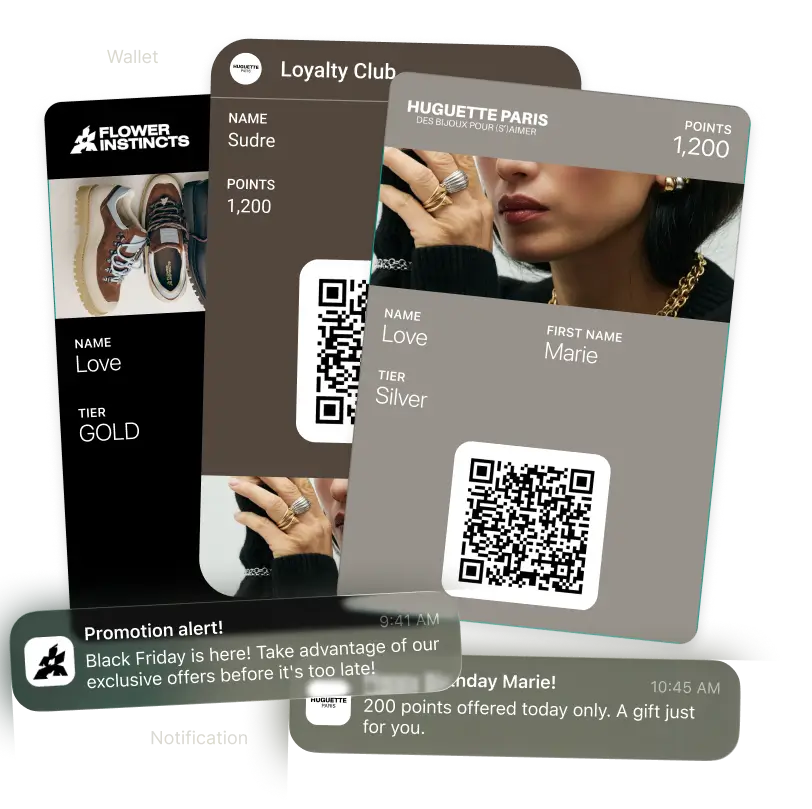
If you sell both online and in-store, this section decides the comparison. Loyoly is the only platform in this trio with a truly native omnichannel stack: Apple and Google Wallet built in-house (not via a partner), geo-based push notifications, QR redemption in store, and integrations with Cegid and Fastmag in addition to Shopify POS. That covers the full retail footprint, from DTC to multi-location brick-and-mortar.
LoyaltyLion relies on JeriCommerce for wallet passes, which is a third-party dependency, not an internal feature. Shopify POS, ConnectPOS, and Cin7 Core POS are supported, but there are no push notifications and no QR redemption. Smile.io supports Shopify POS only and has no wallet, no push, no QR.
According to the Loyoly Industry Report (2025), 30% of consumers say the ability to earn and redeem points both online and in-store is a key driver of loyalty program engagement. If you are not covering that, you are leaving a significant share of repeat purchases on the table.
On-site experience and customisation
Loyoly and LoyaltyLion both offer full custom UI, multi-language, multi-currency, a floating widget, customer account module, and checkout and product page extensions. The difference is that Loyoly supports custom CSS natively for complete visual alignment with brand identity.
Smile.io is limited to branding tweaks on its widget. There is no dedicated loyalty page, just a pop-up. For brands that want their loyalty program to feel like a core part of the product experience rather than a tacked-on widget, this is a meaningful limitation.
Pricing comparison: what you actually pay
Published pricing rarely tells the full story. Here is what each platform costs at three meaningful scales, based on available data.
Smile.io: low entry, steep growth curve
Smile.io starts at $49/month and reaches around $199/month at SMB scale. Mid-market pricing lands near $999/month. The platform also applies per-order overage charges on some plans, which means a brand processing high order volumes can pay significantly more than the headline price suggests.
There is a free plan, which is functional for first-time programs on very small volumes. But the cost-to-feature ratio becomes harder to defend as your program matures.
LoyaltyLion: premium entry, enterprise features locked
LoyaltyLion starts at $199/month, which is the most expensive entry point in this comparison. Compared to Loyoly (from $99) and Smile.io (from $49), that gap is hard to justify unless you are using the advanced analytics and segmentation features that justify the investment.
Mid-market and enterprise pricing is on request. The most powerful features, including dedicated support, strategic sessions, and custom development, are reserved for upper tiers only. Smaller brands on entry plans get a standard support queue.
Loyoly: mid-market pricing, full-service model on every plan
Loyoly starts at $99/month, with SMB plans around $523/month and mid-market around $823/month. Enterprise pricing is on request.
The structural difference is that dedicated account management, strategic sessions (MBR/QBR), and custom development support are included across all plans, not locked behind enterprise tiers. That changes the total cost of ownership calculation meaningfully, especially for brands that would otherwise pay for a loyalty consultant separately.
Pssst... You might find this interesting!
Loyalty programs are strategic for your brand and we can probably help. Discover our platform!
Support quality: the hidden variable
A loyalty program that is not actively optimised will consistently underperform, regardless of the underlying features. Support is not a nice-to-have, it is part of the product.
Loyoly: dedicated manager on every plan
Loyoly provides a dedicated account manager, strategic sessions, MBR/QBR reviews, and custom development support on all plans. Average response time is under 2 minutes. That is not a tier-gated feature, it is the baseline experience.
LoyaltyLion: account manager with tiers
LoyaltyLion offers a dedicated account manager, but strategic sessions and custom development are not available across the board. Support quality for non-enterprise clients has been flagged by users, and mission verification issues have been reported in independent reviews.
Smile.io: account manager, no strategic layer
Smile.io provides a dedicated account manager but no strategic sessions, no MBR/QBR, and no custom development on any plan. For brands that want a platform partner rather than a software vendor, that gap is significant.
What the data says about loyalty program performance
Choosing a platform is one thing. Understanding what a well-run loyalty program can actually deliver is another. The Loyoly Loyalty Benchmark (2026), which analysed data from 600+ e-commerce brands, provides useful anchors.

LTV impact by sector
Engaged loyalty members, meaning customers who have used at least one reward, generate significantly higher LTV than non-engaged customers across all categories measured over 90 days. In the fashion and apparel sector, LTV among engaged members is 60% higher than among non-engaged customers. In home and decoration, that figure reaches +117%. In health and supplements, +67%.
Those are not theoretical projections. They are measured outcomes from programmes already running on Loyoly's platform.
Referral conversion rates
Referral programmes convert invited friends into first-time buyers at rates between 30% and 41% depending on the sector, according to the same benchmark. Fashion leads at 41.5%, health and supplements at 39.1%, and beauty at 37.1%. These rates are achievable with a well-configured referral program, but they require the right mechanics and incentive structure to reach them.
For a deeper dive into how referral works at the mechanics level, this guide to referral marketing covers the key principles and implementation decisions.
ROI by sector
Monthly ROI from loyalty programmes ranges from 11.5x (beauty) to 23.2x (sports and fitness), measuring additional revenue generated relative to total programme cost. Those returns are only achievable with platforms that combine strong mechanics, engagement depth, and proper optimisation. A basic point-for-purchase programme rarely reaches the upper end of that range.
Who should choose what: a decision framework
Knowing the features is useful. Knowing which profile maps to which platform is more useful.
Choose Smile.io if
You are launching your first loyalty program and want to go live in hours rather than weeks. Your brand is early-stage, your order volume is low, and you need to validate that a program makes sense before investing further. You are on Shopify and you are comfortable migrating later if you outgrow the platform within 12 to 18 months.
Choose LoyaltyLion if
You are a mid-to-large brand that has validated loyalty as a retention driver and wants advanced analytics, deep Klaviyo integration, and multi-platform support beyond Shopify. You are willing to pay $199/month to start and your team has the technical capacity to leverage the more complex feature set. You are not a priority omnichannel use case.
Choose Loyoly if
You are a growth-focused e-commerce or retail brand that wants to go beyond transactional loyalty. You need UGC generation, social proof amplification, automation that adapts to individual customer behaviour, and a native omnichannel stack that covers online and physical retail. You want a platform where the support model does not degrade as you scale. You are on Shopify or PrestaShop.
For a broader understanding of how to design a customer loyalty program that drives these outcomes, this complete guide to customer loyalty programs is worth reading alongside this comparison. And if UGC is a strategic priority for your brand, this primer on user-generated content explains exactly how to integrate it into your retention strategy.
To sum up: Loyoly, Smile.io, and LoyaltyLion are three fundamentally different tools. Smile.io wins on speed and entry cost. LoyaltyLion wins on analytics depth and multi-platform support. Loyoly wins on engagement breadth, native omnichannel, UGC generation, and full-service support across all plans. The right choice depends on where your brand is now and where you want your retention strategy to be in 18 months.
Loyalty programs are strategic for your brand, and the platform you choose will determine whether you build a program your customers actually use or one that collects dust in your Shopify dashboard. If you want to see how Loyoly could work for your specific context, their team responds in under 2 minutes.
FAQ
What is the difference between Loyoly, Smile.io and LoyaltyLion?
Smile.io is a simple, fast-to-deploy loyalty app best suited for early-stage Shopify brands. LoyaltyLion is a more advanced platform focused on analytics and customisation for established mid-to-large brands. Loyoly is a post-purchase engagement platform that adds UGC generation, a native digital Wallet, automation, and full omnichannel support beyond what the other two offer.
Which loyalty platform is the cheapest?
Smile.io has the lowest entry price at $49/month (with a limited free plan). Loyoly starts at $99/month. LoyaltyLion starts at $199/month. However, total cost of ownership differs significantly: Loyoly includes dedicated support and strategic sessions on all plans, while LoyaltyLion reserves those for enterprise tiers.
Does Smile.io support omnichannel loyalty?
Smile.io supports Shopify POS but has no digital Wallet, no push notifications, and no QR-based in-store redemption. For brands with physical retail presence, that is a significant limitation. Loyoly is the only platform in this comparison with a fully native omnichannel stack.
Does LoyaltyLion support digital Wallet passes?
LoyaltyLion offers Wallet passes via a third-party integration with JeriCommerce. It is not a native solution built in-house. Loyoly, by contrast, developed its Apple and Google Wallet functionality internally, which means faster updates, better reliability, and native geo-based push notifications.
Can Loyoly replace both Smile.io and LoyaltyLion?
For brands that have outgrown Smile.io and want more than what LoyaltyLion offers in terms of engagement mechanics, UGC, and omnichannel, Loyoly is a direct upgrade path. It covers points, tiers, referrals, social missions, UGC, reviews, Wallet, and in-store redemption in a single platform. Migration is fully managed by the Loyoly team.
What engagement mechanics does Loyoly offer compared to Smile.io and LoyaltyLion?
Loyoly offers 40+ auto-verified engagement mechanics, including Instagram and TikTok UGC creation with automatic content rights. Smile.io offers around 10 template-based actions. LoyaltyLion offers custom point rules but limited social mechanics and no automated verification. The depth of Loyoly's mechanics is the main reason engaged members generate significantly higher LTV on the platform.