.png)


You've narrowed it down to three names: Loyoly, Yotpo, and Smile.io. Each shows up when you search for a loyalty platform, and each claims to be the best solution for ecommerce brands. So which one actually is?
This comparison doesn't cherry-pick metrics to favour one platform. It breaks down what each tool really does, where it falls short, and which brand profile it actually suits. No fluff, just the information you need to make a decision your P&L will thank you for.
According to the Loyoly Industry Report (2025), 23% of consumers say a well-designed loyalty program directly motivates a repeat purchase, and 38% are ready to join the program of a brand they already love. The platform you choose determines whether you capture that intent, or leave it on the table.
Three platforms, three different philosophies
Before diving into the feature breakdown, it's worth understanding what each platform is actually trying to do. These aren't three versions of the same product. They serve different objectives, different team sizes, and different stages of retention maturity.
Loyoly: post-purchase engagement beyond the transactional
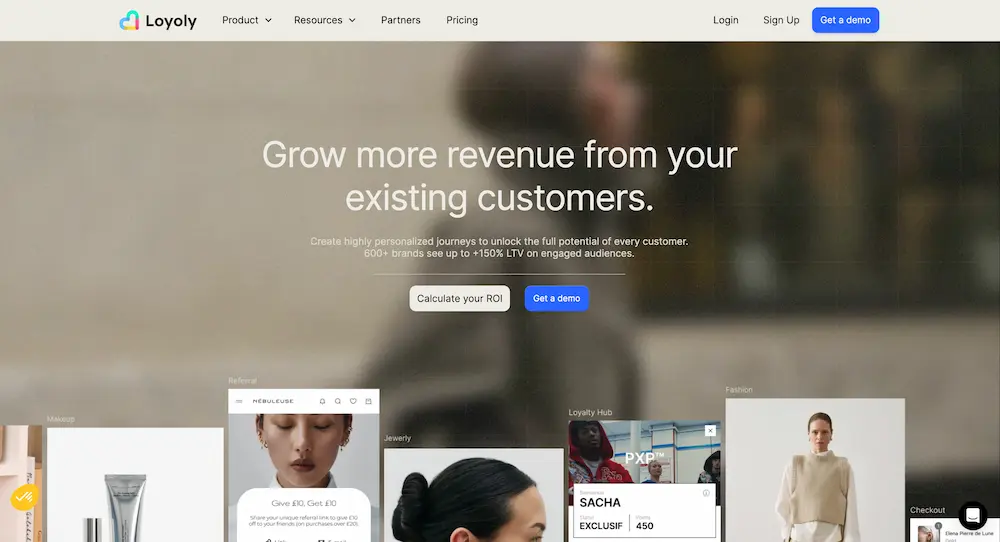
Loyoly positions itself as a post-purchase engagement platform, not just a loyalty tool. With 40+ verified engagement mechanics, including social missions on TikTok and Instagram, UGC collection, reviews on multiple platforms, and a native digital wallet for Apple and Google, the platform goes well beyond points and tiers.
It's built for brands that want to activate every layer of customer potential: repeat purchases, social proof, referrals, and zero-party data collection. Available on Shopify and PrestaShop, with a dedicated account manager and strategic sessions included in all plans.
600+ ecommerce and retail brands already use it, with an average 150% increase in LTV among engaged users in their cohort.
Yotpo: the marketing suite combining reviews and loyalty
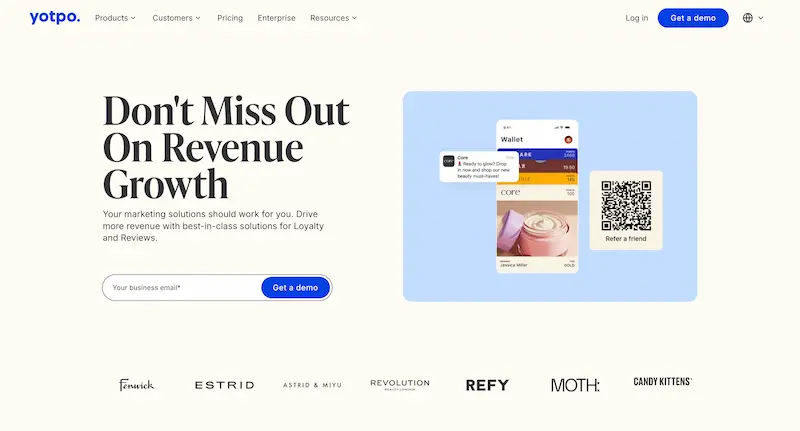
Yotpo started as a reviews platform and expanded into loyalty, SMS marketing, and UGC. The appeal is straightforward: one vendor for multiple marketing functions. The loyalty module includes points, VIP tiers, referrals, and memberships, and integrates tightly with Yotpo Reviews to create a rewards-for-reviews loop.
The trade-off: 100+ integrations and a broad feature set come with added complexity. Onboarding is heavier than average, and dedicated support is only available on premium plans. For brands in the growth phase, that friction matters.
Smile.io: the easiest entry point for a first loyalty program
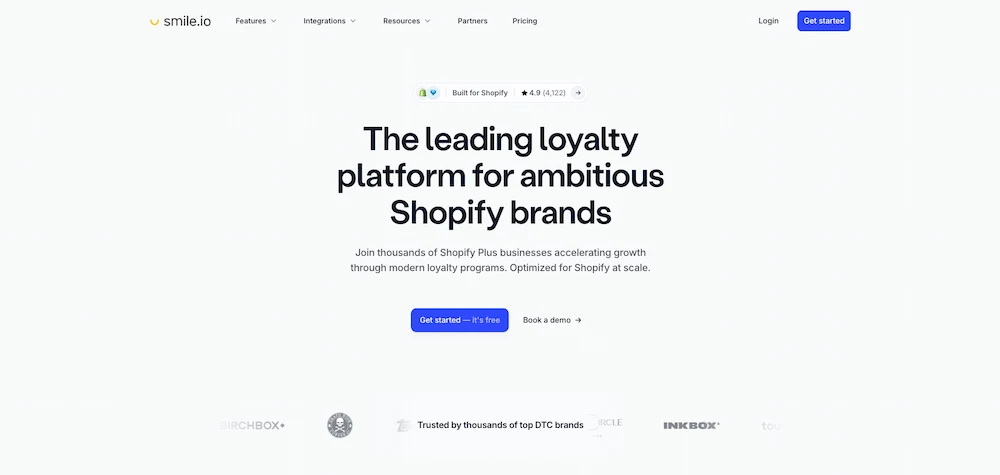
Smile.io is the most widely installed loyalty app on the Shopify App Store. You can go live in a few hours with zero technical expertise: points for purchases, referrals, birthday rewards, social follows.
At $49/month to start, it's the most affordable option in this comparison. But the feature set plateaus quickly. Around 10 types of actions, no automated UGC verification, no dedicated loyalty page (just a pop-up widget), and referral links that aren't individually tracked. A strong starting point for first programs, but one that shows its limits as your retention strategy matures.
Feature depth and engagement mechanics
Features determine whether your loyalty program generates incremental revenue or just creates discount dependency. Here's where the three platforms genuinely diverge.
Verified actions and social missions
This is where the gap between platforms becomes significant. Loyoly offers 40+ verified mechanics: the platform actually confirms that a customer completed a social action before awarding points. Follow a brand on TikTok, post a Reel, reshare an Instagram post, submit a review on Trustpilot: all auto-verified.
Yotpo offers around 20 actions, but social engagement is limited to follows only. No UGC generation, no post or story verification. Smile.io sits at roughly 10 actions: the basics (sign-up, purchase, birthday, review, social follows), with no verification layer at all.
If building a UGC engine and a real social proof loop matters to your brand, understanding what UGC really means for retention is worth exploring before you configure any mechanics.

UGC, reviews, and social proof
Loyoly integrates with Trustpilot, Avis Vérifiés, Judge.me, and other review platforms to reward customers for leaving verified reviews. It also drives real UGC by rewarding posts, photos, and videos on social networks, with automated content validation.
Yotpo has its own review engine, which is a genuine strength. For UGC beyond reviews, however, social missions are limited to follows. Smile.io offers no native review generation and no UGC mechanics. If social proof is core to your acquisition strategy, the difference is not marginal.
.webp)
Referral programs
All three platforms support referral programs. But the depth varies considerably. Loyoly provides individually tracked referral links, automation flows triggered by referral events, and omnichannel redemption. Yotpo offers referrals within its loyalty module with solid reporting. Smile.io's referral tracking is basic, with no individual link attribution.
According to the Loyoly Benchmark (2025), referral conversion rates sit between 30% and 40% across sectors, with fashion hitting 41.5%. Choosing a platform that tracks and optimises those conversions properly is not optional when referral is a meaningful acquisition channel for your brand.

Pricing: what you actually pay at each stage
Entry pricing tells you where a platform wants to position itself. Scaling pricing tells you whether it actually respects your margin. Both matter, and the gap between the two is where the real story lives.
Entry-level and SMB plans
Yotpo and Smile.io both start at $79/month for basic paid plans. Smile.io also has a free entry-level tier. Loyoly starts at $99/month. At this stage, Smile.io wins on accessibility, especially for first-time programs with limited budgets.
But comparing entry-level pricing alone misses the point. The real question is: what do you get for that price, and what does the bill look like when you need to grow?
Mid-market and enterprise pricing
At the mid-market level, the picture changes sharply. Smile.io reaches around $999/month. Yotpo climbs to roughly $899/month. Loyoly sits at approximately $823/month for mid-market brands, with a broader feature set included at that price point.
Loyoly becomes more competitive at scale, not less. Yotpo's pricing is justified by its wider marketing suite. Smile.io's cost-to-feature ratio becomes harder to defend as your program matures. For a broader view of the market, a comparison of the best loyalty program software in 2026 provides useful additional context.
Support, onboarding, and strategic guidance
Support quality is often the hidden variable in platform selection. A loyalty program that isn't actively optimised will consistently underperform, regardless of the underlying features.
Loyoly includes a dedicated account manager, strategic sessions (MBR/QBR), and custom development support across all plans. Average support response time is under 2 minutes. Yotpo offers a dedicated account manager and MBR/QBR reviews, but only on premium plans. Smile.io provides a dedicated account manager with no strategic sessions, no MBR/QBR, and no custom development available on any plan.
The data reinforces why active program management matters. According to the Loyoly Benchmark (2025), engaged loyalty members in fashion show +60% LTV vs. non-engaged customers. In home and decoration, that figure reaches +117%. Results at that level don't happen by accident; they come from strategic iteration and continuous optimisation.
Omnichannel capabilities and integrations
If your brand operates both online and in physical retail, or plans to, the omnichannel capabilities of your loyalty platform will determine whether the program creates a unified experience or a fragmented one.
In-store earning, redemption, and the digital wallet
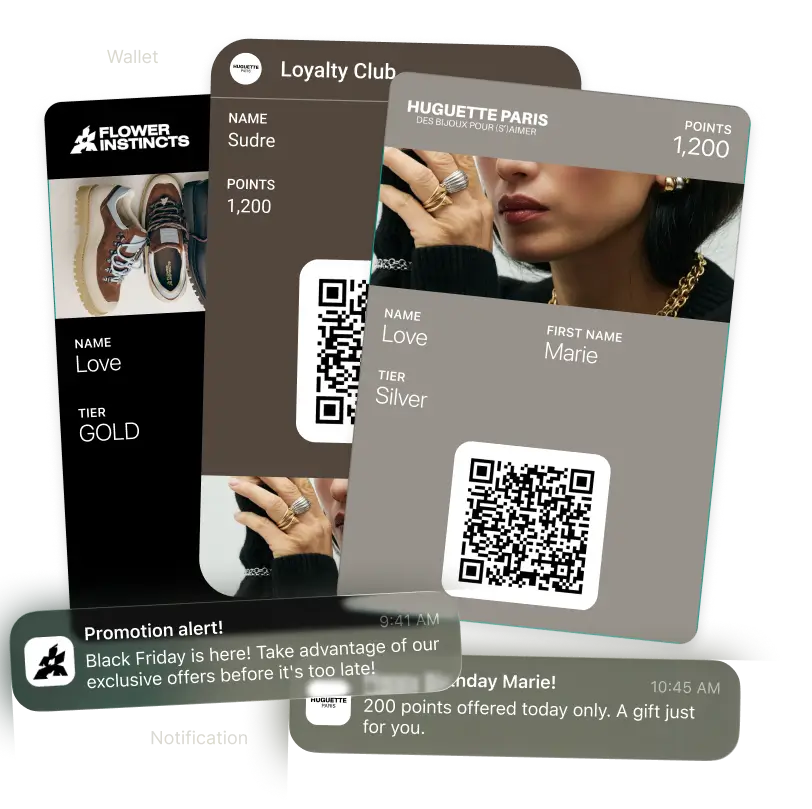
Loyoly supports in-store earning and redemption via Shopify POS, Cegid, and Fastmag, covering both pure-play ecommerce brands and retail chains. The digital wallet (Apple Wallet and Google Wallet) is developed entirely in-house, with dynamic updates and geolocation-based push notifications.
Yotpo supports Shopify POS only for in-store use. The wallet is handled through a third-party partnership (Novel), not built natively. Smile.io is limited to Shopify POS with no wallet, no push notifications, and no QR redemption in store.
Integration ecosystems
Yotpo leads on raw integration count with 100+, which makes sense for a suite-level product. Loyoly covers 20+ integrations, including Klaviyo, Gorgias, Recharge, Trustpilot, and major POS systems. Smile.io offers 30+, with strong Shopify-native coverage.
Depth matters more than count. A shallow Klaviyo integration that only sends basic purchase events is far less useful than a deep sync that passes loyalty tier, points balance, and UGC status as custom properties for segmentation. Evaluate integrations by what data they actually expose, not by how many logos appear on the pricing page.
Which platform should you choose?
After breaking down features, pricing, support, and omnichannel capabilities, the answer comes down to where your brand is today and where you're heading over the next 12 to 24 months.
Choose Loyoly if you want to go beyond transactional loyalty
Loyoly is built for brands that see the loyalty program as a full engagement engine: social proof, UGC, referrals, omnichannel, and zero-party data in one platform. It suits ecommerce and retail brands on Shopify or PrestaShop in the mid-market segment, with ambitious retention objectives and a P&L that demands measurable outcomes.
If your current program consists of a basic points-and-discount mechanic and you've hit the ceiling of what that delivers, Loyoly is the natural next step.
Pssst... You might find this interesting!
Loyalty programs are strategic for your brand and we can probably help. Discover our platform!
Choose Yotpo if you want a unified marketing suite
Yotpo makes sense for brands that want to consolidate reviews, loyalty, and SMS under one vendor. The suite effect is genuine: rewarding customers for reviews, then displaying their loyalty tier next to the published review creates a compelling social proof loop.
If you're already a Yotpo reviews customer and want to add loyalty with minimal migration friction, the case is straightforward. Be prepared for a heavier onboarding process and for support quality to vary considerably by plan tier.
Choose Smile.io if you're launching your first loyalty program
Smile.io is the right choice for SMBs launching their first loyalty program on Shopify with a limited budget and no in-house technical expertise. It gets you live fast, with a familiar interface. The free plan lets you validate the concept before committing to a paid plan.
The moment your retention strategy involves UGC, custom segmentation, omnichannel touchpoints, or deeper Klaviyo integration, you'll hit Smile.io's ceiling. That's a deliberate product decision: Smile.io prioritises simplicity over depth.
To sum up: Loyoly, Yotpo, and Smile.io each serve a distinct brand profile. Smile.io is the easiest entry point for first-time programs. Yotpo suits brands that want to consolidate reviews and loyalty in one marketing suite. Loyoly is the most complete platform for brands that want to go beyond transactional mechanics and build a real post-purchase engagement engine.
Loyoly works with 600+ ecommerce and retail brands and generates an average 150% increase in LTV among engaged customers. Whether you're migrating from Smile.io, reassessing Yotpo's ROI for your budget, or building your first real loyalty strategy from scratch, there's a strong chance the platform can help. Discover what Loyoly can do for your retention strategy at loyoly.io/loyalty.
FAQ
What is the main difference between Loyoly, Yotpo, and Smile.io?
Loyoly is a full post-purchase engagement platform with 40+ verified mechanics, native omnichannel, and a built-in automation engine. Yotpo is a marketing suite combining reviews, loyalty, and SMS. Smile.io is a simple, fast-to-deploy loyalty app for Shopify SMBs. Each serves a different stage of loyalty program maturity.
Which loyalty platform has the best pricing in 2026?
Smile.io has the lowest entry price ($49/month with a free tier), but its cost-to-feature ratio weakens at scale, reaching around $999/month at mid-market. Loyoly starts at $99/month and becomes the most competitive option at mid-market (~$823/month) with a broader feature set. Yotpo sits at ~$899/month for mid-market brands.
Can Loyoly replace both Yotpo and Smile.io?
For brands that need loyalty, referrals, UGC, and omnichannel in one platform, Loyoly covers all of it. It does not include a native reviews display widget or SMS marketing, which Yotpo offers. For pure Shopify loyalty basics, Smile.io remains the simpler and faster-to-deploy option.
Does Smile.io work well for growing ecommerce brands?
Smile.io works well for early-stage and small Shopify brands launching a first program. As retention strategy matures and requires deeper UGC mechanics, social missions, omnichannel engagement, or advanced Klaviyo segmentation, the platform's feature ceiling becomes a real limitation.
Is Yotpo worth the price for loyalty programs specifically?
Yotpo's pricing is most justified when you use the full suite (reviews, loyalty, SMS). If you're using the loyalty module only, the value proposition weakens compared to more focused platforms. Dedicated support is also reserved for top-tier plans, which is a genuine constraint for mid-market brands with active programs.
How does omnichannel loyalty work on Loyoly versus its competitors?
Loyoly supports in-store earning and redemption via Shopify POS, Cegid, and Fastmag. The digital wallet (Apple and Google) is developed natively in-house with dynamic updates and geolocation push notifications. Yotpo relies on a third-party wallet integration (Novel). Smile.io offers no wallet, no push notifications, and no QR in-store redemption.