

.png)


Retail customers do not think in channels. They think in moments, needs and expectations. They discover a product online, buy it in a store, contact support later and expect the brand to remember them every single time.
Yet, behind the scenes, many retailers still operate with fragmented systems, disconnected data and inconsistent processes. CMS, PoS, ERP, CRM and customer service often run in parallel, not together.
This gap creates friction. For customers, it feels like repetition, delays and a poor experience. For businesses, it means lost sales, limited visibility and inefficient operations.
This is exactly the problem unified commerce aims to solve.
Not by adding more channels, but by creating a single, real-time foundation that connects customers, inventory, orders, payments and customer status across the entire commerce ecosystem.
You follow? Good. Let’s start with a clear definition.
What Unified Commerce really means ?
Unified commerce is a retail approach where all commerce systems operate on a single, shared data foundation.
In practice, this means ecommerce, PoS, ERP, inventory, payments and so on are not just connected, but fully integrated. They access the same customer, order and product data in real time.
From a business perspective, unified commerce replaces fragmented platforms with a single source of truth. Every channel relies on the same information, at the same moment.
For customers, the impact is immediate. They are recognised across online and store interactions. Their purchase history, preferences and VIP status are always up to date.
This is what makes unified commerce fundamentally different. It is not a front-end experience layer. It is an operational model that aligns technology, data and retail operations to support one consistent customer experience.
Next, let’s clarify a common confusion: unified commerce versus omnichannel.
Unified commerce vs omnichannel
Omnichannel connects channels, not systems
Most omnichannel strategies focus on multiplying touchpoints. Brands sell online, in-store, on mobile and on social platforms.
But behind the scenes, core systems often remain separated. Customer data, inventory and orders are synchronised with delays or manual processes.
The result is a fragmented experience. Customers are present on multiple channels, but they are not recognised as one single customer.
👉 Discover what is omnichannel and how to implement it
Unified commerce connects everything in real time
Unified commerce removes these silos. All channels rely on the same data, at the same time.
Inventory visibility is accurate. Orders are consistent. Payments and returns follow the same logic everywhere.
For retailers, this means simpler operations and better control. For customers, it means one seamless experience, without friction or repetition.
A real-world example of unified commerce in action
Unified commerce becomes tangible when a customer journey stays consistent from start to finish, without any visible break between channels.
One customer, one journey across online and store
A customer discovers a product on social media, visits the ecommerce site and checks in-store availability. Stock levels are accurate because inventory is shared in real time.
Later, the customer walks into a store and completes the purchase. The transaction is instantly linked to the same customer profile, without duplication or manual matching.
From the customer’s perspective, there is no channel switch. There is only one brand experience.
Loyalty that works everywhere, instantly
The customer earns loyalty points whether they purchase online or in-store. Their points balance, status and rewards update immediately.
According to Loyoly's Industry Report (2025), nearly 30% of consumers say that being able to earn points both online and in-store makes them more active in a loyalty programme.
This level of consistency is impossible when it operates as a separate tool. In a unified commerce model, such a programme is part of the core commerce infrastructure.
Post-purchase without friction
After the purchase, the customer can return the product in-store, even if it was bought online. Store staff access the full order history in seconds.
Customer service teams see the same information and do not ask the customer to repeat themselves. Refunds and exchanges follow the same rules everywhere.
This is where unified commerce truly delivers value: fewer frictions, faster resolution and a smoother end-to-end experience.

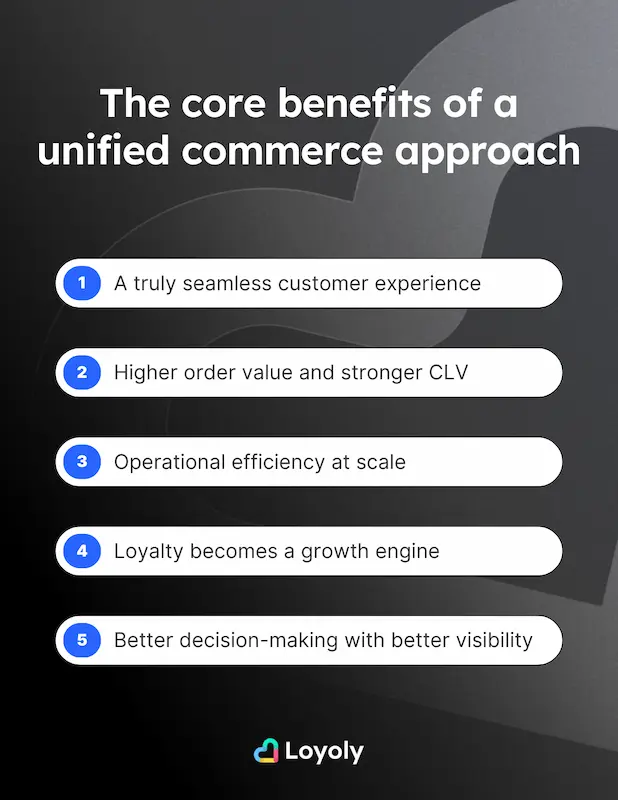
The core benefits of a unified commerce approach
Once unified commerce is in place, its impact becomes visible across both customer experience and business performance.
A truly seamless customer experience
Experience consistency is not a nice-to-have anymore. According to PwC’s 2023 study, 32% of customers will leave a brand they love after just one poor experience, and nearly 60% after multiple bad experiences.
Unified commerce eliminates the small but cumulative frictions that customers notice immediately. Being asked to identify themselves again, seeing inconsistent information or receiving irrelevant messages damages trust.
With unified systems, every interaction is informed by the same customer data. Whether online or in-store, the experience feels continuous and coherent.
Over time, this level of consistency becomes a real differentiator in competitive retail environments.
Higher order value and stronger customer lifetime value
Unified commerce enables smarter cross-channel engagement. Customers can start a purchase in one channel and complete it in another without interruption.
According to Manhattan Associates (2025), multichannel shoppers spend on average 15% more per order than single-channel customers.
By removing barriers between channels, unified commerce increases both average order value and customer lifetime value.
👉 Master your Customer Lifetime Value (and why you shouldn't rely on it 100%)
Operational efficiency at scale
Managing growth with fragmented systems leads to complexity and higher operational costs. Unified commerce reduces this burden.
Inventory, orders and payments follow the same logic across all channels. Teams spend less time resolving discrepancies and more time improving operations.
This efficiency becomes critical as businesses scale and expand their retail footprint.
Loyalty becomes a growth engine
In a unified commerce approach, this should be deeply embedded into the commerce experience.
Points, rewards and status update in real time and reflect the full customer journey. Offers feel relevant because they are triggered by real behaviour.
This transforms loyalty into a strategic lever for retention, engagement and long-term growth.
Better decision-making with real-time visibility
Unified commerce gives teams access to a single, reliable view of sales, inventory and customer behaviour.
Decisions are no longer based on delayed or inconsistent data. Pricing, promotions and stock allocation become more accurate.
For leadership teams, this real-time visibility enables faster, more confident decisions that directly impact performance.
The essential technology stack behind unified commerce
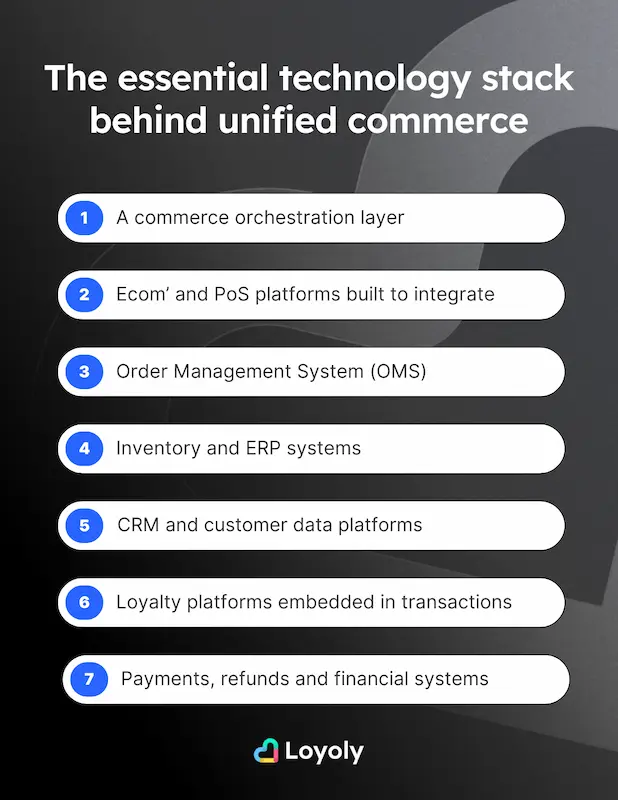
Unified commerce relies on a clearly structured technology stack. Each layer plays a specific role in connecting data, processes and customer experiences.
A commerce orchestration layer
At the centre of unified commerce sits a commerce orchestration platform. This layer coordinates flows between ecommerce, PoS, ERP and order management systems.
Its role is not to replace existing tools, but to ensure that all channels operate on the same rules and timelines. Pricing, availability and order status remain consistent everywhere.
Ecommerce and PoS platforms built to integrate
Ecommerce platforms and PoS systems must be API-first and integration-friendly.
They handle transactions, checkout and in-store operations, but rely on shared services for inventory, customer data and loyalty. In a unified model, they become execution layers, not isolated silos.
Order Management System (OMS)
An OMS is a core component of unified commerce. It manages orders across channels and decides how and where they should be fulfilled.
Ship-from-store, click and collect or returns in-store all depend on a centralised order management system connected to inventory in real time.
Inventory and ERP systems
The ERP and inventory management systems remain the source of truth for stock, pricing and operational data.
In unified commerce, these systems expose real-time data to all channels. This ensures accurate availability, better stock allocation and fewer operational errors.
CRM and customer data platforms
Unified commerce requires a single customer view shared across all channels.
CRM and customer data platforms centralise identities, purchase history and interactions. This data feeds every touchpoint, from checkout to post-purchase communication.
Without a unified CRM layer, recognition and personalisation break down.
Loyalty platforms embedded in transactions
In a unified commerce model, such platform must be directly connected to transactions.
Points, status and rewards update in real time, whether the purchase happens online or in-store. It becomes part of the transaction flow, not a delayed marketing process.
This integration turns loyalty into a real customer identifier across channels.
Payments, refunds and financial systems
Payment systems must support both online and in-store transactions through consistent processes.
Refunds, exchanges and reconciliations need to follow the same logic everywhere. This financial consistency is critical for both customer experience and internal reporting.
The future of unified commerce: emerging trends
Unified commerce is no longer a static model. It continues to evolve as retail technology and customer behaviour change.
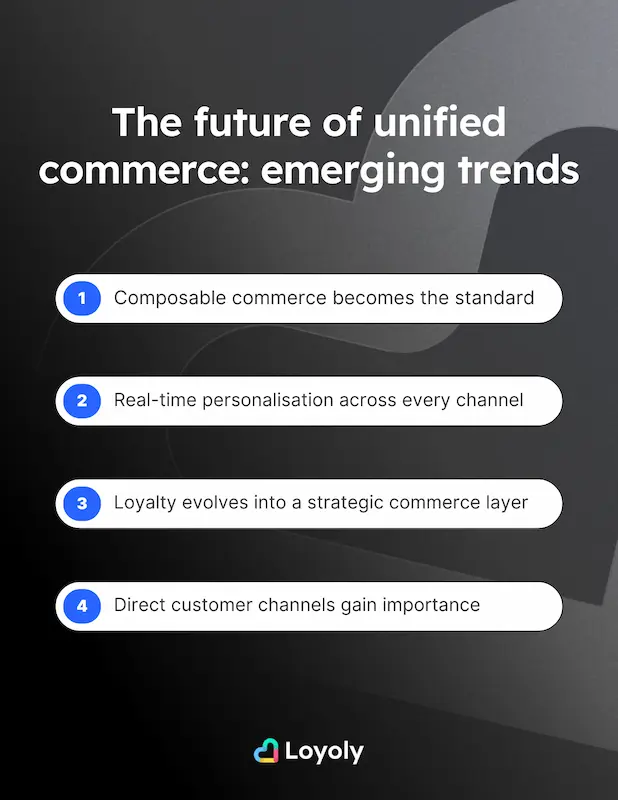
Composable commerce becomes the standard
Retailers are moving away from rigid, all-in-one platforms. They increasingly adopt a composable approach, selecting specialised tools that integrate easily.
Unified commerce benefits from this shift. Brands can build flexible architectures while maintaining a consistent data foundation.
The focus moves from replacing systems to orchestrating them efficiently.
Real-time personalisation across every channel
As data becomes more accessible, experiences become more contextual.
Unified commerce enables real-time personalisation based on behaviour, purchase history and engagement level. Offers, content and rewards adapt instantly.
This level of relevance is becoming an expectation, not a differentiator.
👉 In this extract from Loyoly Talks, Camille Aâssila provides a clear and in-depth introduction to personalisation in ecommerce.
Loyalty evolves into a strategic commerce layer
This is no longer just about points and rewards. It is becoming a core service layer within commerce systems.
By connecting loyalty to transactions and customer identity, retailers turn it into a real-time engagement engine across channels.
This shift strengthens retention and increases long-term value.
Direct customer channels gain importance
Traditional channels like email and paid media are losing efficiency. Brands need direct, owned channels to engage customers consistently.
Unified commerce supports this by centralising data and enabling communication that is timely and relevant.
Retailers who control their customer relationship will gain a structural advantage.
How Loyoly helps brands build unified commerce
Unified commerce depends on a shared customer identity across all touchpoints. This is where many retailers still struggle.
Loyoly integrates loyalty directly into the ecommerce stack, including ecommerce platforms, PoS and CRM. Customer data and transactions stay aligned across online and store channels.
With Loyoly, loyalty lives inside the mobile Wallet. Customers access their points and status without an app or login. The Wallet also acts as a persistent customer identifier, enabling instant recognition everywhere.
For brands, this creates an owned engagement channel and a unified customer view. For customers, it delivers one consistent experience across channels.
To sum up, unified commerce is a retail approach that unifies systems, data and customer identity in real time to deliver one seamless experience across every channel.
But unified commerce only works if customer identity is unified first. Before adding new channels or tools, ensure loyalty, data and recognition are aligned. A Wallet-based approach is often the missing link between online and store experiences.



.webp)