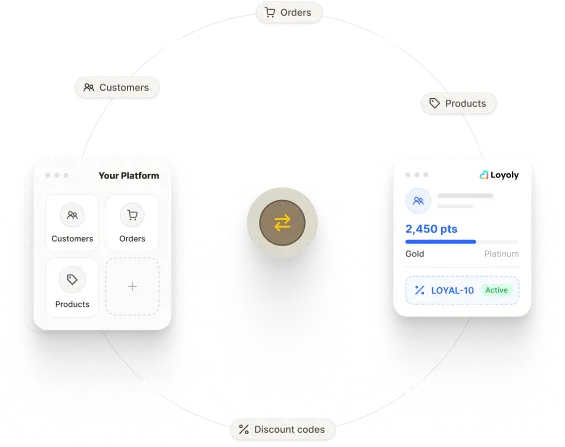
01
02
03
Use one on its own, or both together to run a full program on a stack with zero native connectors.


Three ways to build on the API. Jump to yours.



“Our customers want their loyalty program inside our product.”
See the integrations ↓
Your website runs on Magento, Salesforce Commerce Cloud, WooCommerce, an in-house platform or any CMS we don't connect natively.

Your till isn't Shopify POS, Cegid or Fastmag.

Or your stack is supported, but you want loyalty somewhere our standard loyalty page doesn't reach: a headless front, your app, your checkout.
What you need: the Enterprise plan and developers, yours or an integrator's. To connect a till or a website, your till or CMS must also be able to create and apply discount codes.
01
Before
A customer buys in store and your program never hears about it. No points, no rewards, no profile.
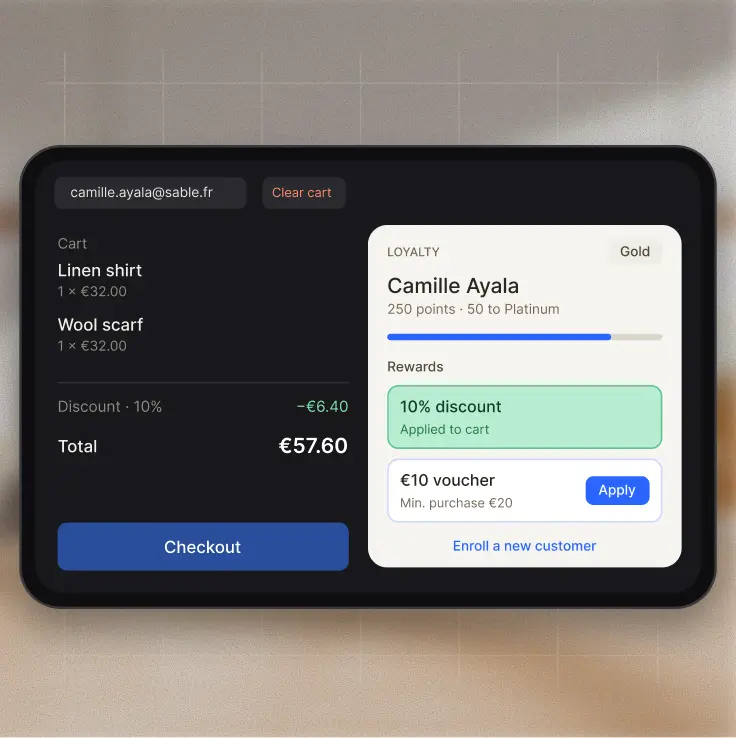
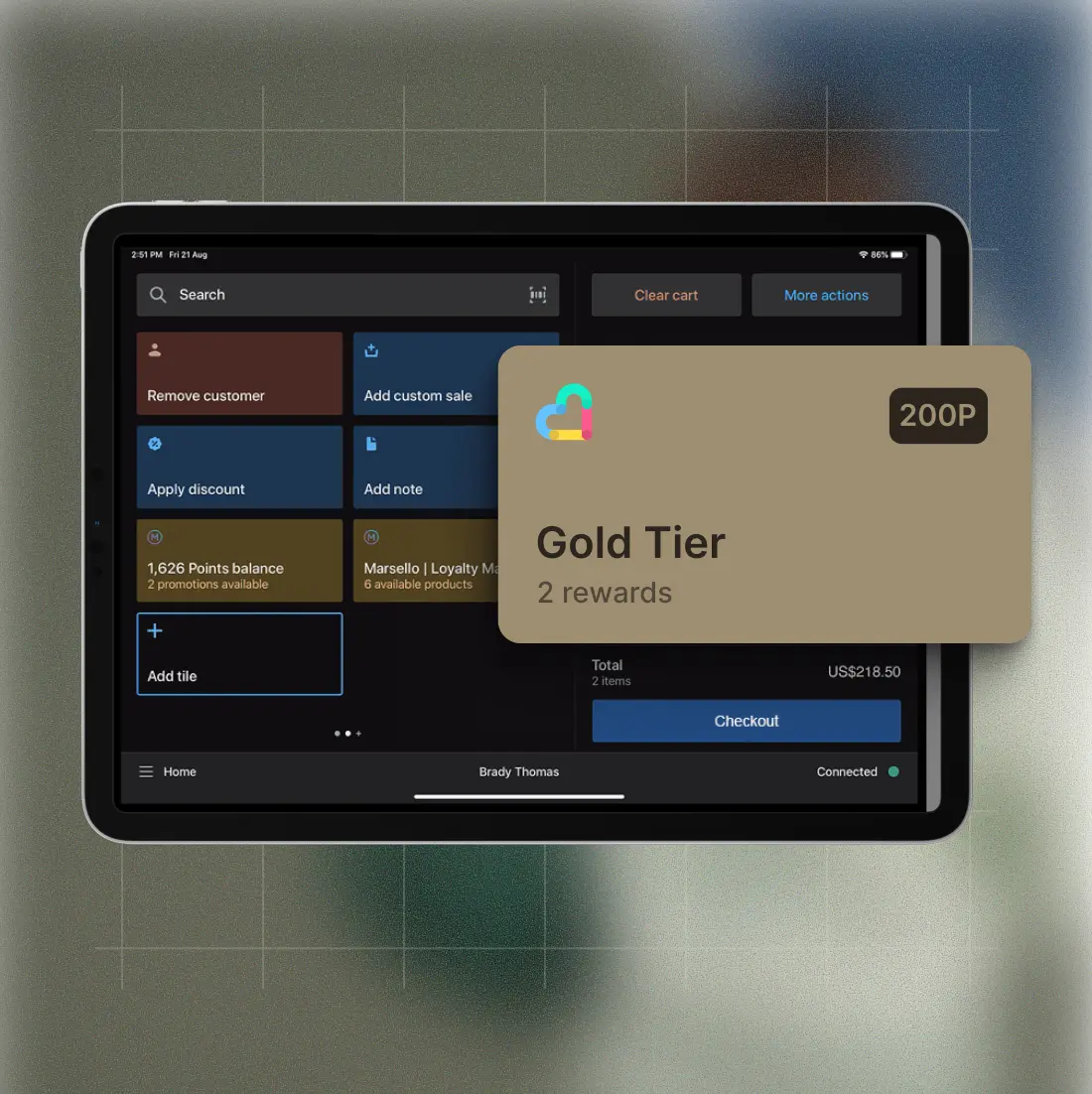
From a loyalty screen your team adds to your till, your associate looks the customer up by email, sees their balance and tier, enrolls them if needed, and applies a reward in the same sale. The purchase credits points straight away. A return or partial refund takes points back pro rata.
One balance online and in store. A euro spent in store counts like a euro spent online, and a reward earned online works at the till.
02
Before
You're not on Shopify or PrestaShop, so serious loyalty felt out of reach.
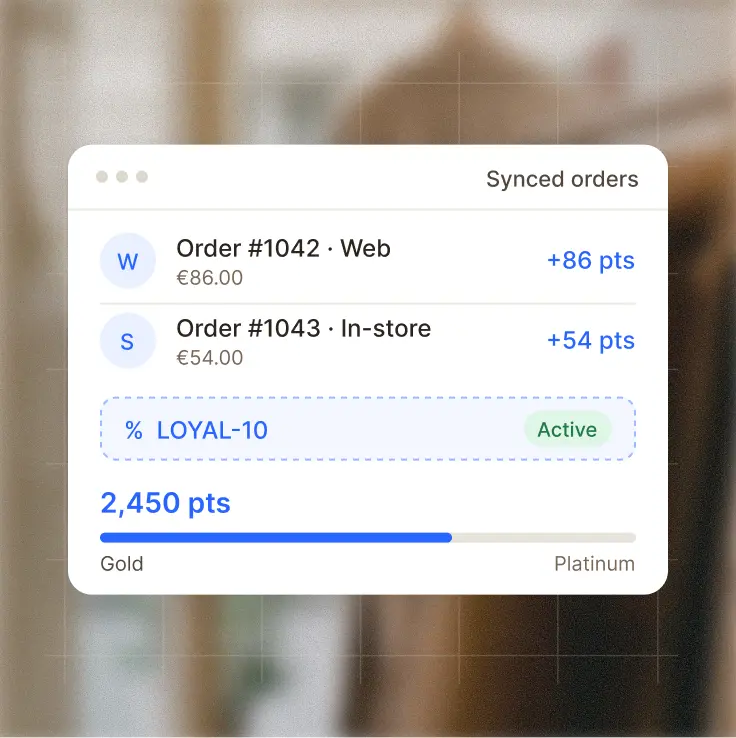
Orders, customers, catalog and discount codes flow to Loyoly. Points are accurate on every order: VAT, shipping, gift cards and product exclusions follow your rules. Referral, review missions and customer-group rules work too. No replatforming.
On a custom website, there's no ready-made Loyoly page to install: you build your loyalty page and account area with the Customer API (see 3).
03
Before
Your loyalty page doesn't look like the rest of your site.
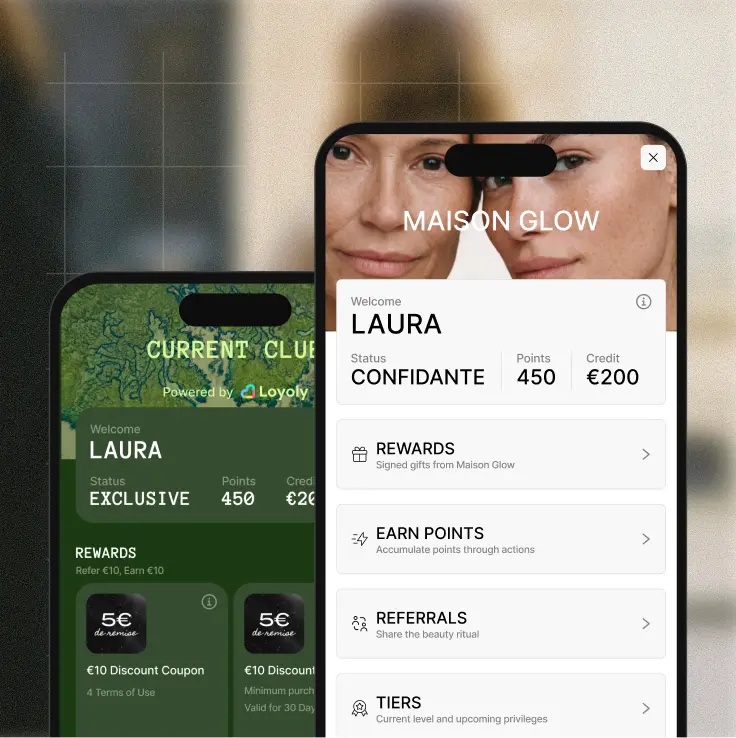
Build your loyalty page and account area from scratch, headless stacks included (Hydrogen, Next.js, Nuxt). Reuse the branding set in the back office, or ignore it entirely.
04
Before
Your best customers live in your app. Your program doesn't.
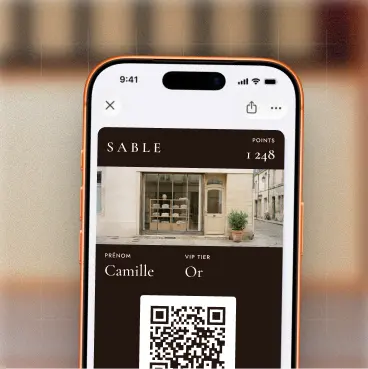
A native loyalty tab, a Wallet card added in one tap, photo missions taken with the phone camera, referral through native sharing.
05
Before
Customers forget their points because they only see them on the loyalty page.
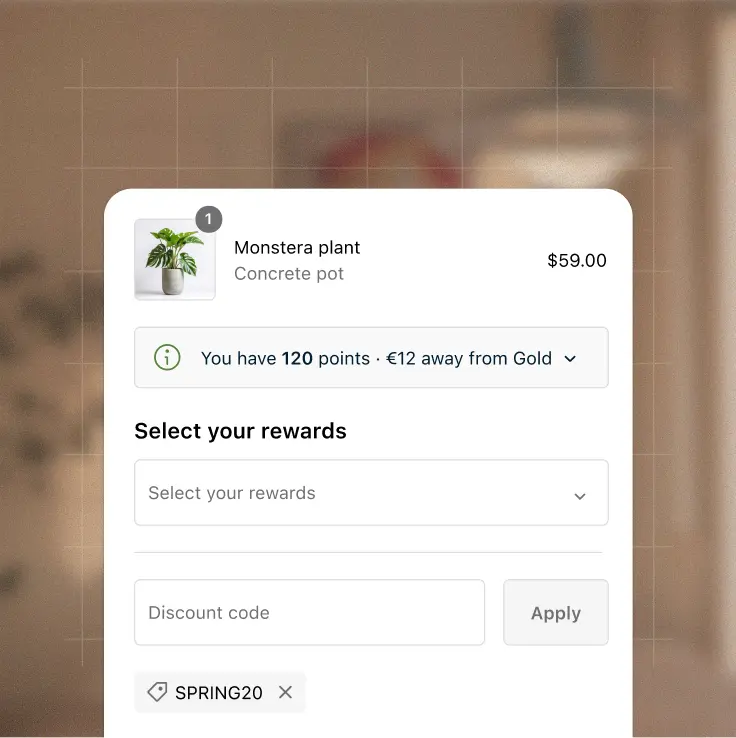
Balance and next reward on the product page, in the cart, at checkout and on the order confirmation: “+120 points. €12 away from Gold.”

Your client runs Loyoly. You build the experience and the connections; we bring the engine, the documentation and a technical contact. Both APIs are part of the Enterprise plan: if your client isn’t on it yet, we’ll help you make the case.
Headless builds, loyalty included. Loyalty page, account area and reusable components (React, Vue) on the Customer API. Pixel-perfect, no third-party widget.

Connect your client's till or website. You get the documentation, a sandbox on your client's pre-prod, a test plan and a technical kick-off with our team. You build, we validate, your client goes live.

Reuse your work. A connector you build for one brand can serve other Loyoly brands on the same system. Planning to package it as a product and offer it to many brands? Apply as a tech partner instead.

All your clients, one login. Switch between your clients' Loyoly accounts in one click.
Tell us about your client and their stack. We'll check feasibility with you and join the client call if that helps.
Your customers want their loyalty program inside your tool. Build an integration once on the Customer API and offer it to every Loyoly brand on the Enterprise plan: the biggest accounts on the platform.
Show the balance and the next reward, and let customers spend points in the cart.

A native loyalty tab, Wallet card and photo missions in the app.

Points, tier and rewards in the customer profile, so agents answer “where's my reward?” and redeem a reward for the customer on the spot.

A review left on your platform completes a Loyoly mission and earns points.

Customers check their balance or redeem a reward when they ask in a conversation.

Build the Loyoly connector once and offer in-store loyalty to all your brands on the Enterprise plan.
01
Apply: tell us about your product, your merchants and the integration you have in mind
02
Technical kick-off, test account and shared Slack
03
App review by Loyoly
04
Soft launch with 1 to 2 pilot brands
05
Co-marketing
Who should apply: software vendors with a product already on the market, brands using it, and a team able to build and support a GraphQL integration.
Free to join during phase 1
Already available
Not available today
In store
Any till that can create and apply a discount code: look up, enroll, credit points, redeem rewards, handle returns and cancellations
A ready-made till interface: your team or integrator builds the screen your associates see. More than one POS system per brand.
Website
Any custom website or CMS without a native connector, with the full program
A hosted loyalty page or plug-and-play script on a custom CMS: you build the front with the Customer API
Customer experience
Profile, points and history, rewards, missions (quiz, photo, video, reviews), VIP tiers, referral, gifting, Wallet, Instagram and TikTok, receipt scanning, branding, multiple languages
Creating missions or rewards through the API: your catalog stays in the back office
Rewards
Percentage off the cart, fixed-amount vouchers (cart or product), product discounts, rewards without a code
Free shipping, “buy X get Y” and cashback on a custom till or website
Real time
Read any customer's data on demand
Loyoly pushing events to your tools (outgoing webhooks)
Access
Both APIs on the Enterprise plan, including integrations built by tech partners.
API access on other plans [à valider]


Native integrations in production: Shopify POS · Cegid · Fastmag · Zendesk · Freshdesk · Tapcart