
.png)


Customer retention rate tells you one thing every ecommerce team cares about: how many customers stay with your brand over a given period.
Simple on paper, critical in practice.
Retention influences revenue, margins, customer lifetime value, and the long-term health of your customer base.
Yet many brands still prioritise customer acquisition even though it costs between 5 and 25 times more than retention, according to Joseph, CEO of Loyoly.
That’s why understanding how to calculate your retention rate properly matters.
The wrong formula, the wrong period, or a misunderstanding of churn can lead to misleading conclusions. And once you get the calculation right, retention becomes a strategic lever.
It reveals the quality of your customer experience, the strength of your loyalty mechanics, and the effectiveness of your CRM journeys.
Ready to dig in?
What is customer retention rate
Customer retention rate becomes much clearer once you understand what customer retention actually means and how it differs from churn.
Definition of customer retention rate
Customer retention rate measures the percentage of customers who stay with your brand over a defined period.
It shows how many customers remain active, continue to purchase, and do not churn.
The rate reflects the strength of your customer experience, the perceived value of your product, and the overall quality of your customer journey.
In ecommerce and retail, it is a core performance indicator because it links directly to repeat purchase behaviour, customer satisfaction, long-term loyalty, and stable revenue.
The 2025 Loyoly Industry Report shows how fragile loyalty can be, with 72% leaving after a drop in quality and 33% after slow customer service.
Retention is therefore a direct signal of operational performance.
Retention rate vs churn rate
Retention rate tells you the percentage of customers who stay with your brand; churn rate tells you the percentage who leave.
Retention highlights loyalty and stability, while churn exposes friction or dissatisfaction.
Looking at both metrics together is essential, because the same factors that drive churn (such as price increases (57%), higher delivery fees (39%), or poorly rewarded loyalty (30%)) directly influence your retention performance.
Analysing both sides of the equation gives a clearer view of customer health.
👉 Find 8 levers to reduce churn rate and customer loss
Calculating customer retention rate
Calculating your customer retention rate is simple once you know which inputs matter and how to interpret the result.
The goal is to isolate customers who genuinely stayed with your brand, not those who joined during the period.
What you need to calculate your customer retention rate
To calculate retention accurately, you need three numbers for the selected period (month, quarter, or year):
- Customers at the beginning of the period – your baseline.
- Customers at the end of the period – your final count.
- New customers acquired during the period – to avoid inflating retention.
Using these numbers ensures you're measuring loyalty, not growth. Many teams misinterpret retention by forgetting to remove new customers, which leads to misleading conclusions about customer health.
The customer retention rate formula
The standard formula used in ecommerce, retail, SaaS, and CRM analytics is:
Retention rate = ((customers at end of period – new customers acquired during period) / customers at beginning of period) × 100
This formula identifies the proportion of customers who stayed with your brand throughout the period.
It is a more reliable indicator than simply comparing customer counts, because it removes the effect of acquisition spikes, seasonal sales, or marketing campaigns.
.webp)
2 examples of customer retention rate calculations
Example 1
You start the month with 1,000 customers and end with 1,100.
You acquire 250 new customers during the month.
Retention rate = ((1,100 – 250) / 1,000) × 100 = 85%
This means 85 percent of your existing customers remained active.
Example 2
You start the quarter with 5,000 customers and end with 4,800.
You acquire 600 new customers.
Retention rate = ((4,800 – 600) / 5,000) × 100 = 84%
Even though your total customer base decreased, your retention rate remains strong because the loss is smaller than it appears once new customers are removed.
What is a good customer retention rate?
A good customer retention rate depends on your market, your product, and the pace at which customers normally repurchase.
There is no universal benchmark. What matters most is whether your retention rate improves over time and whether it reflects a healthy customer experience.
A strong rate is one that shows customers see enough value to return without heavy discounting, remain satisfied throughout the journey, and are not leaving due to quality issues, price increases, or poor service, the factors most consumers cite when loyalty breaks.
The real benchmark is your own trendline: consistent improvement and lower churn are the clearest signs of progress.
The 3 main benefits of a high customer retention rate
A high customer retention rate strengthens your brand’s long-term performance.
It impacts revenue stability, acquisition efficiency, and customer lifetime value in ways that most ecommerce teams underestimate.
1 - Revenue increase
When retention rises, revenue becomes more predictable.
Returning customers tend to buy again with less hesitation and require fewer incentives to convert.
They already trust your brand, understand your product, and move through the customer journey with less friction.
This means higher repeat purchase rates, more stable monthly revenue, and a stronger foundation for long-term growth.
Retention also supports healthier average order value because satisfied customers are more willing to explore new products or upgrade their purchase.
2 - Cost reduction
Retaining customers directly reduces marketing and acquisition costs.
Since acquiring a new customer costs 5 to 25 times more than retaining one (Joseph, CEO of Loyoly), improving retention immediately strengthens your P&L.
With a loyal base, your brand depends less on paid channels, seasonal promotions, and high acquisition spend to hit revenue targets.
It also reduces pressure on operational teams, as loyal customers require fewer support interactions and fewer interventions to complete a purchase.
3 - Lifetime value increase
Customer lifetime value (LTV) grows naturally when retention improves.
Loyal customers stay active longer, purchase more frequently, and are more likely to engage with your loyalty programme, referral activities, or social content.
Because retention directly influences the “time” and “value” components of LTV, even a small improvement can compound into significant long-term revenue.
A higher LTV also gives brands the flexibility to invest more intelligently in marketing, product development, and customer experience without eroding margins.
👉 Learn how to master customer lifetime value
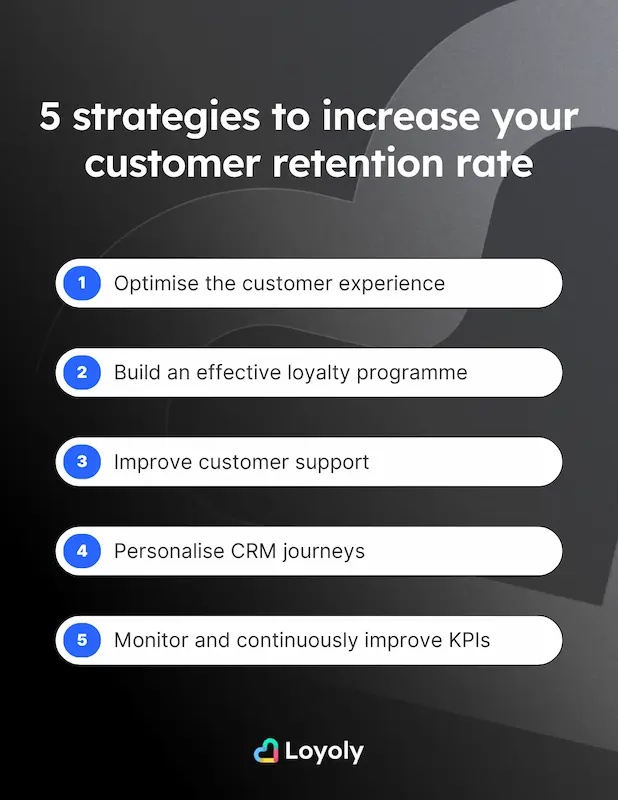
5 strategies to increase your customer retention rate
Improving customer retention requires a mix of experience design, CRM personalisation, operational consistency, and ongoing measurement.
Here are the core levers that help ecommerce and retail brands reduce churn and strengthen loyalty.
1 - Optimise the customer experience
Retention always starts with the customer experience.
If the product underdelivers or the customer journey feels unreliable, even loyal customers begin to disengage.
The 2025 Loyoly Industry Report confirms how fragile loyalty can be: 72% leave when quality drops, and 57% churn when prices increase.
Improving customer retention therefore means reducing friction at each stage of the journey, from browsing to purchase, delivery, and repeat use.
Clear delivery timelines, reliable packaging, accurate product descriptions, intuitive site navigation, and transparent communication all contribute to stronger customer satisfaction.
The same applies to post-purchase touchpoints: proactive updates, well-timed educational content, and reassurance about returns or exchanges help maintain confidence.
When the customer experience feels smooth, predictable, and aligned with expectations, customers are far more likely to return and increase their long-term retention rate.
2 - Build an effective loyalty programme
A well-designed loyalty programme is one of the most powerful tools to increase customer retention.
It rewards behaviours that matter for your business: repeat purchases, advocacy, and engagement across channels like email, social media, or UGC.
According to the 2025 Loyoly Industry Report, 23% of customers say they return specifically because the loyalty programme delivers real value.
That’s a strong signal that loyalty mechanics directly influence your retention rate.
To succeed, a loyalty programme must feel personalised and meaningful.
Instead of generic discounts, brands should reward actions such as leaving a review, referring a friend, completing a challenge, or sharing UGC.
These actions deepen the connection between the customer and the brand.
When rewards feel fair and aligned with actual customer value, loyalty becomes a long-term habit rather than a transactional trick, and your customer retention rate rises naturally.
Discover the three main types of loyalty programmes 👇
3 - Improve customer support and proactive issue resolution
Support quality has a direct impact on customer churn.
The 2025 industry report shows that 33% of customers abandon a brand when support is too slow or unhelpful.
That makes customer service one of the key drivers behind your retention rate.
To reduce churn, teams need clear SLAs, well-trained support agents, and proactive communication when issues arise.
Small adjustments make a big difference: sending early delivery updates, acknowledging delays before customers ask, or processing refunds quickly eliminates frustration.
These actions signal reliability and reinforce the perception of value. When customers feel supported, they stay longer, spend more, and contribute to a healthier customer lifetime value (LTV).
4 - Personalise CRM journeys based on behaviours and segments
Today’s customers expect brands to understand their behaviour and adapt to it.
Generic CRM workflows don't increase customer loyalty or retention.
Personalising journeys based on purchase history, product usage, predicted churn, customer segment, or preferred channels significantly improves engagement.
Behaviour-based flows (replenishment reminders, win-back sequences, browse abandonment emails, or post-purchase education) guide customers through the customer journey at the right moment.
They also prevent churn by addressing pain points before they escalate.
When CRM journeys feel relevant and timely, customers perceive higher value and are far more likely to remain loyal over the long term.
5 - Monitor and continuously improve KPIs such as NPS and repeat purchase rate
Improving customer retention requires ongoing measurement.
Key KPIs such as NPS, repeat purchase rate, churn rate, and customer satisfaction reveal whether your initiatives deliver real value.
NPS in particular is a strong predictor of retention: a decreasing score often appears before customers stop buying.
Tracking these indicators over time helps teams act quickly. Adjusting CRM personalisation, refining the customer experience, or intervening before at-risk customers churn.
Retention is never static. It improves only when brands monitor performance continuously and iterate confidently.
4 other customer retention metrics
Retention rate becomes even more powerful when combined with complementary metrics that help you understand behaviour, sentiment, and long-term value.
These indicators reveal why customers stay, how they interact with your brand, and where you can take action to reduce churn.
👉 Discover 11 top KPIs to measure customer loyalty
1 - Repeat purchase rate
Repeat purchase rate measures the proportion of customers who buy more than once within a defined period.
It tells you how effectively your brand converts new customers into loyal customers.
A rising repeat purchase rate shows that customers find real value in the product, experience low friction, and see enough relevance to come back without heavy incentives.
For CRM teams, this metric is essential to evaluate the impact of post-purchase flows, replenishment reminders, loyalty mechanics, and product education.
2 - Purchase frequency
Purchase frequency tracks how often customers buy from you on average.
It goes deeper than repeat purchase rate by showing whether returning customers buy regularly or only occasionally.
Higher purchase frequency contributes significantly to lifetime value because customers who come back often tend to engage more, discover more products, and build stronger habits around your brand.
Increasing frequency usually requires a mix of better timing (CRM triggers), clearer product use cases, and seamless reordering experiences.
3 - Net Promoter Score (NPS)
NPS measures customers’ likelihood to recommend your brand to others.
It is one of the most reliable indicators of loyalty and long-term retention because it captures sentiment, not just behaviour.
A high NPS signals trust, satisfaction, and emotional connection.
A declining NPS, on the other hand, usually appears before churn becomes visible in your data.
That makes it a valuable early-warning KPI.
Monitoring NPS alongside retention rate helps identify whether churn is driven by product issues, experience gaps, or unmet expectations.
4 - Lifetime Value (LTV)
Lifetime value represents the total revenue a customer generates throughout their relationship with your brand.
It is directly influenced by retention, purchase frequency, and average order value.
When retention improves, LTV increases naturally because customers stay longer, buy more often, and engage more deeply with your ecosystem.
A strong LTV gives brands more strategic flexibility: it allows higher acquisition bids, stronger loyalty rewards, and larger investments in customer experience without damaging margins.
LTV is therefore one of the most strategic retention KPIs for long-term growth.
2 common mistakes when calculating customer retention rate
Even though the retention rate formula looks simple, many brands miscalculate it or misinterpret what the result means.
These mistakes lead to incorrect conclusions and poor strategic decisions.
1 - Using the wrong time period
Retention must always be calculated over a clearly defined and relevant period.
Using inconsistent time frames (for example switching between monthly, quarterly, and annual views) makes results impossible to compare.
A period that is too short may exaggerate fluctuations, while a period that is too long may hide early churn signals.
The key is to choose a time frame aligned with your purchase cycle and stick to it consistently.
2 - Confusing retention with loyalty or satisfaction
Retention shows whether customers stay; loyalty and satisfaction show why they stay.
These metrics are connected but not interchangeable.
A customer may continue buying for practical reasons while feeling increasingly dissatisfied, meaning retention looks stable while churn risk is rising.
Conversely, a high NPS does not guarantee strong retention if customers have infrequent purchase needs.
Treating these concepts as the same metric leads to misguided decisions, so they must be analysed together rather than merged.
Customer retention rate is calculated by isolating the customers who stayed over a given period and remains one of the most reliable indicators of long-term loyalty, revenue stability, and customer lifetime value.
If you want to increase retention, start by mapping your entire post-purchase journey and identifying where customers lose confidence. Then activate personalised CRM flows, loyalty rewards, referrals, UGC, and engagement mechanics at the exact moment they create value. With over 40 engagement levers, Loyoly helps you orchestrate journeys that adapt in real time to each customer’s behaviour, making retention a predictable growth driver rather than a guessing game.
👉 Learn everything you need to know to create a top-notch loyalty program!




.webp)