
.webp)
.png)


Let's be honest. Most digital marketing strategies spray their message everywhere and hope something sticks. Geofencing marketing does the exact opposite. It draws an invisible boundary around a physical location and sends a tailored message the moment someone crosses it.
Right message. Right place. Right time. That's the core promise of geofencing, and it's why the global market is projected to grow from $2.65 billion in 2024 to $12.23 billion by 2032, at a compound annual growth rate of 21% (camphouse.io, 2025).
In this guide, you'll understand what geofencing marketing is, how it works technically, and how to use it to drive foot traffic, boost repeat purchases and build long-term loyalty, especially when combined with a mobile wallet strategy.
What is geofencing marketing, exactly?
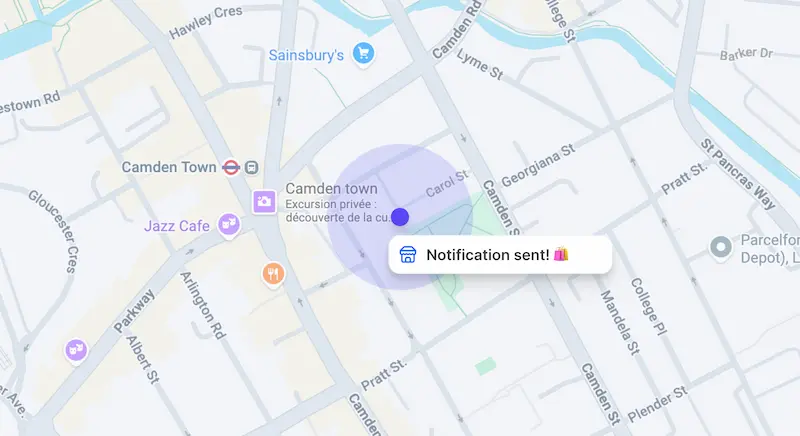
Geofencing marketing is a location-based strategy that sends targeted messages to mobile users when they enter or exit a predefined geographic area, commonly called a "geofence." That virtual boundary can be as small as the perimeter of a single storefront or as wide as an entire neighborhood.
When a customer's smartphone crosses that boundary, an event is triggered automatically. They receive a push notification, an SMS, a display ad or an in-app message. The key distinction from other targeting methods is that geofencing reacts to physical presence in real time, not just browsing behavior or demographic data.
Do not confuse it with geotargeting, which operates at a broader scale, like targeting all users in a given city or postal code. Geofencing is hyper-local. We are talking about a specific block, a competitor's parking lot or even a single aisle inside a shopping center.
How does geofencing work technically?
Geofencing is not one technology. It is a combination of several, often layered together to maximize precision across different environments.
GPS for outdoor targeting
GPS is the most widely used technology for outdoor geofencing campaigns. It uses satellite signals to pinpoint a device's location within a few meters.
It works well in open spaces but weakens indoors or in dense urban canyons where tall buildings interfere with satellite reception. For most drive-to-store campaigns, GPS alone covers the majority of use cases.
Wi-Fi and Bluetooth for indoor precision
For indoor environments, Wi-Fi beacons and Bluetooth Low Energy (BLE) take over where GPS falls short.
A beacon placed inside a store can detect a device within 10 to 50 meters, enabling in-store geofencing with a level of precision GPS cannot match.
This is what lets a retailer alert a customer when they walk past a specific product section or a promotional display. BLE beacons are particularly powerful in shopping malls, airports and large retail spaces.
RFID and cellular data for broader coverage
RFID and cellular network signals provide a third layer of location data, generally used for wider area coverage or logistics contexts.
Sophisticated marketers often combine all three technologies.
GPS handles the outdoor perimeter, Wi-Fi and Bluetooth cover the interior, and cellular data fills in any remaining gaps, giving the geofence full coverage across every customer touchpoint.
Why geofencing marketing matters for ecommerce and retail brands
Two data points frame the opportunity clearly. 53% of shoppers visited a specific retailer after receiving a location-based message, and geofencing campaigns consistently deliver around double the click-through rate of traditional digital advertising (fetchfunnel.com, 2025).
For brands running omnichannel operations, those numbers translate directly into incremental revenue. Ecommerce brands with physical points of sale can use geofencing to bridge the online-to-offline gap in a measurable way. Pure players can activate it near partner locations, pop-up stores, or events to generate traffic at exactly the right moment.
Beyond acquisition, geofencing is a retention lever. According to Loyoly's Industry Report 2025, based on a survey of 1,016 French consumers, 23% say a loyalty program with genuine advantages motivates them to make a second purchase, up 10 points compared to first-purchase drivers. Geofencing, when tied to a loyalty program, is precisely the channel that delivers that timely nudge at the most decisive moment.
That said, the same report shows 25% of consumers stop being loyal to a brand when they feel over-solicited. Frequency capping and message relevance are not nice-to-haves. They are the difference between a high-performing geofencing strategy and one that quietly destroys your customer relationships.
5 concrete use cases for geofencing in ecommerce
Theory is one thing. Let's look at what actually works when brands deploy geofencing in real conditions.
Drive-to-store campaigns
A customer walks past your store on a Saturday afternoon.
Your geofencing setup detects their presence and sends a push notification:
"You're 50 meters away. Flash offer: 15% off today only."
That is drive-to-store at its most direct. Combining location-triggered messages with exclusive in-store incentives consistently outperforms standard digital campaigns for physical retail activation.
You can explore complementary approaches in our guide to driving foot traffic to your store.
Competitor conquesting
This is one of the bolder applications of geofencing.
You draw a virtual fence around a competitor's location and target their visitors with your own offer.
A customer waiting at a rival store receives your message:
"Before you decide, check our offer. Free shipping today on your first order."
Done compliantly and with a strong creative, competitor conquesting can generate high-intent leads at a significantly lower cost than paid search or social advertising.
Event-based targeting
Trade shows, festivals, sports events and pop-up markets are geofencing goldmines.
You define the venue perimeter and push relevant content to attendees as they arrive or circulate.
A sports brand at a running event can send a post-race recovery offer.
A beauty brand at a wellness expo can invite visitors to their booth with a time-limited discount.
The physical context amplifies the message's relevance.
Loyalty reward redemptions
Your loyalty members are physically close to your store but haven't visited in weeks.
A geo-triggered message reminds them they have unredeemed points expiring soon.
This is a textbook win-win: the customer recovers value they would otherwise lose, and you generate a visit without spending on acquisition.
A loyalty card strategy powered by geofencing is one of the most cost-efficient reactivation tools in retail.
You can learn more about loyalty card marketing mechanics to build on this approach.
Re-engagement of dormant customers nearby
Geofencing lets you segment by behavior, not just location.
A customer who hasn't purchased in 90 days but is now physically near your store is in a unique window of potential reactivation.
A personalized message referencing their loyalty status or their last product category creates the exact kind of contextual relevance that generic retargeting cannot replicate.
This level of ecommerce personalisation turns raw location data into a genuine CRM action.

Geofencing plus mobile wallet: the combination that changes everything
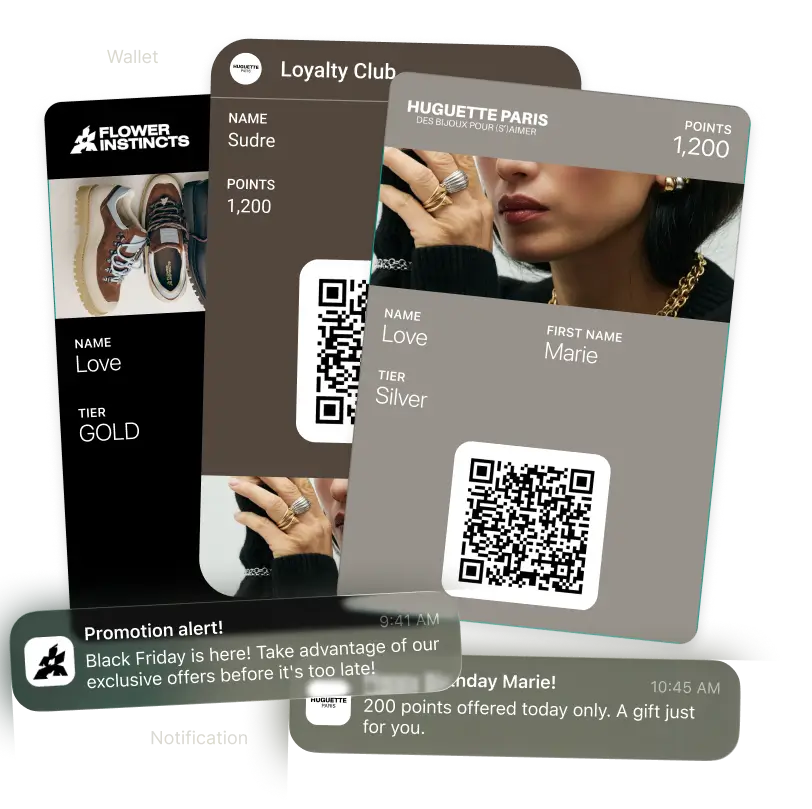
Push notifications through a brand app require app installation. That's a real adoption barrier. Most customers will not download a dedicated app just to receive promotions. Mobile wallets, specifically Apple Wallet and Google Wallet, remove that friction entirely.
When a brand adds a loyalty card to a customer's mobile wallet, they gain the ability to send geo-triggered push notifications without any app. The customer adds the pass once, and the brand can communicate with them based on their physical location for as long as that pass stays in their wallet. No download. No login. No barrier.
This is where geofencing reaches its full potential for loyalty programs. Imagine a customer who walks within 200 meters of your store. Their wallet card lights up with a notification: "Welcome back. Your 150 points expire this weekend. Come use them today." One message. Zero friction. Maximum relevance.
Loyoly's Wallet feature is built exactly for this use case: geo-based push notifications that drive reward redemptions, increase in-store visits and maintain long-term engagement, all from a single loyalty pass added to the customer's smartphone. If you want to go deeper on the strategy, download the Loyoly Wallet ebook for a complete breakdown of how to build a wallet-based loyalty and geofencing program from scratch.
For brands managing a customer loyalty program, the wallet plus geofencing combination offers one of the highest return-on-investment setups currently available, and one of the few that works without relying on a dedicated mobile app.
Pssst... You might find this interesting!
Geofencing marketing is strategic for your brand and we can probably help. Discover our platform!
5 steps to launching a geofencing campaign
No complicated jargon here. Here is a practical sequence that works for ecommerce and retail brands at any stage.
Step 1: Define your objective and your fence
Start with a single, clear objective: drive-to-store, competitor conquesting, event activation or loyalty reactivation.
Then define the physical perimeter. A radius of 100 to 500 meters is standard for brick-and-mortar drive-to-store campaigns.
For events, use the venue boundaries. For competitor conquesting, be surgical: target the immediate storefront or the parking lot only, not the entire neighborhood.
Step 2: Choose your technology and platform
Most enterprise mobile marketing platforms, including Klaviyo, Braze and Insider, support geofencing natively or through integrations.
If you are running a wallet-based loyalty program, your wallet provider should handle geo-triggers natively without requiring additional tools.
Always align your technology choice with your existing marketing stack to avoid data silos and attribution gaps.
Step 3: Build the message and the offer
The copy must be short, relevant and time-sensitive.
"You're near us" is not an offer. "Your points expire in 3 days and you are 100 meters away" is.
Every geofencing message needs a clear value proposition and a single call to action. No fluff. No paragraphs. You have one sentence to create urgency and justify the interruption.
Step 4: Set frequency caps and consent rules
Never send more than one geofencing message per visit per location.
Set a cooldown of at least 24 hours between triggers for the same user. And always operate within GDPR and local consent frameworks.
Users must have actively opted in to receive location-based notifications. This is non-negotiable, both legally and for long-term brand trust.
Step 5: Measure and iterate
Track your core metrics from day one: notification open rate, conversion rate from notification to visit or purchase, foot traffic lift during active campaign periods, and loyalty redemption rate for loyalty-focused campaigns.
Geofencing programs improve significantly with iteration. Test different perimeter sizes, message angles, timing windows and audience segments before scaling.

Geofencing marketing KPIs you need to track
You cannot optimize what you cannot measure. These are the five indicators that matter most for a geofencing program in ecommerce and retail.
Notification open rate
This metric tells you immediately whether your message is relevant enough to earn attention.
Location-based push notifications generally outperform standard push in open rates, but if yours are low, the problem is usually the message content or a perimeter that is too wide, not the channel itself.
Conversion rate from notification to action
What share of users who received the notification actually visited, clicked or redeemed?
This is your core performance indicator. Segment it by campaign type, audience segment and location to identify what drives results and what does not.
Foot traffic lift
Measure store visits during active geofencing periods versus comparable baseline periods without campaigns.
This attribution model is never perfect, but it gives solid directional evidence of the incremental traffic your geofencing activity is generating beyond organic visits.
Loyalty redemption rate
For loyalty-focused geofencing, track whether geo-triggered messages lead to point redemptions or reward usage.
This metric connects geofencing directly to the health of your loyalty program and makes ROI calculation straightforward: you know exactly which visits and which redemptions your campaign generated.
Opt-out rate
If users are revoking location permissions after receiving your messages, you are over-reaching.
Monitor this metric closely. A spike in opt-outs after a campaign is a clear signal to revisit your frequency, your creative relevance or your targeting logic.
Losing location permission means losing the channel entirely for that customer.
To sum up: Geofencing marketing is a location-based strategy that triggers personalized messages when a customer's device enters or exits a predefined geographic zone, making it one of the most precise and contextually relevant tools available for ecommerce and retail brands today.
Loyoly's Wallet feature lets brands send geo-triggered push notifications directly to customers' Apple Wallet or Google Wallet loyalty cards, with no app required. It's the most frictionless way to combine geofencing and loyalty into a single, measurable retention channel. Explore how it works and what results it delivers for brands like yours by downloading the Loyoly Wallet ebook.
FAQ
What is the difference between geofencing and geotargeting?
Geotargeting delivers ads or messages to users based on a broad location, such as a city or a region. Geofencing is far more precise: it creates a virtual boundary around a specific physical location and triggers messages in real time when a device enters or exits that zone. Geofencing is hyper-local, geotargeting is broad-scale.
Do you need an app to use geofencing marketing?
Not necessarily. Traditional geofencing does require an installed mobile app to send push notifications. However, wallet-based geofencing bypasses this entirely. When a customer adds a loyalty card to their Apple Wallet or Google Wallet, the brand can send geo-triggered notifications without any dedicated app. This dramatically improves reach and adoption.
Is geofencing GDPR-compliant?
Geofencing can be fully GDPR-compliant when users explicitly opt in to location-based notifications. Consent must be informed, specific and freely given. Brands must also respect frequency caps, data minimization principles and the right to withdraw consent at any time. GDPR does not ban geofencing; it regulates how location data is collected and used.
What is the ideal geofencing radius for a retail drive-to-store campaign?
Most retail drive-to-store campaigns perform best with a radius between 100 and 500 meters. A tighter fence, around 100 to 200 meters, captures high-intent prospects who are genuinely close and likely to act immediately. Wider fences, up to 1 km, can work for large-format stores or for campaigns where dwell time at the destination is long, like shopping malls or leisure venues.
How does geofencing connect to a loyalty program?
Geofencing and loyalty programs are natural complements. Geo-triggered messages can notify loyalty members of expiring points, exclusive in-store rewards or VIP events when they are physically nearby. When delivered through a mobile wallet loyalty card, this combination requires no app installation and delivers personalized, contextually relevant communication at exactly the right moment.
What are the most common mistakes in geofencing marketing?
The three most frequent mistakes are setting a perimeter that is too wide and targeting users who have no real intent to visit, sending too many messages too quickly and triggering opt-outs, and writing generic copy that does not justify the intrusion. Geofencing earns attention because it is contextual. The moment the message stops feeling relevant to the physical situation, the strategy fails.
.webp)
.webp)