.png)


You run a small ecommerce brand. Your budget is tight, your team is lean, and every euro you spend on acquisition feels like a gamble. Good news: a loyalty program for small business is one of the highest-ROI investments you can make right now.
And no, you don't need the budget of Sephora or the tech stack of Nike to pull it off. You just need the right structure, the right rewards, and a clear understanding of what actually drives repeat purchases.
In this guide, we break down exactly how to design, launch, and optimize a loyalty program tailored to the constraints and opportunities of a small ecommerce brand. With concrete data, sector-specific benchmarks, and actionable tips you can implement this week.
What is a loyalty program for small business?
A loyalty program for small business is a structured system that rewards customers for repeat purchases and engagement with your brand. It goes beyond the old punch card model. Today, it means points, tiers, referral bonuses, and engagement mechanics, all managed digitally.
The core idea is simple. You give customers a reason to come back instead of shopping with a competitor. In return, you get higher customer lifetime value, lower acquisition costs, and a growing base of brand advocates.
For small ecommerce brands specifically, a loyalty program solves three critical problems at once. It reduces dependency on paid ads for repeat revenue. It generates social proof through reviews and UGC. And it turns your best customers into your most effective acquisition channel via referrals.
Why small brands need loyalty programs more than big ones
Here is a common misconception: loyalty programs are for big brands with big budgets. The reality is the opposite. Small brands benefit disproportionately from customer retention because their acquisition costs are often higher relative to revenue.
According to Loyoly's Industry Report (2025), 23% of consumers say that an attractive loyalty program is what makes them come back for a second purchase. That is a 10-point increase compared to first-purchase decision factors. For a small brand with a limited marketing budget, that shift is massive.
Your margins are tighter, so retention matters more
When you are spending 20-30% of revenue on paid acquisition, every customer who buys once and never returns is a loss. A well-calibrated loyalty program flips that equation. Data from 600+ ecommerce brands shows that engaged loyalty members generate +60% higher LTV in fashion and up to +117% in home and decoration (Loyoly Benchmark, 2025).
Those are not theoretical numbers. They are measured over 90 days, comparing customers who redeemed at least one reward versus those who did not.
You can compete on relationship, not just price
Big brands compete on price and convenience. You cannot win that game. But you can win on relationship. A loyalty program gives you a structured way to build emotional connection: personalized rewards, VIP treatment, exclusive access. Things that make customers feel seen.
Loyoly's data confirms this: 26% of loyal customers are willing to pay more even when cheaper alternatives exist. That number has grown 8 points year over year. Relationship beats price more than you think.
Your community is your competitive advantage
Small brands thrive on community. A loyalty program turns passive buyers into active participants. When you reward customers for leaving reviews, posting user-generated content, or referring friends, you are building a marketing engine that runs on authenticity.
And that engine compounds. 59% of loyal customers are willing to recommend a brand they love. With the right program, you are not just retaining customers. You are acquiring new ones at near-zero cost.
How to choose the right loyalty program model for your brand
There is no one-size-fits-all. The right model depends on your product category, average order value, and purchase frequency. Here is what works for small brands, based on real performance data.
Points-based programs: the safest starting point
Points programs work for almost every ecommerce vertical. Customers earn points on purchases and redeem them for discounts or free products. The beauty is in the simplicity: customers understand how it works immediately.
A good baseline: 5 points per euro spent, with a first reward reachable after one or two purchases. If your AOV is around 50 euros, set your first reward at roughly 250-500 points, which equals a 5-10% discount. This keeps the program achievable without killing your margins.
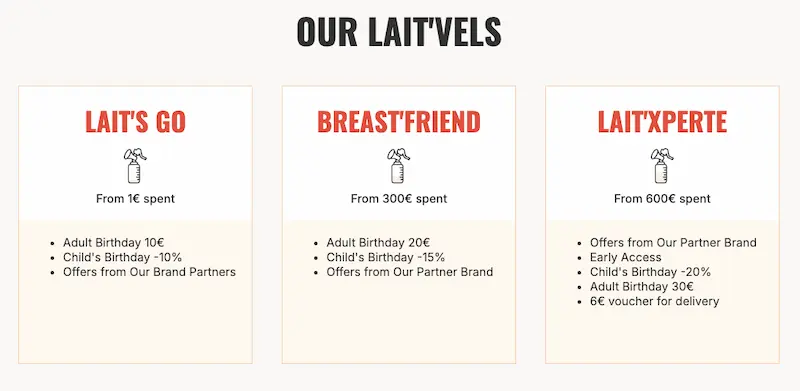
Tiered VIP programs: when you are ready to level up
Once your base program runs for a few months, consider adding VIP tiers. This is where things get interesting for small brands. Tiers create aspiration and exclusivity, two powerful psychological drivers.
Loyoly recommends sizing your tiers like this: Bronze covers 60-75% of your customer base, Silver 20-30%, and Gold 5-10%. Gold members should generate 20-30% of your loyalty-driven revenue. This creates a natural pyramid where your most engaged customers feel genuinely special.
Referral programs: your lowest-cost acquisition channel
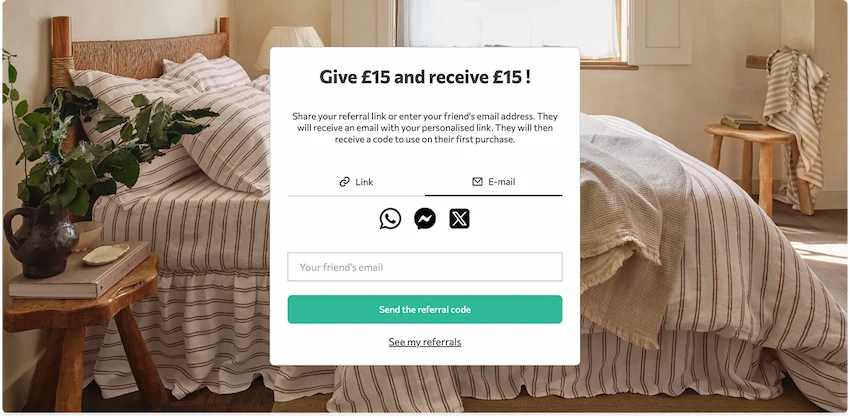
A referral program turns every happy customer into an acquisition channel. The conversion rates are remarkable: across industries, 30-40% of referred prospects make a first purchase (Loyoly Benchmark, 2025). Compare that to a 2-3% conversion rate on paid ads.
For small brands with AOV under 50 euros, coupon codes work best as referral rewards. For higher AOV brands, vouchers encourage bigger baskets. A good starting point is 10 euros for both the referrer and the referee. Then adjust based on your margins.
Pssst... You might find this interesting!
Loyalty programs are strategic for your brand and we can probably help. Discover our platform!
How to calibrate rewards without destroying your margins
This is where most small brands either get too generous and bleed money, or too stingy and get zero engagement. The sweet spot depends on your sector and your gross margin.
Cashback rates by sector
Here are the recommended cashback equivalents based on industry benchmarks. These represent the effective discount a customer gets when they redeem loyalty points.
Fashion and clothing: 5 to 10%. Beauty and care: 6 to 12%. Home and decoration: 7 to 12%. Food and beverage: 2 to 5%. Health and supplements: 5 to 15%. Sport and fitness: 5 to 15%.
The rule of thumb: your cashback rate should stay below your net margin. If you are running on 20% net margin, a 10% cashback is sustainable because the customer who redeems is already a repeat buyer with near-zero acquisition cost.
First reward: the critical threshold
Your first reward should be reachable within roughly one month of a customer's first purchase. Set it just above what a customer can earn without buying again (account creation + social follows + one review). This creates a natural incentive to place that second order.
If your sign-up bonus is 100 points and social actions give another 100, set your first reward at around 250-300 points. The customer needs one purchase to unlock it. Simple, clean, motivating.
The mission value ladder
Not all engagement actions are equal, and your point values should reflect that. Low-effort actions like following on social media should earn few points. High-value actions like posting a product review or creating UGC should earn significantly more.
A product review is worth roughly half the points needed for the first reward. A birthday gift can equal the full first reward threshold, since it only triggers once per year. The goal is to create a progression that feels fair and motivating.
5 engagement mechanics that actually work for small brands
Points on purchases are table stakes. What separates high-performing loyalty programs for small businesses from basic ones is what happens between purchases. Here are five mechanics that drive measurable results.
Product reviews for social proof
Loyoly's Industry Report reveals that 59% of consumers are willing to leave a positive review in exchange for a reward. That is the highest-performing engagement mechanic across all categories. For small brands that desperately need social proof, this is gold.
Set generous point values for reviews. A customer who just bought from you and writes a review is already engaged. Make it worth their while, and you stack social proof while keeping them active in your program.
User-generated content to fuel your marketing
Rewarding customers for posting photos or videos of your products creates a library of authentic content you can reuse across ads, social, and product pages. 12% of consumers say they are willing to send photos or videos to a brand in exchange for rewards. That might sound small, but for a brand with 5,000 customers, it means 600 pieces of original content.
.webp)
Social media engagement for visibility
Likes, follows, shares, story reposts. These are low-effort actions that expand your organic reach. 27% of consumers are willing to interact on social media for rewards. The key is to not over-reward these. Keep point values low and use them as stepping stones toward the first redemption.
Referrals for acquisition
We covered this above, but it is worth emphasizing: referral programs consistently deliver the best ROI of any acquisition channel for small brands. A referral conversion rate between 30-40% is typical. Fashion brands lead with a 41.5% conversion rate.
The trick is making the sharing process frictionless. One-click referral codes, shareable links, and clear communication about what both parties get.
Account creation and profile completion
The welcome bonus is your foot in the door. Offer roughly half the points needed for the first reward upon account creation. This gives new customers immediate progress and a tangible reason to explore the program.
But here is the fine print: make sure the total points from sign-up plus social actions do not exceed the first reward threshold. Otherwise, customers get free rewards without ever buying.
What does the ROI of a small business loyalty program actually look like?
Let us talk numbers. Because if you cannot justify the investment, none of the strategy matters.
Loyoly's Benchmark (2025) measured monthly ROI across 600+ brands by dividing incremental revenue from the loyalty program by total program costs (software plus reward costs). Here is what they found.
ROI by sector
Sport and fitness leads with a monthly ROI of 23.2x. Home and decoration follows at 20.4x. Petcare at 19.7x. Health and supplements at 18.2x. Fashion at 16.8x. Food and beverage at 14.4x. Beauty and wellness at 11.5x.
Even the lowest-performing sector delivers over 11x return. For a small brand spending 100-200 euros per month on a loyalty platform, that means 1,150 to 4,640 euros in incremental revenue. Monthly.
Impact on key business metrics
The performance gap between engaged and non-engaged customers is striking. In fashion, engaged members place 41% more orders with a 12.5% higher AOV, resulting in 60% higher LTV. In health and supplements, orders increase by 31%, AOV by 26%, and LTV by 67%.
For small brands, these lifts are transformative. A 30-60% LTV increase on your existing customer base can fund your entire growth strategy.
How to launch your loyalty program in 5 steps
You have the strategy. Now here is the implementation roadmap, designed for small teams with limited technical resources.
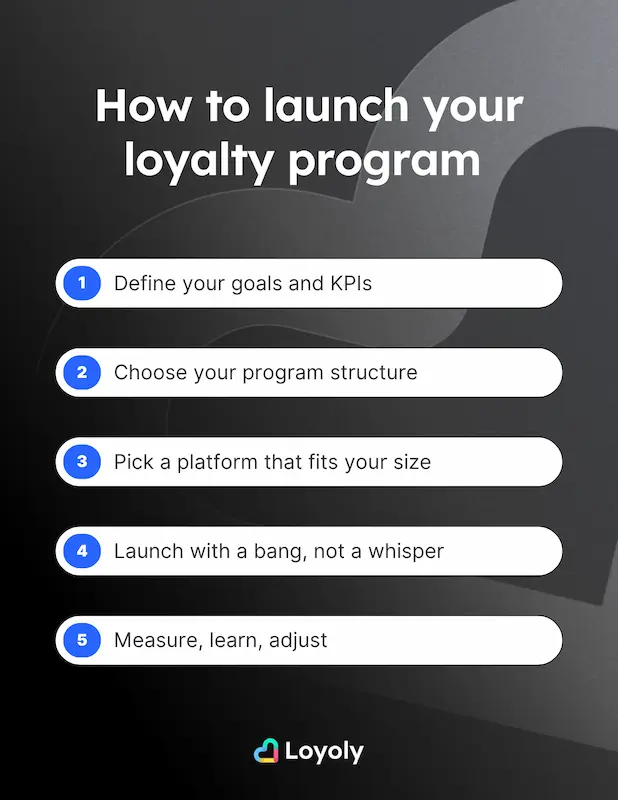
Step 1: Define your goals and KPIs
Before touching any software, write down what success looks like. Is it repeat purchase rate? Average order value? Referral-driven new customers? Pick two or three core KPIs and set realistic targets based on the benchmarks above.
For most small brands, the primary goal is increasing purchase frequency. Secondary goals usually involve generating reviews and referrals.
Step 2: Choose your program structure
Start with a points-based program. Add 3-5 earning actions: purchases, account creation, product reviews, social follow, and referrals. Set your point values using the calibration guidelines above. Keep it simple enough that a customer understands the program in under 30 seconds.
Step 3: Pick a platform that fits your size
You need a loyalty platform that integrates with your ecommerce stack and does not require a developer to configure. Look for these non-negotiables: Shopify or PrestaShop integration, customizable widget, referral functionality, and review collection. Avoid platforms that charge per transaction at scale. That pricing model kills small brands as they grow.
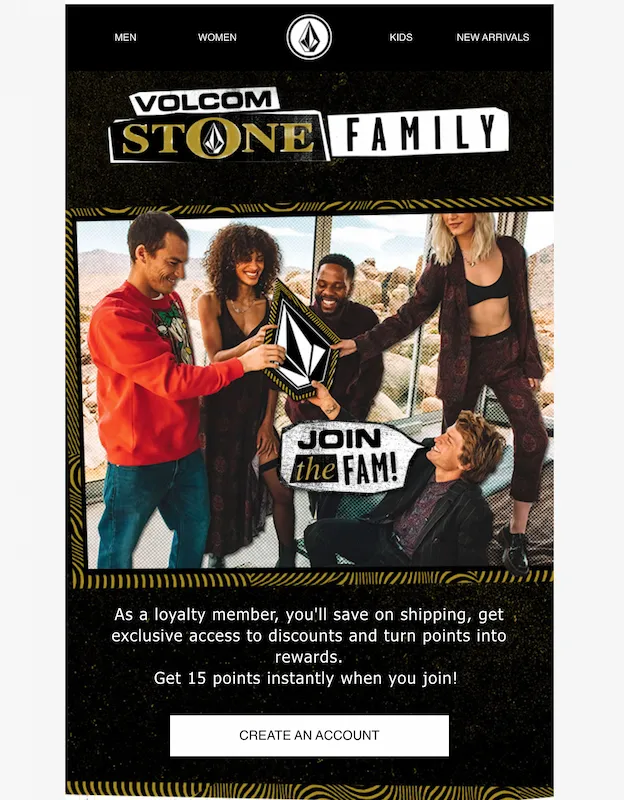
Step 4: Launch with a bang, not a whisper
Send a dedicated email campaign to your entire customer base. Offer a limited-time sign-up bonus (double points for the first week, for example). Feature the program prominently on your homepage, product pages, and checkout. The first 30 days determine whether your program gains traction or fizzles out.
Step 5: Measure, learn, adjust
After the first month, check your activation rate (the percentage of orders including a loyalty reward). Industry averages range from 3.3% to 5.7% depending on sector. If you are below 3%, your rewards are either too hard to reach or not attractive enough. If you are above 6%, you might be too generous. Adjust and iterate.
3 mistakes that sink loyalty programs for small businesses
Knowing what to do is only half the battle. Here are the pitfalls that trip up most small brands, and how to avoid them.
Making the program too complex
If a customer needs to read a FAQ to understand how your program works, you have already lost them. Stick to one earning mechanic (points) and one primary redemption type (discounts or vouchers) at launch. You can always add complexity later. 71% of consumers want immediate discounts on purchases, so start with what works.
Ignoring non-transactional engagement
A program that only rewards purchases misses the biggest opportunity. In Loyoly's data, brands that activate engagement mechanics like reviews and UGC see their members' LTV increase progressively. In beauty, purchase frequency doubles after just three completed missions. If your program is points-on-purchase only, you are leaving ROI on the table.
Setting and forgetting
A loyalty program is not a set-it-and-forget-it tool. The best-performing programs run seasonal bonus point events, refresh their reward catalog regularly, and communicate with members at least once per month. Loyoly's Industry Report shows that 39% of consumers are happy to receive brand communications at least once per week. Silence kills engagement faster than over-communication.
To sum up: a loyalty program for small business is not a luxury. It is the most efficient lever to increase repeat purchases, generate social proof, and reduce acquisition costs. Start with a simple points program, calibrate rewards to your margins, and expand with engagement mechanics like reviews, UGC, and referrals. The data is clear: even the smallest ecommerce brands see double-digit ROI from day one.
If you are running a small ecommerce brand and wondering where to start, focus on three things: a fair points-per-euro ratio aligned with your sector, a first reward reachable within one month, and at least two non-purchase earning actions (reviews and referrals). That foundation alone will outperform 90% of the loyalty programs competing for your customers' attention. Loyoly can help you set all of this up in days, not months.
FAQ
How much does a loyalty program cost for a small business?
Most loyalty platforms start between 79 and 199 dollars per month for small businesses. Add the cost of rewards (typically 2-10% of loyalty-driven revenue). The average monthly ROI across sectors is 11x to 23x, which means the program pays for itself many times over within the first month.
Do loyalty programs work for brands with low purchase frequency?
Yes, and arguably they matter even more. Brands with low purchase frequency (home decor, fashion) see some of the highest LTV lifts: +60% in fashion and +117% in home and decoration. The program keeps your brand top-of-mind between purchases and gives customers a reason to return sooner.
What is the best type of reward for a small ecommerce brand?
Vouchers and discount codes are the most effective. 71% of consumers rank discount vouchers as their most desired reward, followed by free products at 57%. Start with percentage-based discounts tied to your AOV, then test free product rewards for higher tiers.
How many engagement mechanics should I start with?
Start with 3 to 5 earning actions. Purchases, account creation, and product reviews are the essential three. Add a social media follow and a referral mechanic if your platform supports them. You can always expand later based on what drives the best results.
Can I run a loyalty program on Shopify without a developer?
Absolutely. Modern loyalty platforms like Loyoly integrate natively with Shopify and require zero coding. You can set up a full points program with rewards, referrals, and engagement missions using a visual interface. Most brands go live within a week.
What activation rate should I target for my loyalty program?
Industry benchmarks range from 3.3% (home and decoration) to 5.7% (beauty and wellness). If your activation rate is below 3% after the first month, review your reward thresholds and communication frequency. If it is above 6%, verify that your reward economics are sustainable.
.webp)