
.png)


The ecommerce world has transformed from simple digital storefronts into smart, intelligent ecosystems.
By 2026, artificial intelligence isn't a "nice-to-have" feature. It's the core infrastructure separating market leaders from stagnating brands.
For B2B and B2C merchants alike, the challenge goes beyond just generating traffic. It's about maximizing the value of every interaction through precision and automation.
We've tested and analyzed the leading solutions to bring you this ranking of the best AI tools for ecommerce.
How AI is revolutionizing ecommerce
Artificial intelligence has fundamentally altered how online retail operates.
We're witnessing a shift from reactive management to predictive execution, where machine learning algorithms process massive datasets to automate complex decisions in real time.
The impact is measurable: businesses deploying advanced AI strategies typically see efficiency gains of 30-40% in operational workflows and major uplifts in customer lifetime value (LTV).
Enhancing customer experience and personalization
Modern consumers demand hyper-relevance. The new standard is a dynamic interface that adapts to user behavior instantly. AI-driven personalization engines analyze clickstreams, purchase history, and browsing dwell time to curate unique product feeds for every visitor. This goes beyond simple "frequently bought together" widgets, it involves predictive modeling that anticipates a user's next need before they explicitly search for it.
In the post-purchase phase, which is often neglected, personalization becomes a critical retention driver. Loyoly stands out in this domain by transforming the transactional aftermath into an engaging journey. By using over 40 different engagement mechanics (such as gamified challenges, UGC rewards, and tiered loyalty incentives) Loyoly creates personalized post-purchase experiences that resonate with individual customer preferences. This approach turns a single transaction into a recurring revenue loop.
Optimizing marketing and content generation
Content creation has historically been a bottleneck for scaling ecommerce brands. Generative AI has dissolved this constraint, allowing marketing teams to produce SEO-optimized text and visual assets at scale. Large Language Models (LLMs) can now generate thousands of unique product descriptions, blog posts, and ad variations in the time it took to write one.
This capability extends to visual content and strategic copy. AI tools can now A/B test ad copy variations in real time, allocating budget to the highest-performing assets without human intervention.
- Automated Copywriting: Generating on-brand product narratives
- Visual Synthesis: Creating lifestyle imagery from product shots
- Dynamic Email Content: Tailoring subject lines and send times to individual user habits
For teams looking to sharpen their visual generation workflows, structured resources like nano banana prompts can help marketers craft more precise inputs and get consistent, on-brand outputs faster.
Streamlining operations and inventory management
Operational efficiency is where AI protects the bottom line. Predictive analytics models ingest historical sales data, seasonality trends, and even weather patterns to forecast inventory requirements with high precision. This reduces the capital trapped in overstock and minimizes revenue lost to stockouts.
In the realm of content operations, speed is currency. For example, Blym exemplifies this operational shift by generating SEO-optimized content in minutes. Instead of a multi-week editorial process, brands can deploy comprehensive, keyword-rich articles and product pages rapidly, ensuring they capture search intent as trends emerge. This agility allows lean teams to compete with enterprise-level content outputs.
Driving data-driven decisions and analytics
The volume of data generated by ecommerce platforms is overwhelming without intelligent interpretation. AI transforms raw metrics into actionable insights. Advanced analytics platforms now offer "anomaly detection," alerting merchants to issues like checkout failures or sudden traffic spikes instantly.
Crucially, the quality of decision-making depends on the quality of data. Loyoly empowers brands by aggregating zero-party and first-party data directly from customer interactions. This clean, consented data makes possible highly accurate data-driven customer journey decisions, allowing brands to segment audiences based on actual engagement rather than assumed demographics. When paired with visualization tools like Polar Analytics, which helps in making sense of data in minutes through unified dashboards, merchants can pivot strategies based on real-time performance indicators rather than lagging monthly reports.
Top AI tools for ecommerce in 2026
Selecting the right technology stack is critical. We've evaluated these tools based on their ability to deliver measurable ROI, their integration capabilities, and the sophistication of their AI models.
Loyoly
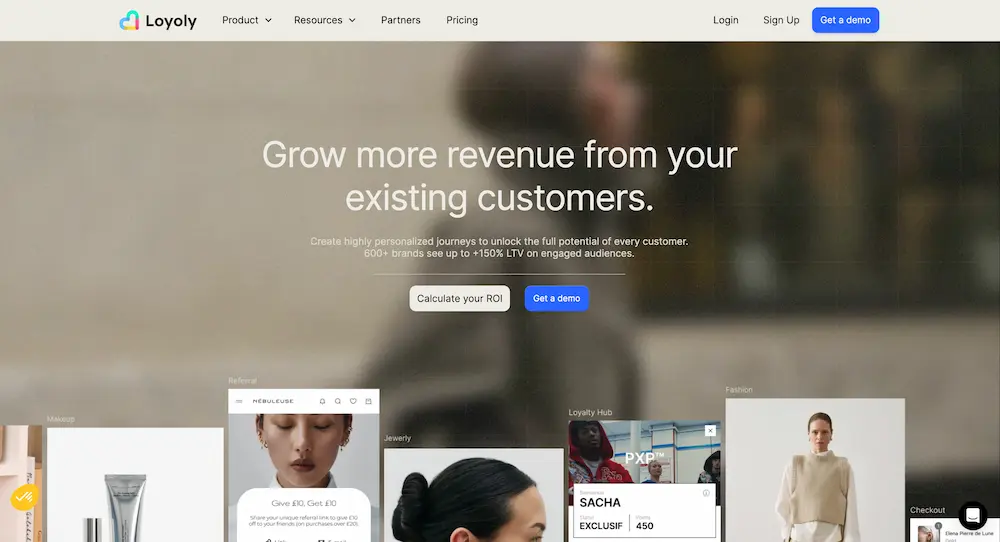
What is Loyoly?
Loyoly is a leading post-purchase engagement platform designed to transform one-time buyers into loyal brand advocates. Unlike traditional loyalty programs that rely solely on points-for-purchase, Loyoly orchestrates a complete customer journey using gamification and social engagement. It helps ecommerce brands significantly reduce Customer Acquisition Costs (CAC) by boosting retention and generating authentic User-Generated Content (UGC) at scale.
AI features of Loyoly
Loyoly uses advanced algorithms to automate and personalize the retention loop:
- Smart Segmentation: The platform analyzes customer behavior to trigger specific engagement mechanics (e.g., a review request vs. an Instagram contest) based on the user's likelihood to engage
- Predictive Engagement: It identifies the optimal moments in the customer journey to incentivize actions, maximizing participation rates
- Automated Reward Validation: AI vision and text analysis verify social media tasks (like tagging the brand in a story) to automate reward distribution without manual checks
Pricing
Pricing starts at $99/Month and varies based on the number of monthly orders
Invideo

What is invideo?
Invideo is an AI video generation tool built for ecommerce teams that need to turn ideas, scripts, and product content into high-performing visuals quickly.
It simplifies video creation with prompt-based workflows, making it easy to produce ads, social content, and campaign assets without the usual production overhead.
It also supports AI-driven image creation, allowing teams to generate visuals alongside videos without switching tools.
AI features of invideo
- AI Video Generation: Convert text prompts, blog content, or product descriptions into fully edited videos with scenes, transitions, and voiceovers
- Automated Editing: Smart scene selection, media matching, and transitions reduce manual editing effort
- AI Voiceovers & Scripts: Generate scripts and realistic voiceovers in multiple languages and tones
- Visual Content Creation: Create images and video assets from prompts, helping brands scale creatives for ads and campaigns
Pricing
Free plan available with limited exports and featuresPaid plans starts at $17/month (Plus) for basic usage and scales to $900/month (Elite) for advanced creators.Mid-tier plans like Max ($85/mo) and Generative ($170/mo) offer higher credits and better value.
Wisepops
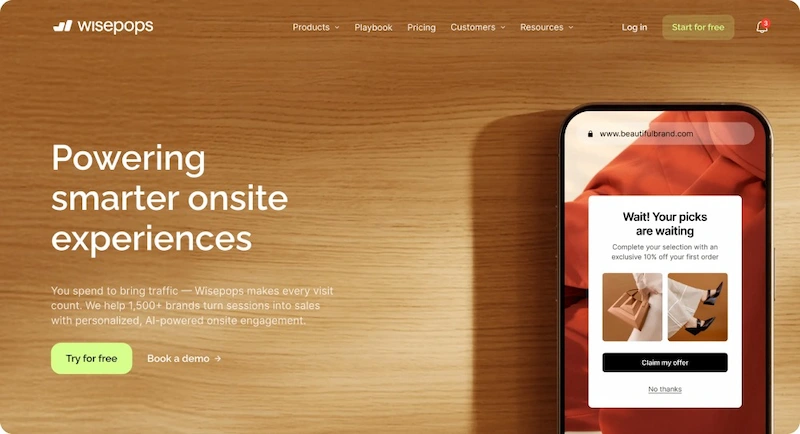
What is Wisepops?
Wisepops is an on-site marketing platform dedicated to growing email and SMS lists and boosting conversion rates. It allows brands to create intelligent popups, bars, and embeds that appear at the right time without disrupting the user experience and helps them maximize the value of their existing traffic.
AI features of Wisepops
- AI Wishlist: Automatically detects products a user has shown interest in and displays them in a notification stream to trigger purchase intent
- Smart Targeting: Uses machine learning to determine the optimal timing and frequency for displaying popups to avoid "popup fatigue" while maximizing sign-ups and sales
- Generative Text: Built-in AI writing assistants help craft high-converting headlines and CTA copy for campaigns
Pricing
Pricing starts at $49/month and varies based on traffic (page views)
Allo
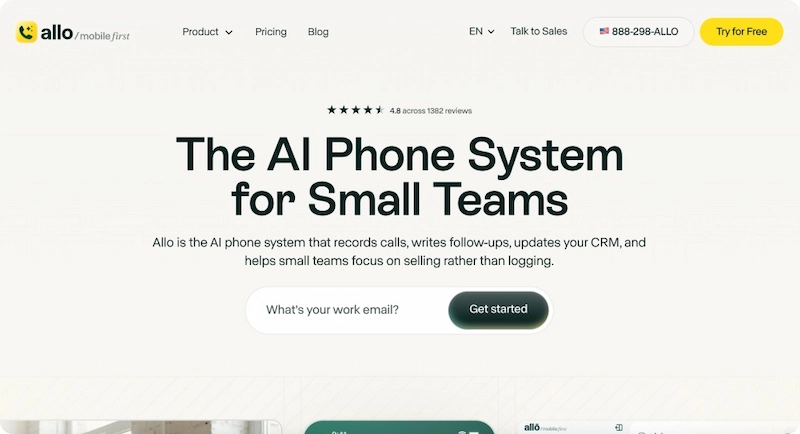
What is Allo?
Allo is an AI-powered VoIP service that helps ecommerce brands reduce the number of calls they have to handle themselves, keep a track of every call (transcript and summary), and sync their communications with Shopify.
AI features of Allo
- AI answering service: Allo's AI can handle your calls when you're too busy to hang up. It can take messages, route the call to the right person on your team, or answer common questions directly.
- AI-generated summaries: Allo records your calls automatically and uses them to generate call notes and summaries.
- AI Assistant: Allo lets you ask questions and reply using your call notes.
Pricing
Pricing starts at $25/month.
Weglot
What is Weglot?
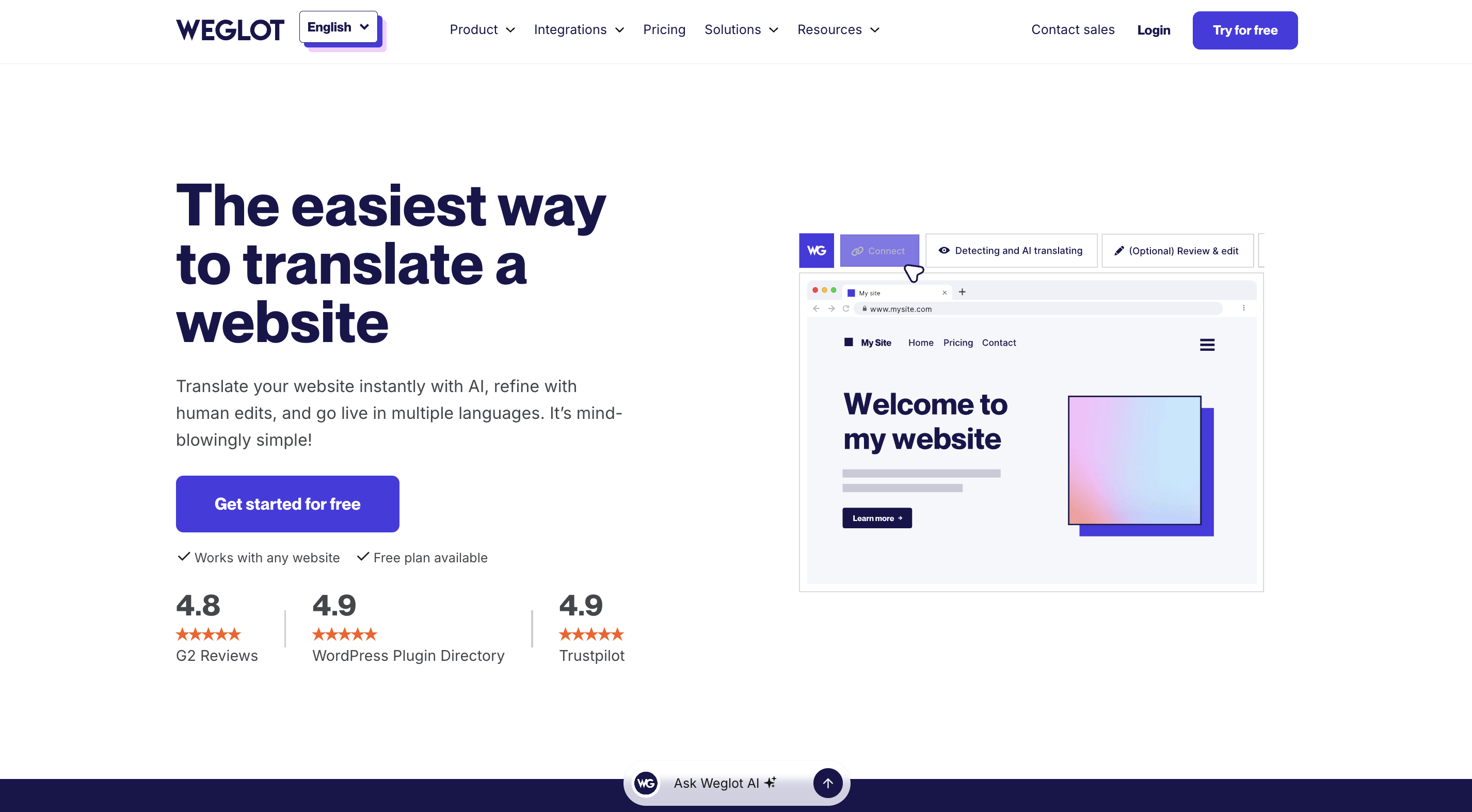
Weglot is an AI-powered website translation solution that automatically detects your website's content, translates it, and displays it live for visitors, no coding required. The first layer of translation is generated by leading engines like DeepL, Microsoft, and Google, and can be easily refined by human editors until the desired quality is achieved. Weglot also features an AI Language Model powered by OpenAI and Gemini for even more contextually accurate, brand-consistent translations.
AI features of Weglot
- AI-Powered Translation: Uses leading machine translation engines such as DeepL, Google, and Microsoft, enhanced with AI language models powered by OpenAI and Gemini to produce context-aware, brand-consistent translations.
- Automatic Content Detection & Sync: Automatically detects all website content (including dynamic elements) and continuously syncs new or updated pages to ensure translations stay up to date.
- Multilingual SEO Optimization: Automatically creates SEO-friendly translated pages with optimized URLs, hreflang tags, and metadata to help multilingual content rank in search engines.
Pricing
Pricing starts at €15/month, with a 14-day free trial and a free plan available.
GPTZero

What is GPTZero?
GPTZero is an AI detector that helps ecommerce brands verify whether written content reads as human-generated. As stores scale their use of AI to produce product descriptions, blog posts, and category pages, GPTZero serves as the quality control layer that flags content reading as overly machine-written, helping brands protect their search visibility in an era where SERP quality signals increasingly penalize obvious AI output.
AI features of GPTZero
- Multi-Model Detection: Identifies content generated by major large language models including ChatGPT, Claude, Gemini, and GPT-4, covering the tools most commonly used to produce ecommerce content at scale
- Sentence-Level Highlighting: Pinpoints the specific sentences that read as AI-generated, so editors can revise only the problem sections rather than rewriting entire product pages or articles
- Bulk Scanning & API: Supports batch document uploads and offers an API to plug detection directly into existing content review workflows, useful for brands publishing high volumes of pages
Pricing
Pricing starts at $14.99/month, with a free tier available for limited monthly scans.
Reteno
What Is Reteno?
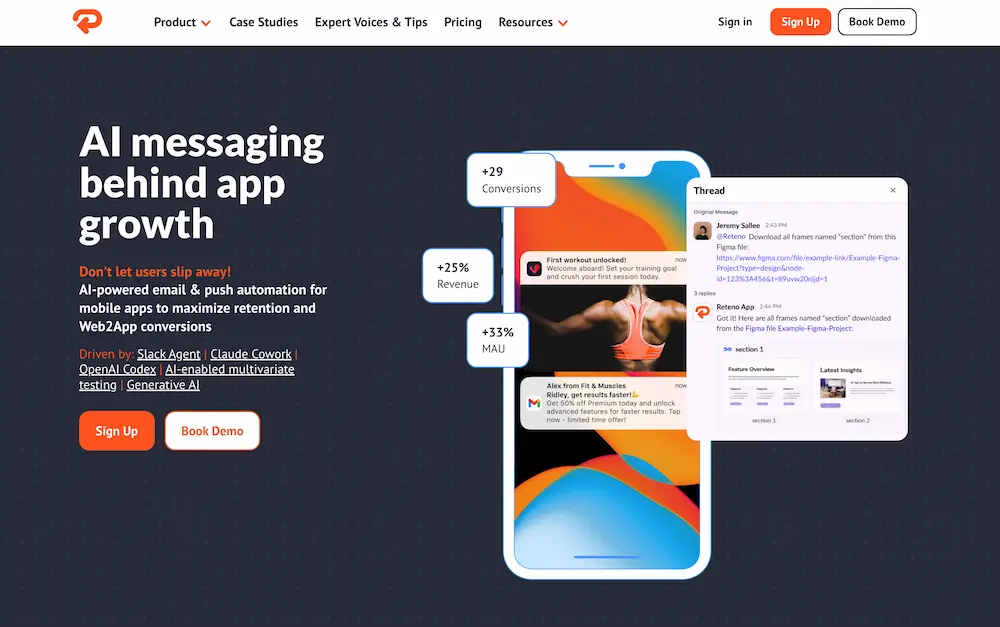
Reteno is an AI messaging platform for mobile app retention and conversion, built for subscription-driven apps that need faster execution and stronger lifecycle performance. The platform supports email, mobile push, in-app, App Inbox, SMS, web push, and messengers across Web2App, direct install, trial, and freemium funnels. Teams can manage messaging through AI agents in Slack, Claude Cowork, and OpenAI Codex, then use the built-in AI and One from Many feature to generate content, automate testing, and automatically optimize message variants.
AI Features of Reteno
- Agent-based execution. The Reteno agent for Slack and the Reteno plugins for Claude Cowork and OpenAI Codex connect directly to a Reteno account, allowing marketers to use natural language to manage templates, contacts, segments, events, and analytics.
- AI -powered messaging. Reteno also applies AI directly inside message production. In the email editor, AI can translate, correct, and optimize text inside message blocks, as well as subject lines and hidden preheaders. For mobile push, AI generation is available inside the One from Many workflow block, where teams can create new variants and expand test coverage without manually rebuilding every message. This supports a more continuous approach to experimentation and localization.
Pricing
Free Startup plan. Growth plan: $30-$750 per month, depending on the number of user profiles. Enterprise plan: custom pricing tailored to your messaging volume.
Blym
What is Blym?
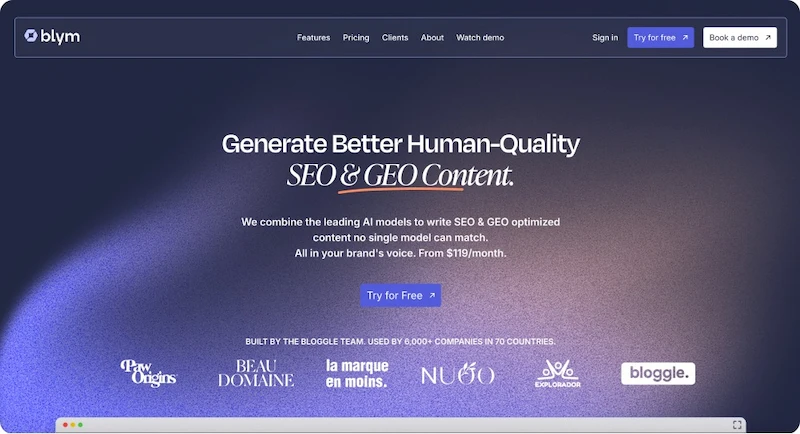
Blym is a specialized AI content generator designed for ecommerce SEO. It automates the creation of blog posts and articles that are structurally optimized for search engines. It helps brands build topical authority and drive organic traffic without the high costs of a large content team.
AI features of Blym
- SEO-First Generation: The AI is trained on ranking factors, making sure that generated content includes proper heading structures, keyword density, and semantic relevance
- Auto-Linking: It intelligently suggests and inserts internal links to product pages within the blog content to drive commercial value from informational searches
- Trend Analysis: Analyzes search trends to suggest content topics that have high traffic potential and low competition
Pricing
Pricing starts at $149/month.
Polar Analytics
What is Polar Analytics?
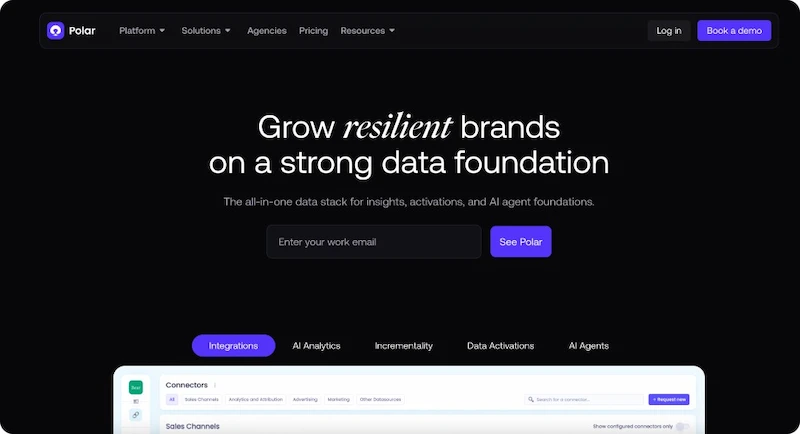
Polar Analytics is a business intelligence platform that unifies data from Shopify, Amazon, marketing channels (Meta, Google, TikTok), and finance tools into a single source of truth. It helps ecommerce brands eliminate manual spreadsheets and gain accurate visibility into their unit economics and profitability.
AI features of Polar Analytics
- Smart Alerts: AI algorithms monitor KPIs across all channels to flag inefficiencies, such as rising CAC on a specific ad platform or declining LTV for a specific cohort
- Predictive Forecasting: Uses historical data to project future revenue and inventory needs, aiding in cash flow management
- Automated Insights: Generates daily briefings on business health, highlighting the most impactful metrics requiring attention
Pricing
Polar doesn't share their pricing publicly.
Klaviyo

What is Klaviyo?
Klaviyo is the industry-standard intelligent marketing automation platform for email marketing and SMS. It stores all customer data in a single profile to power highly targeted communications. It helps brands own their customer relationships and drive revenue through automated flows.
AI features of Klaviyo
- Predictive Analytics: Forecasts the next order date, churn risk, and lifetime value for individual customers
- Subject Line AI: Generates and tests subject lines to maximize open rates based on historical performance data
- Smart Send Time: Automatically determines the specific time each recipient is most likely to open an email
Pricing
Pricing starts at $45/month and varies based on the active subscriber count and number of messages sent.
Google Nano Banana

What is Nano Banana?
Nano Banana is Google's AI image generation tool. It can help ecommerce marketers generate or edit existing images in just a few prompts.
AI features of Nano Banana
- Natural Language Editing: You can upload a photo and simply type "change the shirt to blue" or "add a sunset" without needing to manually mask or select areas.
- Multi-Image Fusion: It can blend up to 14 different photos into one seamless composition (e.g., placing a specific product into a specific room).
Pricing
Nano Banana is included for free in Google Gemini.
Magichour AI

What is Magichour?
Magichour is an AI talking photo platform that transforms static images into realistic talking portraits using advanced facial animation, lip-sync technology, and AI-generated speech. Designed for creators, marketers, educators, and businesses, it makes it easy to produce engaging videos without cameras, actors, or professional editing software.
The platform converts photos into lifelike videos by synchronizing facial expressions and mouth movements with audio, making it ideal for social media content, product promotions, educational materials, personalized messages, and digital storytelling. With a browser-based workflow, users can generate professional-quality talking photos in just a few clicks.
AI Features of Magichour
- AI Talking Photo: Animate static photos with realistic facial expressions, natural lip sync, and AI-powered speech.
- Text-to-Speech & Voice Support: Convert written text into lifelike narration or upload custom audio for personalized talking videos.
- AI Lip Sync: Synchronize spoken audio with realistic mouth movements for natural-looking results.
- Image-to-Video Generation: Turn still images into dynamic videos with smooth camera motion and cinematic effects.
- All-in-One AI Video Suite: Access additional tools including face swap, AI video generation, text-to-video, and AI image editing from a single platform.
Pricing
Magichour offers a Free plan to get started with its AI creative tools. Paid plans start at $15/month (or $10/month billed annually)
Key considerations for implementing AI tools in ecommerce
Adopting AI solutions is a strategic infrastructure change, not just a software purchase. As brands rush to integrate these tools, careful due diligence is required to maintain long-term viability and performance.
Assessing business needs and goals
Before evaluating specific tools, brands must conduct a gap analysis of their current operations. Is the primary bottleneck traffic acquisition, conversion rate, or customer retention? Implementing a tool like Blym makes sense if organic traffic is the weakness, whereas Loyoly is the strategic choice if LTV and community building are the priorities. Define the specific KPI you intend to move, whether it's reducing support ticket volume or increasing repeat purchase rate, and select the tool that directly impacts that metric.
Budget, ROI, and scalability
The cost of AI tools must be weighed against their direct impact on revenue. "Cool" features don't justify a monthly subscription; measurable outcomes do. Brands should look for platforms that offer transparent attribution.
Seamless integration with existing systems
An AI tool is only as good as the data it can access. Siloed tools create fragmented customer experiences. Make sure that any new addition to the tech stack integrates natively with your primary ecommerce platform (Shopify, Magento, BigCommerce) and your CRM (Klaviyo, Attentive).
- API Availability: Does the tool offer a robust API for custom connections?
- Data Sync: Is data transfer real-time or batched? Real-time is essential for personalization
- Workflow Compatibility: Does the tool fit into existing team workflows, or does it require a complete operational overhaul?
Data privacy, security, and compliance
With AI relying heavily on customer data, privacy is non-negotiable. Strict adherence to GDPR, CCPA, and emerging AI governance laws is mandatory. Staying updated with software supply chainsecurity news is also becoming increasingly important as businesses adopt more AI tools, third-party integrations, and cloud-based infrastructure that may introduce new security and compliance risks.
- Data Sovereignty: Know where your customer data is stored and processed
- Consent Management: Make sure the AI tool respects user consent signals (e.g., cookie preferences)
- Zero-Party Data: Prioritize tools that use zero-party data (data customers intentionally share), as this is compliant by design and highly accurate
User experience and support
The sophistication of the backend shouldn't result in a complex frontend. The best AI tools offer intuitive interfaces that marketing and operations teams can use without engineering support. Look for platforms that provide:
- Onboarding: Structured implementation programs to make sure setup is correct
- Documentation: Complete guides and developer docs
- Human Support: Access to technical support teams, not just chatbots, when critical issues arise
Frequently asked questions about AI tools for ecommerce
Which AI is best for eCommerce?
There's no single "best" AI, as the choice depends on the specific business function. For post-purchase engagement and retention, Loyoly is the top-rated solution due to its gamification and data capabilities. For email marketing, Klaviyo remains the industry standard, while Polar Analytics is best for business intelligence and data visualization.
How is AI used in eCommerce?
AI is used across the entire value chain, from predictive inventory management and dynamic pricing in operations to personalized product recommendations and generative content creation in marketing. It also powers customer service through intelligent chatbots and improves security via fraud detection algorithms.
What is the best AI tool for sales?
For driving direct sales through conversion optimization, Wisepops is highly effective for on-site capture. However, for long-term sales growth through increased Customer Lifetime Value (LTV), Loyoly provides the best infrastructure to turn one-time buyers into repeat customers.




.webp)