

.png)


Most ecommerce brands track engagement. Very few understand what they are actually measuring, and even fewer build a strategy around it that moves revenue.
Customer engagement is not a vanity metric. It is a direct predictor of repeat purchase rate, average order value, and long-term LTV. Get it right, and your best customers become your cheapest acquisition channel. Get it wrong, and you are burning budget trying to win back customers you never really had in the first place.
This guide breaks down what customer engagement really means in ecommerce, why it matters at the P&L level, and exactly how to build a strategy around it in 2026.
What customer engagement really means in ecommerce
Customer engagement is the ongoing emotional and behavioral relationship between a customer and a brand. It goes well beyond a purchase. It includes every meaningful interaction, before, during, and after the transaction, that deepens the connection a shopper has with your brand.
A customer who buys once is not an engaged customer. A customer who buys, leaves a review, refers a friend, and comes back three months later because they feel a genuine affinity with your brand: that is what engagement looks like in practice.
More than clicks and open rates
Email open rates and site sessions are activity metrics, not engagement metrics. Engagement measures the quality of the interaction, not just the volume.
A customer who opens every email but never buys is not engaged. A customer who ignores your newsletters but reorders every six weeks, shares your product on Instagram, and refers two friends is one of your most valuable assets, and they deserve to be treated differently.
The distinction matters for how you build your strategy. Chasing surface-level metrics leads to over-communication and list fatigue. Building for genuine engagement leads to retention, advocacy, and compounding lifetime value.
Transactional vs relational engagement
There are two layers of engagement worth understanding: transactional and relational.
Transactional engagement is purchase-driven: repeat orders, higher AOV, reward redemptions, referrals with a financial incentive. It is measurable and directly tied to revenue.
Relational engagement is affinity-driven: leaving a review voluntarily, sharing UGC, joining a community, advocating for the brand without being prompted. It is harder to quantify but exponentially more valuable, because it is the foundation of word-of-mouth and organic growth.
The best customer engagement strategies cultivate both layers simultaneously. Transactional mechanics create the habit of returning. Relational mechanics create the identity of belonging. You need both to build something that compounds.

Why customer engagement directly impacts your P&L
Engagement is not a marketing feel-good concept. It is a financial lever with measurable, predictable ROI.
Loyoly's 2026 Loyalty Benchmark analyzed data from 600+ ecommerce brands to measure the performance delta between engaged customers (those who used at least one reward or completed at least one engagement mechanic) and non-engaged customers. The results are consistent across every sector and every market.
The business impact by sector
Here is what the data shows when comparing engaged vs non-engaged customers over a 90-day window:
These are not projections or modeled estimates. These are real performance deltas measured on Loyoly's platform across 600+ active brands. The takeaway is hard to argue with: customer engagement is your most reliable path to LTV growth.
The hidden cost of disengagement
Disengaged customers are expensive in ways that do not always show up clearly on your dashboard. Acquiring a new customer costs five to seven times more than retaining an existing one. When a customer drops off after their first purchase, you have absorbed the full CAC without capturing the LTV you modeled.
According to Loyoly's 2025 Industry Report, which surveyed 1,016 French consumers, 30% say that a loyalty program that fails to reward them adequately is a direct reason for disengaging from a brand. That number is up 3 points year over year. And it represents a fully preventable churn driver.
The real cost of disengagement is not just lost revenue from one customer. It is the compound effect of customers who could have referred friends, left reviews, and built your brand's social proof, but never received a compelling enough reason to do so.
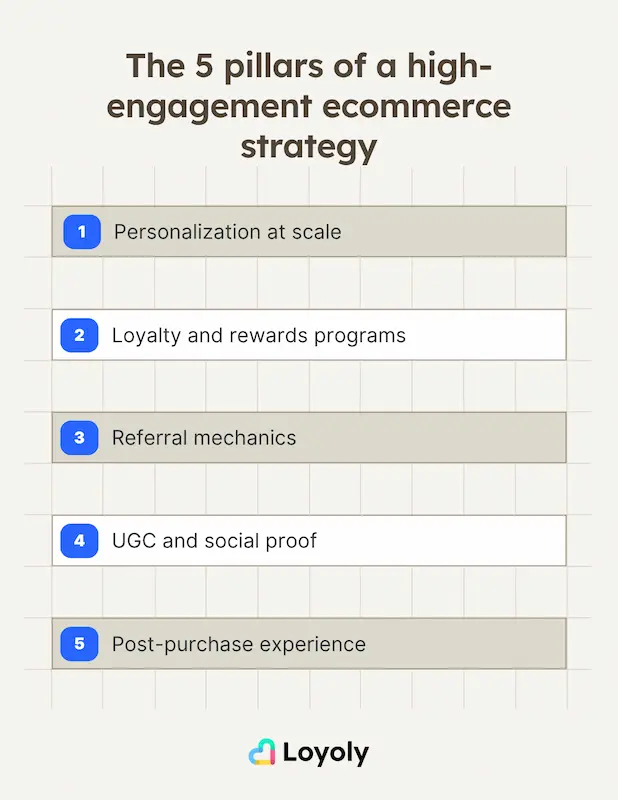
The 5 pillars of a high-engagement ecommerce strategy
Building customer engagement in ecommerce is not about doing more. It is about doing fewer things with more intention, more consistency, and a clear value exchange at every touchpoint.
1. Personalization at scale
Personalization is now the baseline expectation, not a competitive advantage. Loyoly's 2025 Industry Report found that 68% of consumers expect more relevant and tailored communications from the brands they interact with regularly.
The key word is relevant. Generic product recommendations based on broad category behavior are not enough. Personalization that drives engagement is behavior-based: it adapts to what a specific customer has done, when they did it, and what stage of the relationship they are in.
In practice, this means segmenting post-purchase flows by first-order category, adjusting loyalty communications based on points balance and VIP tier, and targeting re-engagement campaigns at customers who are 60 to 90 days away from churning. Our detailed guide to ecommerce personalisation breaks down what this looks like in execution.
2. Loyalty and rewards programs
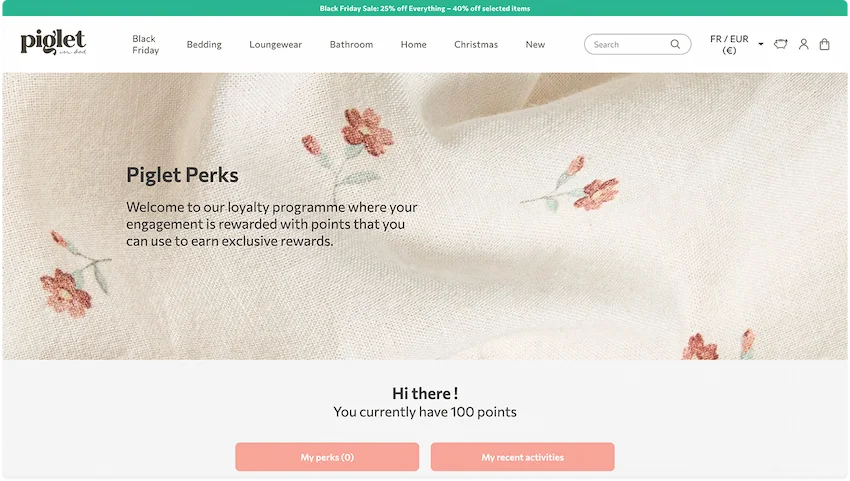
A well-built loyalty program is the single most powerful engagement infrastructure an ecommerce brand can put in place. It creates recurring touchpoints, rewards behavioral depth, and gives customers a concrete reason to choose you over a competitor selling a near-identical product.
According to Loyoly's 2025 Industry Report, 23% of consumers say a compelling loyalty program is one of the main reasons they return for a second purchase. That figure is up 10 points compared to first-purchase drivers. Loyalty programs do not just retain customers, they create the habit of returning.
The most effective programs reward multiple engagement mechanics, not just transactions. Points for purchases, yes. But also points for leaving a review, sharing UGC, following on social media, completing a survey, or celebrating a birthday. Every additional mechanic completed deepens the relationship. Read our complete guide to customer loyalty programs to understand how to structure one that actually performs.
Pssst... You might find this interesting!
Customer engagement is strategic for your brand and we can probably help. Discover our platform!
3. Referral mechanics
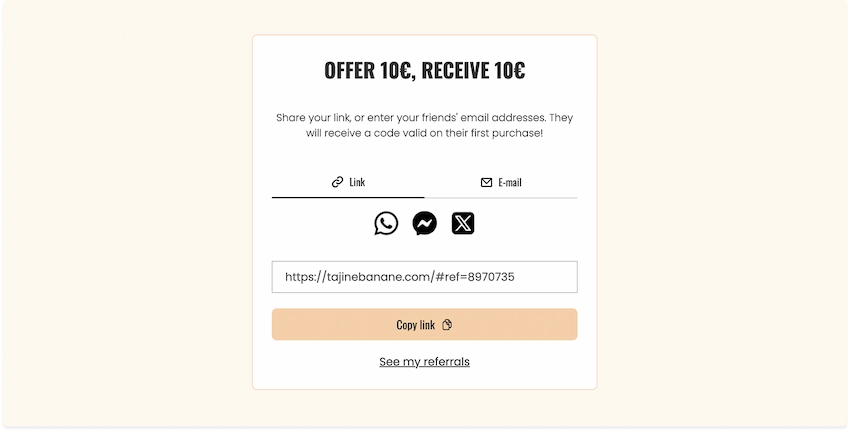
Referral programs sit at the intersection of engagement and acquisition. A customer who refers a friend is, by definition, deeply engaged. They trust your brand enough to put their personal reputation behind a recommendation.
Loyoly's 2026 Benchmark shows referral conversion rates between 30% and 41.5% across sectors. Fashion reaches the top at 41.5%, health supplements at 39.1%. These numbers compare favorably to most paid acquisition channels, and the CAC is structurally lower because the trust barrier has already been removed by the referrer.
Referral programs also create a positive feedback loop for the referrer: the act of recommending a brand deepens their own engagement. Our guide to referral marketing covers the mechanics and incentive structures that drive the highest conversion rates.
4. UGC and social proof
User-generated content (UGC) is both an output of engagement and a driver of it. When customers create content about your brand spontaneously, they are expressing the highest form of engagement: voluntary advocacy with no direct financial incentive.
For ecommerce brands, UGC serves a dual function. It provides social proof that influences purchase decisions: 54% of consumers are influenced by positive customer reviews before a first purchase, according to Loyoly's 2025 Industry Report. And it creates a content flywheel, the more customers see others engaging with a brand, the more likely they are to engage themselves.
The practical approach is to build UGC collection into your loyalty program mechanics. Loyoly's data shows that 59% of consumers are willing to leave a positive review in exchange for a reward. And 27% are willing to like, comment, or share a brand post for points, up 10 points year over year. Explore our complete guide to user-generated content for implementation examples.
.webp)
5. Post-purchase experience
Most engagement frameworks focus on pre-purchase and checkout. The post-purchase window is where the engagement relationship is actually built, or permanently lost.
The moment a customer completes a purchase is the moment of highest brand satisfaction and lowest buyer skepticism. It is the ideal time to introduce your loyalty program, request a review, surface a referral link, or invite them into a community. Brands that activate this window build relationships. Brands that do not, send a shipping confirmation and wait for the next paid acquisition cycle to begin.
A structured post-purchase experience transforms one-time buyers into repeat customers. According to Loyoly's 2025 Industry Report, 38% of loyal customers are already willing to join a loyalty program, but most brands ask too late, too generically, or not at all.
How to measure customer engagement in ecommerce
Engagement cannot be captured by a single number. It requires a composite view that combines behavioral signals across multiple touchpoints and customer lifecycle stages.
The KPIs that actually matter
Here are the engagement KPIs worth tracking on a regular cadence:
Track these KPIs monthly, segment them by cohort and lifecycle stage, and use the data to adjust your engagement mechanics. For a broader perspective on retention measurement, read our guide on customer retention rate strategies.
Three mistakes that kill customer engagement
Getting engagement wrong can be more damaging than not having a strategy at all, because it burns trust and creates the impression that your brand does not actually understand its customers.
Over-communicating without relevance
Loyoly's 2025 Industry Report found that 25% of consumers list excessive communication (emails, SMS, push) as a direct reason to disengage from a brand. Frequency is not a proxy for engagement quality.
The solution is not to send less. It is to send more relevant messages, to better-segmented audiences, at moments that match actual customer behavior. A post-purchase email sent 24 hours after a first order is contextually relevant. The same email sent on the same day to your entire subscriber list is noise.
Treating engagement as a campaign
Customer engagement is not a Black Friday tactic or a quarterly re-engagement blast. It is an always-on system built into every customer touchpoint, from the first order confirmation to the fifth anniversary of their account creation.
Brands that treat engagement as a campaign see spiky activity and flat retention curves. Brands that build it into their infrastructure, through loyalty mechanics, automated post-purchase flows, referral programs, and UGC missions, see compounding returns over time.
Rewarding only transactions
Points for purchases is a minimum viable loyalty mechanic, not a complete engagement strategy. When rewards are limited to transactions, you build a discount program, not a relationship.
The brands with the deepest engagement reward behavioral depth: the customer who leaves a detailed review, shares a real photo, refers three friends. These behaviors are worth far more to your brand than a fifth repeat purchase at baseline, and they should be reflected in how you structure your reward architecture.
To sum up: customer engagement in ecommerce is the strategic discipline of turning one-time buyers into active participants in your brand, through personalized experiences, loyalty mechanics, social advocacy, and a post-purchase relationship that gives them a reason to keep choosing you.
Loyoly is built precisely for this. As a post-purchase engagement platform, it gives ecommerce brands a unified system to orchestrate loyalty programs, referral mechanics, UGC missions, and wallet-based push notifications, calibrated to each customer's actual behavior and engagement level. With 600+ brands already on the platform, the data is clear: on average, engaged cohorts generate 150% more LTV than non-engaged customers. That is not a promise. That is a benchmark.
FAQ
What is customer engagement in ecommerce?
Customer engagement in ecommerce is the ongoing relationship between a brand and its customers, measured through the depth and frequency of meaningful interactions across the full customer lifecycle, from first purchase through advocacy and repeat buying. It encompasses transactional behaviors (purchases, reward redemptions) and relational behaviors (reviews, UGC, referrals).
How do you measure customer engagement effectively?
The most relevant KPIs are repeat purchase rate, customer lifetime value (LTV), loyalty program participation rate, reward redemption rate, NPS, and referral conversion rate. No single metric captures engagement fully, which is why a composite view across behavioral signals is essential.
What is the difference between customer engagement and customer loyalty?
Loyalty is the outcome; engagement is the process that generates it. An engaged customer interacts frequently and meaningfully with your brand. A loyal customer consistently chooses you over alternatives. Engagement is what builds loyalty over time, and loyalty is what makes engagement economically valuable.
What are the most effective strategies to improve customer engagement?
The five most effective strategies for ecommerce brands are: behavior-based personalization, a multi-mechanic loyalty program, referral programs, UGC collection, and a structured post-purchase experience. Applied together, they create a compounding engagement system that grows LTV and reduces dependence on paid acquisition.
Does a loyalty program really improve customer engagement?
Yes, and the data is unambiguous. Loyoly's 2026 Benchmark shows that engaged customers generate between 28% and 117% more LTV than non-engaged customers depending on the sector, with monthly ROI ratios ranging from 11.5 in beauty to 23.2 in sports and fitness. The loyalty program is the infrastructure that makes systematic engagement possible at scale.
How often should ecommerce brands communicate with customers?
According to Loyoly's 2025 Industry Report, 39% of consumers are comfortable receiving brand communications at least once a week. The key variable is relevance: frequency only works when messages are triggered by actual customer behavior rather than broadcast on a fixed calendar schedule.