

.png)


Retail is not dead. But the old playbook is. The brands pulling the most foot traffic in 2026 are not the ones running the deepest discounts. They are the ones that give customers a genuine reason to show up, and an even better reason to come back.
Here is the thing: in-store shoppers spend 34% more than those who shop exclusively online (Retail Dive, 2024). Your physical store is still one of the highest-converting environments you own. The question is not whether to invest in foot traffic. It is how to do it smartly, sustainably, and without torching your margins every weekend.
In this guide, we break down the most effective strategies to drive foot traffic to your store: from local SEO and in-store exclusives to the underrated power of loyalty programs, digital wallet cards, and geo-targeted push notifications.
What foot traffic really means for your retail business
Foot traffic is the number of customers who walk into your physical store over a given period. It is one of the most direct indicators of your store's visibility, attractiveness, and relevance to local shoppers.
But raw visit count is only part of the story. What matters is what happens once people are inside: conversion rate, average transaction value, dwell time, and whether they come back. A store with 500 weekly visitors and a strong loyalty mechanic will outperform one with 1,000 visitors and no retention strategy every single time.
The brands that win at foot traffic in 2026 think in terms of visit quality, not just visit quantity. They optimize for the customer who walks in already knowing their points balance, already motivated by a reward to redeem, already emotionally connected to the brand. That is where the real leverage is.
Build a loyalty program that creates recurring reasons to visit
A loyalty program is not just a retention tool. It is one of the most effective foot traffic drivers you can activate. When customers have points to spend, a reward approaching its expiry date, or a VIP tier to protect, they have a concrete reason to show up at your store.
According to the Loyoly Industry Report 2025 (based on a survey of 1,016 French consumers), 30% of loyalty program members say they want to earn and redeem points both online and in-store. And once a loyalty program is in place, members are significantly more likely to visit in-store than non-members, by 10 percentage points.
The Loyoly Loyalty Benchmark 2026, built on data from 600+ ecommerce brands, shows that engaged loyalty members generate up to 60% more orders than non-engaged customers in fashion, and up to 117% more LTV in home and decoration. These numbers translate directly into more in-store visits per customer per year.
To maximize this effect, your loyalty program needs to be built for omnichannel from day one.
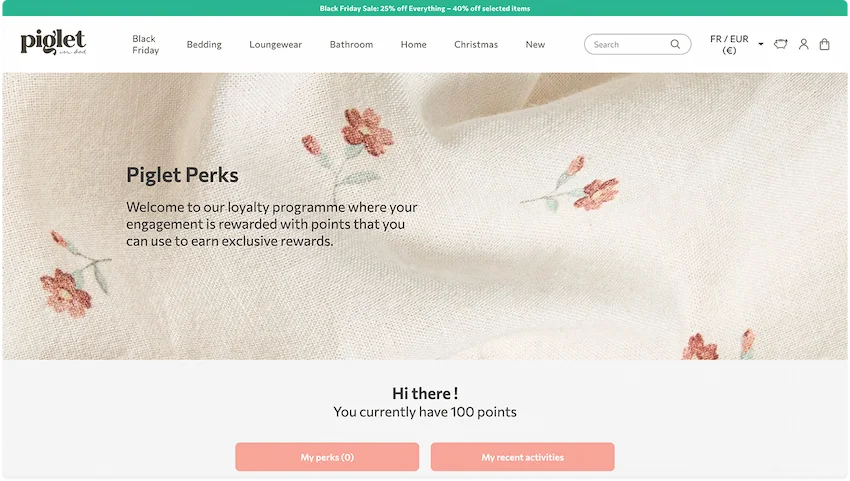
Design your loyalty program for seamless in-store earning and redemption
If customers can only earn points online, your physical store is left out of the loyalty loop entirely. A truly omnichannel program lets customers earn points for in-store purchases, scan a QR code at checkout, and check their rewards balance on their phone without any friction.
Integrations with POS systems like Shopify POS, Cegid, or Fastmag make this possible natively. When the loyalty experience is consistent across channels, customers stop thinking in silos. They simply go where it is most convenient and reward themselves along the way.
Check out how leading retail brands are building these omnichannel loyalty programs for retail to drive measurable foot traffic results.
Use points expiry and reward windows to trigger in-store visits
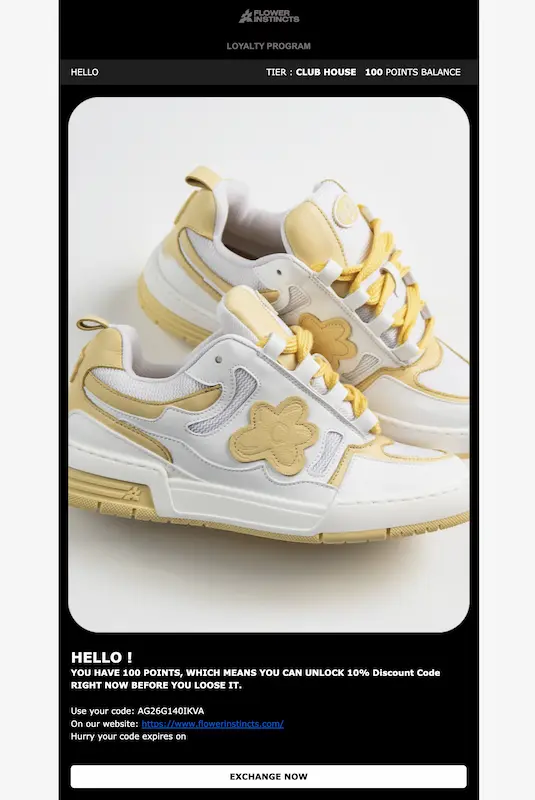
Urgency is one of the most reliable visit triggers in retail. When customers receive a notification that their points are about to expire, or that a reward they earned is available until the end of the month, they act.
This kind of triggered communication, sent at the right moment through the right channel, consistently outperforms generic promotional emails. The more personalized and time-sensitive the message, the higher the conversion to a physical visit.
Local SEO and Google Business Profile: get found before they step in
Before someone walks into your store, they almost always search online first. 78% of location-based mobile searches result in an offline purchase (Shopify, 2024). If your store does not show up prominently in local search results, you are invisible to a massive pool of ready-to-buy shoppers.
Local SEO starts with claiming and optimizing your Google Business Profile. Keep your store hours accurate, add high-quality product photos, collect and respond to customer reviews, and use your primary keywords in your business description. Each of these signals improves your ranking in the local pack, the map results that appear at the top of Google search for nearby queries.
Beyond Google, consistency matters. Your store name, address, and phone number should be identical across every directory: Yelp, Apple Maps, Facebook, and any sector-specific platforms. Inconsistencies confuse both search engines and customers.
Positive reviews as a local SEO and social proof lever
Customer reviews directly influence your local ranking and your conversion rate. A store with 200 recent, positive reviews consistently beats one with 20 old reviews, even if the products are identical.
The most scalable way to collect reviews is to integrate review requests into your post-purchase flow: an automated email or SMS at the right moment, with a simple one-click link. Loyalty mechanics can amplify this further: rewarding customers with points for leaving a verified review gives them both an incentive and a brand touchpoint.
In-store exclusives and events: give people a reason to make the trip
Convenience is Amazon's strongest card. Your strongest card is experience. No algorithm delivers the feeling of discovering a limited product drop in person, attending a brand event, or getting personalized advice from a knowledgeable sales associate.
Exclusive in-store offers (products only available at the physical location, discounts not replicable online, or VIP early-access sales) create a genuinely compelling reason to visit. The key word is exclusive: if customers can get the same deal from their couch, you give them no reason to leave it.
Product drops and appointment retail
Limited product drops, available only in-store for a defined time window, consistently generate high foot traffic and social media buzz. According to Chain Store Age (2024), 64% of consumers say they would visit a store specifically for exclusive product access.
The mechanics are simple: announce the drop in advance through email, SMS, and social media. Make the in-store experience worth documenting. When customers share their purchase on social, your next wave of foot traffic is already building.
Workshops, masterclasses, and experiential retail
Events transform your store from a transaction venue into a community hub. A cooking brand that runs knife skills workshops, a sportswear retailer that hosts weekly running groups, a beauty brand that offers personalized skin diagnostics: these experiences are not replicable online.
Square's 2023 Future of Retail report found that 36% of retailers plan to add DIY classes, tastings, or brand events to enhance their in-store experience. Brands that have done it consistently report higher repeat visit rates among event attendees compared to their general customer base.
BOPIS and click and collect: turning online shoppers into in-store buyers
Buy Online, Pick Up In-Store (BOPIS) is one of the most reliable omnichannel foot traffic levers available. More than half of retailers (54%) now offer BOPIS services (NewStore Omnichannel Leadership Report, 2023), and the market is expected to exceed $150 billion by 2025.
The mechanic is straightforward: a customer orders online, comes to the store to collect, and almost inevitably ends up browsing. Your job is to make that browsing experience as welcoming and discovery-oriented as possible, with your best-sellers, new arrivals, and loyalty offers front and center.
Pair BOPIS with a same-day reward for in-store redemption, and you create a compounding effect. The customer comes to collect, discovers new products, uses a loyalty reward, and leaves as a more engaged member of your brand ecosystem. That is the omnichannel loyalty loop at its best.
The digital loyalty wallet: your most powerful drive-to-store tool
This is the section most of your competitors are not talking about yet. The digital loyalty wallet, a branded loyalty card stored directly in a customer's Apple Wallet or Google Wallet, is one of the highest-ROI drive-to-store tools available to retail brands today.
Unlike a loyalty app (which requires a download, an account creation, and regular re-engagement), a wallet card lives natively on the customer's phone. It updates in real time, showing current points balance, available rewards, and upcoming offers. And it can send push notifications directly to the lock screen, without requiring any app to be open.
The reach advantage is significant. Mobile wallets reach 3 to 10 times more users than a brand app, and push notification open rates are dramatically higher than email. For in-store traffic specifically, geolocation-based push notifications are the game-changer: when a customer enters the vicinity of your store, they automatically receive a triggered message.
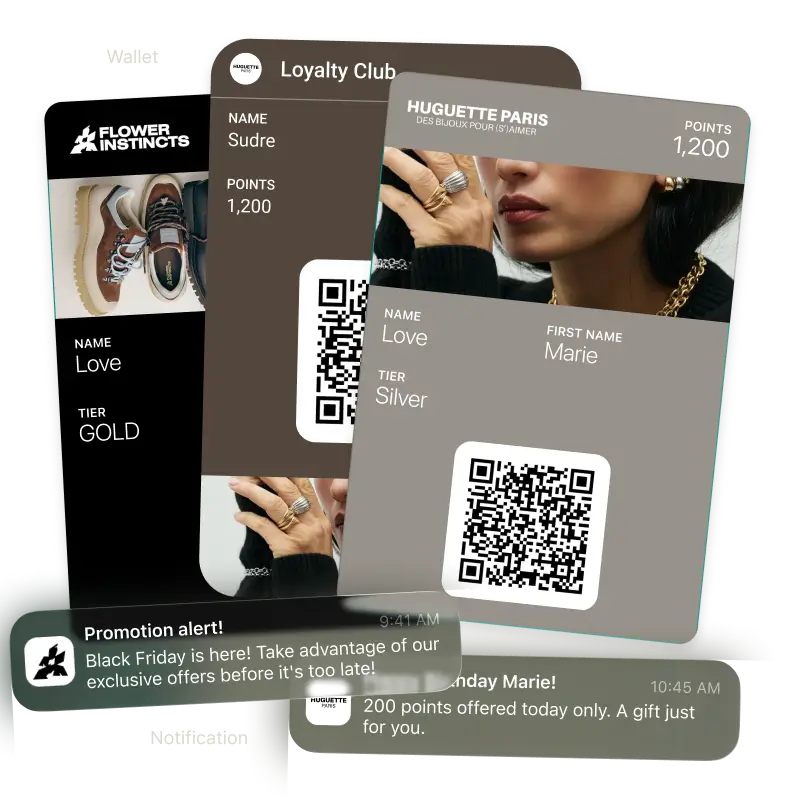
Geolocation-based push notifications: reaching customers at the moment of decision
Geo-triggered notifications work because they reach customers exactly when a visit is already plausible. The customer is already nearby. You are simply tipping the decision in your favor.
The notification can highlight a reward expiring soon, a new product drop available exclusively in-store, or a time-limited flash offer. Because the message is relevant, timely, and location-aware, it converts at a meaningfully higher rate than a generic broadcast email.
Loyoly's wallet module includes native Apple Wallet and Google Wallet integration, built in-house and not via a third-party partnership. Dynamic card updates (points balance, reward status) and triggered geo-based push notifications are all managed from within the same platform as your loyalty and referral programs.
How the wallet transforms your loyalty card into a live drive-to-store channel
A physical plastic loyalty card is static. Once it leaves your store, it is passive. A digital wallet loyalty card is the opposite: it is alive, contextual, and capable of initiating contact at the right moment.
Brands that have deployed wallet-based loyalty programs report a significant uplift in in-store visits among wallet holders compared to non-wallet members. The combination of real-time reward visibility and geolocation-triggered nudges creates a retention and drive-to-store engine that no email newsletter can replicate.
To understand how to integrate a digital wallet into your loyalty strategy and activate geo-push notifications for your store network, download the Loyoly Wallet Ebook, a practical guide to deploying wallet-based loyalty at scale.
And if you want to see how this connects to the broader concept of a modern digital loyalty card, the fundamentals are all there.
Pssst... You might find this interesting!
Driving foot traffic to your store is strategic for your brand and we can probably help. Discover our digital wallet card!
Referral programs: let your best customers bring new ones in
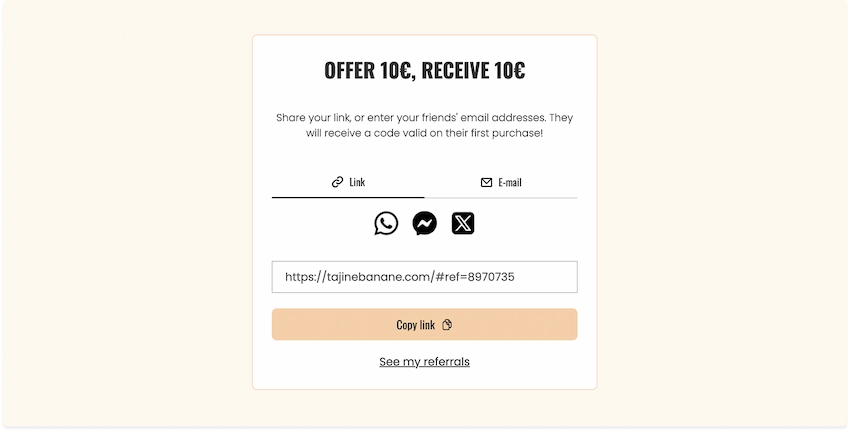
A referral program is one of the only acquisition channels that generates foot traffic from net-new customers with a built-in purchase intent signal. When a friend recommends a brand, the referred customer arrives pre-sold.
According to the Loyoly Industry Report 2025, 59% of loyal customers are willing to recommend the brand to their circle spontaneously, and 29% cite peer recommendation as a factor in their first purchase decision (up 4 points vs 2024). The Loyoly Benchmark shows referral conversion rates between 30% and 41% depending on the sector.
For brands with physical stores, referral vouchers redeemable in-store create a direct and measurable link between your referral program and foot traffic. For a deeper look at how to design a high-converting referral program, the complete referral marketing guide covers structure, mechanics, and examples from successful brands.
How to measure foot traffic and know what is actually working
You cannot optimize what you do not measure. Foot traffic measurement has become far more accessible: from simple door counters to camera-based systems like RetailNext, retailers now have granular data on visit volume, peak hours, dwell time, and in-store conversion rates.
Beyond raw visit count, the most useful metrics are: visit-to-purchase conversion rate, average transaction value per visit, and repeat visit rate (the share of visitors who return within 30 or 90 days). This last metric is the clearest signal of whether your loyalty mechanics are working.
Attribution is increasingly solvable. If you track which customers hold a wallet card, which ones received a geo-push notification, and which ones made a purchase in the following 48 hours, you can build a clear picture of which drive-to-store levers generate the strongest ROI.
To sum up: driving foot traffic in 2026 is not about running more promotions. It is about building a system where your loyalty program, wallet card, geo-push notifications, local SEO, and referral mechanics all point customers toward your physical store at the right moment.
At Loyoly, we help ecommerce and retail brands build exactly that system: a post-purchase engagement platform that connects your loyalty program, wallet card, referral program, and UGC mechanics into one unified engine. If foot traffic is a priority for your brand, our wallet module with native Apple Wallet and Google Wallet integration (including geo-targeted push notifications) is worth a serious look. Explore how Loyoly's loyalty platform can become your most reliable drive-to-store tool.
FAQ
What is foot traffic in retail?
Foot traffic refers to the number of customers who physically enter a retail store over a specific time period. It is a core performance metric for brick-and-mortar businesses, used to evaluate the effectiveness of marketing campaigns, store location, and in-store experience. Higher foot traffic generally correlates with higher sales volume, especially when paired with a strong in-store conversion strategy.
How can a loyalty program drive foot traffic to my store?
A loyalty program creates concrete incentives to visit your physical store: reward redemption windows, points expiry deadlines, VIP exclusive perks, and in-store-only earning opportunities. According to the Loyoly Industry Report 2025, loyalty program members are 10 percentage points more likely to make an in-store visit than non-members. The key is designing your program for omnichannel, where customers can earn and redeem both online and in-store.
What are geolocation-based push notifications and how do they help drive-to-store?
Geo-based push notifications are automated messages sent to a customer's smartphone when they enter a defined geographic area near your store. They are delivered through a digital wallet card (Apple Wallet or Google Wallet) without requiring a dedicated app. These notifications can highlight available rewards, exclusive offers, or nearby in-store events, reaching the customer at exactly the moment when a visit is already plausible.
What is BOPIS and why does it increase in-store foot traffic?
BOPIS (Buy Online, Pick Up In-Store) lets customers order online and collect their purchase at a physical store. It drives foot traffic because customers who come to pick up an order almost always browse while they are there and frequently make additional impulse purchases. Over 54% of retailers now offer BOPIS, and it is one of the most reliable omnichannel bridges between your online presence and your physical store.
How important is local SEO for retail foot traffic?
Very important. 78% of location-based mobile searches result in an offline purchase. If your store does not appear in Google's local pack for relevant nearby searches, you are missing a significant portion of high-intent shoppers who are already in your area. Optimizing your Google Business Profile (with accurate hours, quality photos, and recent reviews) is one of the highest-ROI, lowest-cost actions you can take to improve physical store visits.
What metrics should I track to measure foot traffic performance?
Beyond raw visit count, the most valuable metrics are: visit-to-purchase conversion rate, average transaction value per visit, repeat visit rate (customers who return within 30 or 90 days), and dwell time. For loyalty-driven foot traffic specifically, tracking wallet card holders versus non-holders and correlating push notification opens with subsequent in-store purchases gives you the clearest attribution picture.
.webp)
.webp)