

.png)


Every retail brand says customer loyalty matters. Very few have a structured system to build and measure it. A retail loyalty program is that system. Not a points card collecting dust in someone's wallet, but an engine that connects purchase behaviour, brand engagement, and referral activity into a measurable revenue loop.
This guide covers what actually works in 2026: the program structures, the engagement mechanics, the KPIs that matter, and the benchmarks to measure yourself against, based on Loyoly's analysis of 600+ retail and e-commerce brands.
What is a retail loyalty program?
A retail loyalty program is a structured marketing system that rewards customers for repeat purchases, brand interactions, and referrals. The core logic is simple: you incentivise behaviours that drive revenue, and customers feel recognised for choosing your brand over competitors.
In practice, a retail loyalty program goes well beyond a simple points card. It encompasses omnichannel engagement mechanics, tiered VIP structures, referral incentives, UGC collection, and personalised rewards tailored to each customer's behaviour and lifecycle stage.
Retail brands that implement loyalty programs correctly are not just rewarding purchases. They are building a proprietary data asset, reducing dependency on paid acquisition channels, and systematically increasing customer lifetime value (CLTV).
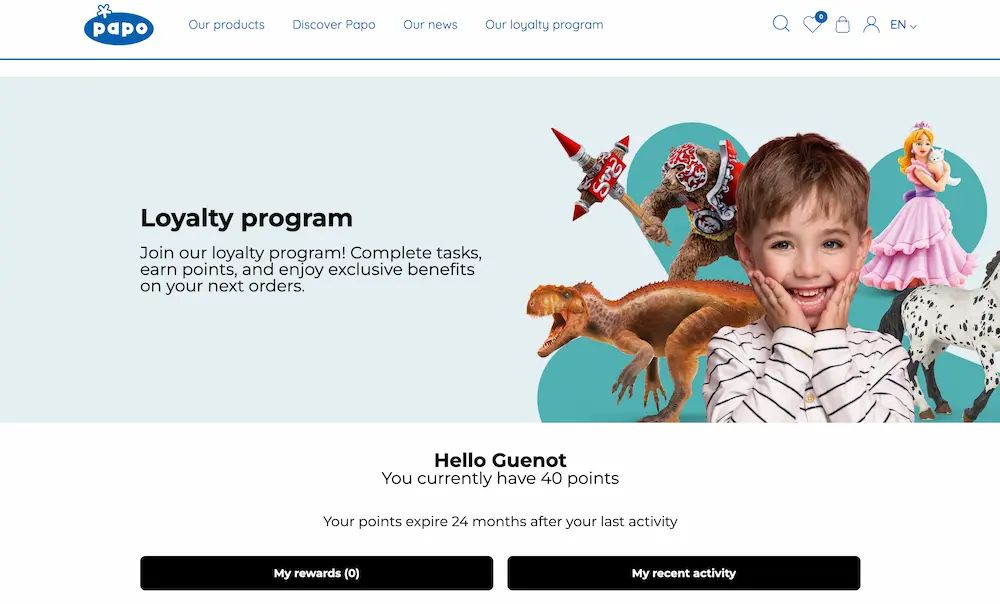
Why retail loyalty programs matter more than ever
The context has changed. Acquisition costs through paid social and search have been rising for years, while third-party cookies are disappearing. Brands that built their growth on Meta Ads or Google Ads are now looking for sustainable alternatives. A well-designed loyalty strategy is one of the most effective answers.
According to Loyoly's Loyalty Benchmark 2026, which analysed data from over 600 e-commerce and retail brands, the impact is measurable across every vertical. In fashion and apparel, engaged loyalty members generate 60% higher LTV and place 41% more orders than non-engaged customers. In home and decoration, the LTV uplift reaches 117%. These are not marginal gains.
A loyalty program also accelerates first-party data collection. Every interaction, review submission, social engagement, or referral enriches your CRM with behavioural data that paid channels simply cannot provide.

The different types of retail loyalty programs
Not all programs are built the same. Choosing the right structure depends on your average order value (AOV), purchase frequency, and competitive landscape. Here are the main models used by retail brands today.
Points-based programs
The most common format. Customers earn points per euro spent, which they then redeem for discounts, products, or exclusive benefits. According to Loyoly's Industry Report 2025 (1,016 consumers surveyed), 71% of consumers say they are most attracted to immediate purchase discounts, and 57% to free products. Points programs address both expectations when structured correctly.
The key variable to get right is the cashback equivalence. Loyoly recommends 5 to 10% cashback in fashion, 6 to 12% in beauty, and 7 to 12% in home and decoration. Set it too low and no one engages. Set it too high and you erode your margins.
One critical benchmark: customers should be able to reach their first reward within one month of their first purchase. If the bar is set too high, disengagement happens before they see any value from the program.
Tiered VIP programs
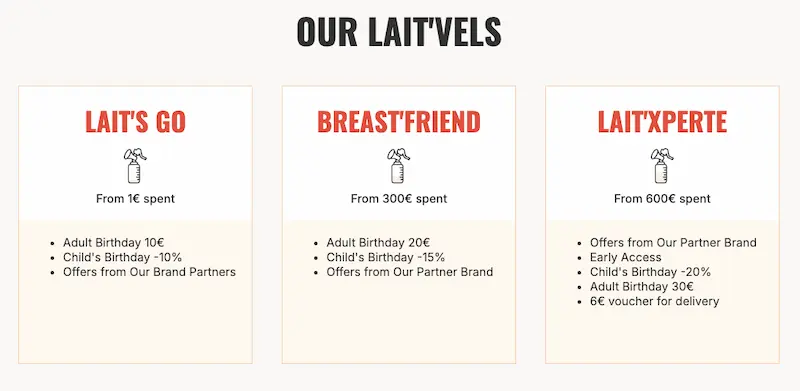
Tiered programs add a status layer on top of points accumulation. Bronze, Silver, Gold. Each tier unlocks exclusive perks: priority access, enhanced rewards, early sale access, dedicated customer service. The psychology at work is powerful: customers do not just want rewards, they want recognition and belonging.
Loyoly's data suggests a healthy tier distribution targets the Gold tier at 5 to 10% of the customer base, Silver at 20 to 30%, and Bronze at the remaining majority. In revenue terms, Gold customers should ideally represent 20 to 30% of total program-generated revenue despite being a minority of members.
In the fashion vertical specifically, LTV among engaged loyalty members is 60% higher than non-engaged customers, measured over a 90-day window. VIP tiers are a primary driver of this gap. For a deep dive, the article on tiered loyalty programs covers every mechanic in detail.
Paid and subscription loyalty programs
A growing format, particularly relevant for high-frequency retail. Customers pay a monthly or annual fee to access exclusive benefits: free shipping, enhanced cashback, early access to new collections. The business logic is simple: customers who have already invested financially in the program are more committed and convert at higher rates.
This model works best when the perceived value of benefits clearly exceeds the subscription cost. If the math does not add up for the customer, churn is fast and your NPS takes a hit.
Omnichannel loyalty programs
Retail brands operating both online and in physical stores need a unified loyalty experience. Points earned in-store should be accessible online and vice versa. According to Loyoly's consumer survey, 30% of consumers say that the ability to accumulate points both online and in-store actively encourages them to stay engaged with a program.
Integrating POS systems like Shopify POS, Cegid, or Fastmag with your loyalty platform is the technical prerequisite. The business payoff is significant: you break the channel silos that frustrate customers, and you gain a 360-degree view of purchasing behaviour across touchpoints. Explore the mechanics of omnichannel loyalty programs if you are running stores alongside your e-commerce.
How to build a retail loyalty program that actually works
A loyalty program is only as strong as the thinking behind it. Here is a practical framework for building one that delivers measurable results.
Define your program objectives before choosing mechanics
Start with the business outcome you want to achieve. Are you trying to reduce churn? Increase purchase frequency? Grow AOV? Generate more UGC and social proof? Each objective maps to a different set of mechanics and KPI targets.
If your primary goal is to increase repeat purchase rate, focus on points redemption mechanics and milestone rewards that trigger at predictable intervals in the customer lifecycle. If you want to grow AOV, tier thresholds tied to cumulative spend are more effective than flat discount codes.
Mixing too many objectives in version 1 of your program leads to dilution. Pick one or two primary goals and design the program around them. You can layer complexity as you gather data.
Choose the right engagement mechanics
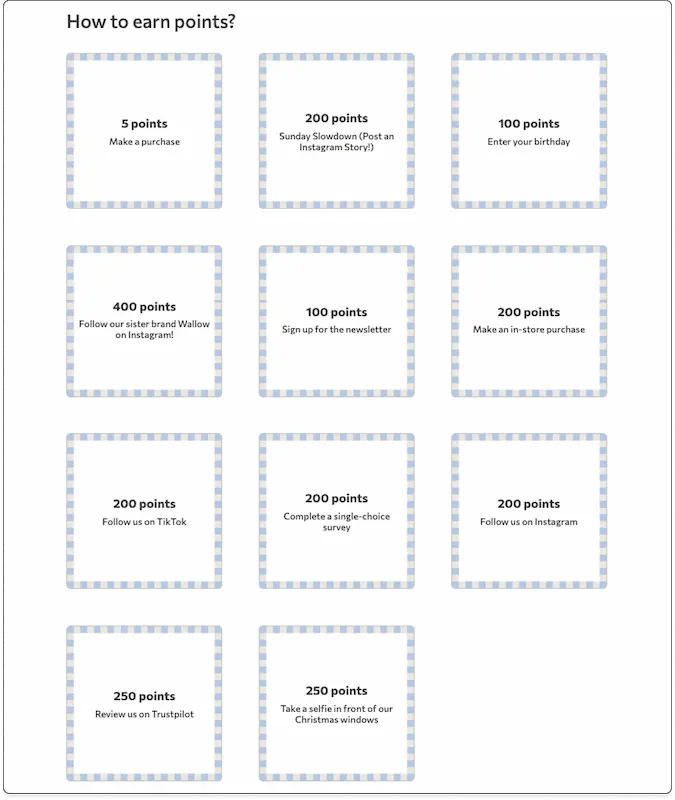
Modern loyalty platforms offer far more than points per purchase. The best-performing programs combine transactional rewards with relational engagement mechanics: leaving a review, submitting UGC, completing a social media interaction, referring a friend, answering a survey. Each action enriches your CRM while deepening the customer relationship.
Loyoly's Industry Report 2025 shows that 59% of consumers who are loyal to a brand are willing to leave a positive review in exchange for rewards. And 27% are willing to interact on social media for incentives. These are concrete conversion rates you can plan around.
The principle is to offer a variety of missions with different commitment levels: low-effort actions (follow on Instagram) earn fewer points; high-commitment actions (submit a UGC video) earn significantly more. For a broader view of customer loyalty programs, including all available mechanics, the dedicated article is a solid reference.
Design the rewards catalogue strategically
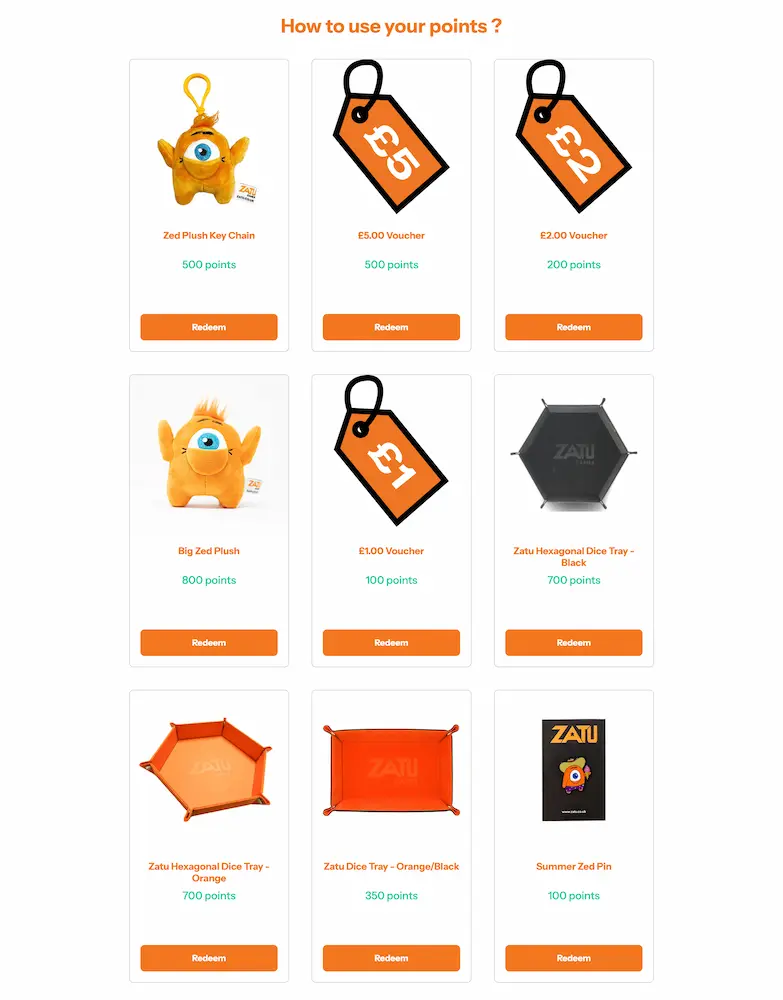
Rewards are the visible face of your program. They need to be desirable, attainable, and margin-safe. According to Loyoly's consumer data, 71% of consumers prioritise immediate discounts, 57% want free products, and 44% respond to promo codes. That is your ranking by preference.
For referral rewards specifically, Loyoly recommends starting at €10 for the referrer and €10 for the referred customer. Adjust upward if your AOV exceeds €80 and your net margin allows it. Compare your referral acquisition cost against your CAC on paid channels. If referral-acquired customers show higher LTV (they typically do), you can afford to be generous.
One tactical note: vouchers encourage higher basket values because customers want to maximise the reward. Percentage discounts are simpler to communicate but may not drive the same AOV lift. Test both formats against your own baseline.
Communicate your program consistently
The best-designed program fails if customers do not know it exists or forget about it between purchases. Email and SMS are the primary communication channels for loyalty programs: 76% of consumers prefer brands to reach them via email, 52% via SMS or WhatsApp, according to Loyoly's Industry Report.
The optimal communication frequency is nuanced. 39% of consumers accept communications at least once a week. But 72% will break their loyalty if quality drops. The lesson: communicate with purpose and relevance, not just frequency.
Klaviyo is the leading CRM integration for e-commerce loyalty programs. Syncing loyalty data into Klaviyo flows lets you trigger personalised sequences based on tier status, points balance, or last redemption date, all of which drive engagement at the right moment.
Retail loyalty program benchmarks by sector
Performance varies significantly across verticals. Here are the key benchmarks from Loyoly's Loyalty Benchmark 2026, based on data from 600+ brands. These are your reference points to evaluate your own program performance.
Fashion and apparel
Fashion is the category where consumers declare the highest propensity for brand loyalty (57%, top of all categories). The program activation rate, which measures the share of orders including a loyalty reward, sits at 4.4%. Engaged customers generate 41% more orders and a 60% higher LTV compared to non-engaged customers. Monthly ROI: 16.8x.
The specific challenge in fashion is the seasonal purchase pattern. Customers may buy twice a year, making engagement mechanics that work between purchases (social interactions, referrals, reviews) particularly important. To go deeper, the fashion loyalty program guide covers sector-specific tactics.
Beauty and wellness
Beauty and wellness leads on activation rate at 5.7% and on points utilisation at 12.3%. Reward utilisation is 51%. These strong engagement indicators are consistent with the higher purchase frequency typical of beauty brands. LTV uplift among engaged members is 28%, with a 17% increase in orders and 9.5% in AOV. Monthly ROI: 11.5x.
The key lever in beauty is the review and UGC mechanism: customers in this category are highly motivated to share their experience. Review and UGC missions consistently outperform other engagement types in terms of completion rates.
Home and decoration
Home and decoration shows the highest LTV uplift of any sector: +117% for engaged loyalty members. Orders increase by 61.5% and AOV by 33.6%. Monthly ROI is 20.4x. These numbers reflect the low base purchase frequency in this category: when a loyalty program successfully re-activates customers, the impact is disproportionate.
The participation rate in home and decoration reaches 23%, which is among the highest across all sectors. Detailed figures across all seven verticals are available in the loyalty program benchmark.
Common mistakes that kill retail loyalty programs
Building a loyalty program is one thing. Avoiding the traps that make most of them underperform is another. Here are the most common ones.
Setting rewards that are too hard to reach
This is the most frequent mistake. A program that requires customers to accumulate points for six months before seeing any reward does not generate loyalty. It generates frustration and dormant members. The benchmark is clear: first redemption within one month of the first purchase. If your current threshold is higher than that, you have a problem to fix.
Track the time-to-first-redemption metric actively. It is one of the strongest leading indicators of long-term program engagement and LTV impact.
Ignoring the omnichannel dimension
If your customers can buy in-store and online but only earn points in one channel, they feel penalised rather than rewarded. 30% of consumers say omnichannel points accumulation is a key driver of active program participation. Siloed loyalty experiences create siloed customers and siloed data.
The solution is a platform that integrates natively with both your e-commerce stack and your POS. Loyoly connects with Shopify POS, Cegid, and Fastmag to ensure every transaction is captured regardless of channel.
Treating loyalty as a discount mechanism
A loyalty program that only offers discounts trains customers to wait for the next discount rather than pay full price. The more effective approach is to mix financial rewards with experiential and status-based rewards: early access to new products, VIP events, exclusive content, dedicated service.
Consumers who are genuinely loyal to a brand are 26% willing to pay more than competitors charge, according to Loyoly's Industry Report 2025. That number is 8 points higher than in 2024. Status and recognition matter more than pure economics for your most valuable customers.
Launching without a referral mechanic
A loyalty program without a referral component leaves a significant acquisition lever untapped. Referral conversion rates across all sectors analysed by Loyoly range from 30% to 41%. In fashion, 41.5% of invited referees complete a first purchase. These are exceptional conversion rates compared to any paid channel.
The most effective time to surface the referral prompt is immediately after a purchase. For a full breakdown, the referral marketing guide covers strategy, mechanics, and measurement in detail.
How to measure the success of your retail loyalty program
You cannot manage what you do not measure. These are the KPIs that matter for retail loyalty program performance, drawn from Loyoly's benchmark methodology.
Program activation rate
This measures the share of orders that include a loyalty reward redemption. Sector averages range from 3.3% (home and decoration) to 5.7% (beauty). Low activation rate is the clearest signal that customers are accumulating points but not engaging with the full program loop.
Points utilisation rate
The share of credited points that are actually spent. Sector averages range from 5.6% (sports and fitness) to 12.3% (beauty). High utilisation indicates that rewards are desirable and achievable. Low utilisation suggests either the rewards are not compelling or the threshold to redeem them is too high.
LTV differential between engaged and non-engaged members
This is the headline metric for any loyalty program. Measure the LTV of customers who have used at least one loyalty reward against those who have not, over a 90-day window. Loyoly's benchmark shows differentials ranging from +28% (beauty) to +117% (home and decoration). If your differential is below sector benchmark, your program needs structural improvement.
Monthly ROI
Calculated as incremental revenue generated by the program divided by total program cost (platform fee plus reward costs). Sector averages range from 11.5x (beauty) to 23.2x (sports and fitness). A well-run program typically achieves double-digit ROI within six to twelve months of launch. If you are not tracking this, you are managing your loyalty investment blind.
To sum up: retail loyalty programs that work in 2026 combine points-based earning with engagement mechanics, VIP tier recognition, and a referral component, all connected to your CRM and POS systems. The data from 600+ brands is clear: engaged loyalty members consistently generate significantly higher LTV, AOV, and purchase frequency than their non-engaged counterparts, across every retail vertical.
Retail loyalty programs are strategic for your brand and we can probably help. Loyoly is used by 600+ retail and e-commerce brands to run loyalty and referral programs that directly impact LTV and CAC. The platform connects natively with Shopify, Klaviyo, and leading POS systems so every customer interaction feeds back into your marketing stack.
FAQ
What is the difference between a retail loyalty program and an e-commerce loyalty program?
The core mechanics are identical. The key difference is the channel complexity. A retail loyalty program must work consistently across physical stores and online channels, which requires integration with both your e-commerce platform and your POS system. E-commerce-only programs are simpler to implement but miss a significant share of customer transactions for brands with physical presence.
How long does it take to build a retail loyalty program?
With a dedicated platform like Loyoly, a fully operational loyalty program can be launched in a matter of weeks, not months. The technical integration with Shopify or other e-commerce platforms is straightforward. The time investment is primarily in defining your points structure, rewards catalogue, and communication strategy before launch.
What is a good ROI for a retail loyalty program?
According to Loyoly's Loyalty Benchmark 2026, monthly ROI across sectors averages between 11.5x (beauty) and 23.2x (sports and fitness). For most retail brands, a well-implemented program delivers double-digit monthly ROI within six to twelve months of launch, driven by increased purchase frequency, AOV uplift, and referral-generated new customer acquisition.
How do you keep customers active in a loyalty program?
The most effective lever is ensuring customers reach their first reward within one month of joining. Beyond that, regular communication through email and SMS, a varied missions catalogue that gives customers reasons to engage between purchases, and periodic bonus points events all contribute to long-term program activity. Tiered VIP structures add a progression dynamic that sustains motivation over time.
Should a retail loyalty program include a referral component?
Yes, and it is one of the highest-ROI decisions you can make. Referral conversion rates in retail range from 30% to 41% depending on the sector, which significantly outperforms most paid acquisition channels. The referral mechanic is most effective when surfaced immediately after a purchase, at the moment when customer satisfaction is highest.
What are the most common reasons loyalty programs fail?
The primary failure modes are: rewards set too high for customers to ever reach them, no omnichannel integration causing channel-specific frustration, overreliance on discounts at the expense of experiential and status rewards, poor program communication between purchases, and absence of a referral mechanic. The most impactful single change most brands can make is adjusting their first-reward threshold downward to drive early engagement.



.webp)
.webp)