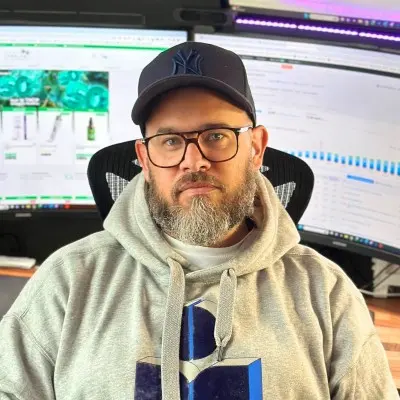
[00:00.0] Hi Julien. Hi. Thanks very much for accepting the invitation. With great pleasure. And I'm genuinely excited to talk about a subject that I find quite fascinating, which is the world of CBD in the context of e-commerce and retail. [00:17.9] I think there are loads of questions people ask themselves about how you acquire customers, how legal all of this actually is, the role of platforms, differentiation. So I'm really looking forward to getting into the nitty-gritty of all that with you. But perhaps first, I'll let you introduce yourself. [00:35.6] So, I've been in the web industry since ninety-six. In practice, I've been working in it since ninety, ninety-nine. So I'm one of the old guard. I've watched the web evolve over time, and I was doing search engine optimisation before Google even existed. [00:53.4] So I've been in the industry for quite a while. Yes, I can see that, clearly. And in terms of your background before cbd.fr, had you had other experiences? If we're talking about career paths, you'd need a whole episode for that. Ok. A whole episode. No, I didn't arrive on the web by chance. [01:12.0] My father had the good idea of buying me a computer when I was young. Back then, people still bought magazines, and in the magazines there were CD-ROMs with software demos. And inside one of them, there was a piece of software called Hotdog at the time, which was an HTML editor. Ok. I installed it. [01:27.1] And then I started making a webpage. Then two, three more. And it became a bit of a hobby alongside school. And one day, at my mum's house, a long-time friend of my parents started chatting with me, he said "What do you do?" I told him, "Well, I build websites." [01:44.8] He said "Oh, that interests me — I run a web company and I'm looking for people who build sites." He told me: "Look, I have a project — it's Harley-Davidson Paris. I'm looking to build their website. Let's give it a go." So I built the site. It worked, it clicked, so they hired me. And that's how I got into the web. But after that, I had quite a journey — I actually left the web because I'd had enough. Ok. [02:06.1] I went into sales for a very long time. I even worked as a salesperson at FNAC when I needed to make ends meet as a young man. I was poached by a client, I went back into the web. I left the web again. I had a meeting with a financial director who was looking to build a website for a company. [02:23.7] At the same time, he was also looking for salespeople. And at the end of the website meeting, he said "No, we actually want you as a salesperson." Ok. So I joined as a salesperson and was selling ERPs. We were a Sage distributor. For about ten years, during which I was also looking after the company's marketing and website on the side. [02:45.3] After that, we wound down those activities and moved into wealth management. Yes, Ok. I've genuinely been through everything, always in industries that are a real pain to work in. And then that business came to an end as well. And I wasn't doing much. And the cousin of a mate of mine was looking for a salesperson in electric scooters at the time. [03:03.5] Ok. So I was supposed to come in as a salesperson. Then we got talking and he said "Actually, I don't need you as a salesperson. I'm looking for someone to handle the web side of things." And so, in the end, I went back to doing web work. I was doing the web again, the marketing, a lot of marketplace stuff. And once again, in a really tedious industry, because we were selling electric scooters — this was right at the peak of the electric scooter craze. [03:25.6] Electric bikes, we were really at the height of the hoverboard trend at the time. Yeah. And then we parted ways. Six months later, he got back in touch saying "Listen Julien, I've met someone — how about we launch a CBD site together?" Ok. [03:43.1] I said "Ok, why not? Let's go for it." So we launched a site — this was in January. We launched the site, if I'm not mistaken, I'd just come back from Thailand. So we must have launched the site on the first of April. Within a month, the site was making quite a splash in the CBD world. And then one of our suppliers, called Fitocane, got in touch. [04:02.0] I got a call, I believe on Ascension Thursday, from one of my business partners, because I was a partner in the CBD project. Ok. He called me saying "I'm with the supplier. The boss, his name is Alexandre Lacarraille." And he told me "He wants to meet you." So straight away, I headed up to Paris, we met up, we started talking, and he said "Listen, I don't think you quite understand, but you're going to be working for me." That was that. [04:23.9] So that's how it happened. I left my old team because they couldn't match the offer I'd been made. I joined the Phytocane group. And what's more, I joined not just as an employee but also as a partner. Ok. So at first I joined in June. The group was Phytocane, and we were only distributing brands in B2B. [04:42.6] And he had a project — he'd told me that if I came on board, it was because there were talks in the pipeline about acquiring the site cbd.fr. And so we bought cbd.fr in mid-October, I think, something like that. A full site redesign. We launched the site on the fourth of January. [05:00.5] And the adventure had begun. Since then, we've been acquiring, acquiring, acquiring. Today we have nine sites. We have sites in CBD, we have a site you see everywhere now — Silent Seeds — which is a very large seed bank, for THC, though. [05:16.8] Ok. A seed bank with fabulous genetics. So to all growers out there, I'd recommend buying from Silent Seeds. The genetics are very highly regarded. And we have sites up and running in England, and we launched a new site on the first of January where we sell THCA. [05:33.9] Ok. Because THCA is permitted in England. Right, Ok. Interesting. In France it's considered part of the THC calculation, whereas in England it isn't. And THCA on its own, as it stands, has no effect whatsoever. Right, Ok. Interesting. We can come back to all the different molecules in a bit. [05:53.4] I know there are loads of other acronyms and so on. I'm very curious to understand how it all works. And your background is really fascinating. Quite a journey. So if you like, let's now kick off the episode with a quick true-or-false round. [06:09.5] First question: marketing CBD is harder than marketing luxury goods. Yes. Do you want a straight true or false, or shall you elaborate a bit? Elaborate a little, yeah. It's very, very hard. Very, very hard. Of all the businesses I've been involved in, I thought I'd had... Well, I'll take the SEO angle too, but the whole marketing side of it. [06:27.1] It's the hardest business because it's the most regulated. Today, CBD is still very closely associated with cannabis. So, basically, we're not allowed to do anything. And the few things we were allowed to do, we're no longer allowed to do either. Yeah, it's only got stricter over time. Something as basic as SMS campaigns — we used to be able to run those. [06:43.9] That's completely banned now. WhatsApp — we can't open a WhatsApp account, for instance, because we can't get our numbers validated. Google Ads — not allowed. Meta Ads — not allowed. Or if you do want to do Meta Ads, it means you have to send the products to the US, get them certified — that costs, I believe, a thousand dollars per product. [07:02.6] It's a real mess. Not that I'm saying we don't do any of it. We do. But that's the pirate side of this industry — all the doors are shut. So what I always tell my staff is: the doors are shut, but we go through the windows, and when the windows are shut, we find a little gap and we'll always find a way through. Excellent. [07:19.4] Really looking forward to digging into this, because I think there are loads of marketers out there who are going to be in a panic hearing that they can't run ads, SMS, or... In a way, that's actually a good thing. I experienced the electric scooter market where ads were allowed — and it just becomes a race to see who can outspend everyone else at the click. [07:37.0] What I love about this industry is that here, we're doing SEO the old-fashioned way. And that's not something just anyone can do. Paying for ads — if you've got the budget, someone with deep pockets can just throw money at it and climb the rankings. Organic SEO — if you don't know what you're doing, you can try whatever you like, you'll stay stuck at the bottom. That's what makes it so interesting. [07:53.2] And that actually links to the second true-or-false: regulation is ultimately the best barrier to entry. Yeah. Which explains everything. You can freely advertise CBD on Meta. You've already answered that one. No. The platforms are stricter than French regulations. Oh yes. [08:12.3] Oh yes. Because CBD is not a controlled substance, it's not prohibited. Yeah. They're imposing their own restrictions. I think it's a safety concern. The problem today is that because CBD isn't properly regulated — apart from, let's say, the 0.3% THC limit that must not be exceeded in France — a lot of different molecules are circulating out there. [08:30.0] The molecules don't exceed 0.3%. So they're technically legal. But there are molecules out there that get you genuinely high and are truly synthetic. And accidents can happen. And indeed there have been accidents where many people ended up in hospital. And I think Google, Meta, and so on tell themselves: if they promote a brand and the kid behind the screen takes something and ends up in hospital, those things will be turned against them. [08:49.1] So they'd rather protect themselves by saying "it's banned, we won't allow it." And then they have no problem. Yeah, they take zero risk. TikTok has just opened up. Ok. I've been contacted by TikTok. So I'll tell you — anyone in the CBD world who hears this is going to rush straight to TikTok. Clearly. For those who weren't aware, TikTok is now allowing certain product categories, but you have to be very careful about the images you show, the terms you use, and so on. [09:10.2] It's still very, very complicated. Ok. Well, there's a glimmer of hope that things might loosen up on certain platforms, at least perhaps. The CBD market is already a mature market in France. Not at all. We're right at the beginning. It's still very young, still... No, no. [09:26.3] Many people think that yes, the smokers' market has reached its peak. That means all the people who used to smoke THC, who are tired of getting high but still want that sense of relaxation — rolling a joint before bed, or... Those people — there are a lot of them, and everyone's jumping into flowers and resin, and the market is saturated on top of that. [09:44.8] But the whole wellness side of things, which is where CBD's true appeal lies — we're right at the very beginning there. We really are at the absolute start. What's holding things back today is that food products haven't been recognised as novel food. So technically, we're not supposed to be selling them at all. [10:01.4] Now there's been a breakthrough — the dossier has advanced over the past month, because it had been dragging on for three years, and it's now moved forward with the European standards. We're beginning to see a framework taking shape for novel food. So I think that over the course of this year, CBD food products will be classified as novel food. [10:18.1] And when that happens, it's going to be an explosion. Because what does that mean? It means pharmaceutical laboratories are already on it. They've all already got their oil ranges ready — Boiron Laboratories, all of those — they've got everything prepared. So they're going to flood the pharmacies. The major supermarket chains are waiting for nothing else but for it to pass as novel food so they can start stocking it. And then we're going to see a real explosion. [10:35.3] You get the impression that CBD is well known, because you know about it. I'm inside the industry, so I know about it. But if you go outside and ask a hundred people "Do you know what CBD is?", I reckon seventy, maybe eighty of them have no idea what it is. Yeah. And as you said, it's true that it can take many different forms as well. [10:52.6] Maybe it's the flowers and the resin and all that which have a bad reputation, but ultimately, the molecule itself has a huge range of uses. It's extraordinary. It really is. And more and more doctors are taking an interest in it. More and more doctors are recommending it. Not prescribing it directly, but pointing people towards it saying "Try CBD." And we genuinely get fantastic results. [11:09.5] In my life, I've had to sell some absolute nonsense — products where I knew, clearly, I was essentially selling rubbish. Not exactly rubbish, but I was overselling the product. CBD as a molecule is genuinely extraordinary. We have people who were on very heavy treatments — tramadol. [11:27.6] That's a serious treatment. And they've stopped taking tramadol, switched to CBD, and they thank us for it. Because with tramadol, they were heavily sedated and weren't well. CBD calms their pain. Now, to be clear — legally we're not allowed to say... That too, legally, we cannot make claims about the therapeutic benefits of CBD. But for us, as a retailer today, you only have to read our customer reviews on the site to realise it's a remarkable product. [11:48.8] Yeah, it's interesting. I've got loads of questions coming to mind. I'm trying not to get too distracted, but it's true that historically, with hemp as well, for all sorts of very deep-rooted historical reasons, it's always been pushed aside — even though in reality, you can do so many things with it. Exactly. [12:05.0] Houses... Incredibly interesting. SEO is the most strategic channel in CBD. Today, yes. Today, yes. We can come back to that in proper detail with all the pirate secrets. Trust is more important than price in this market. [12:24.5] It depends on the products. Smokers will chase the price. Then they'll realise quality matters because there's all sorts on the market. But let's say the first purchase will be driven by price and the offers sites are running. In the wellness market, though, there's genuine consideration around brand reputation and product reputation. [12:47.3] There are really two markets within the same market. Ok. If everyone truly understood CBD, the market would double. More than double. Exactly. The French market is behind other European countries. [13:04.0] No, it's not behind. The regulations aren't the same, but we're not behind. We're not behind at all, actually. In Spain, it's more of a headache. In England, for example, our English sites — normally, the flower is banned. So we're forced to play a bit of a game by saying it's not a flower but rather flowers used for making infusions — tea, in other words. [13:25.3] So it falls under a different directive. So no, France has tried to crack down — that was in 2020, if I'm not mistaken — and it was immediately overturned. No, France is not behind at all. [13:41.6] For once. For cannabis, yes. But not for CBD. Ok. The product is already commoditised. Same answer — yes and no. There's a segment where yes — everything around flowers and resins, yes. But beyond that, especially the oils, the capsules, what I'd call semi-food, because we still can't claim it's food today. [14:04.6] No, there are still beautiful things to be done there. CBD could become as commonplace as aspirin. Oh yes. Oh yes. And without the harmful side effects of aspirin. Because there are no negative effects from CBD. [14:22.1] There are only positives to CBD. There's no dependency. Exactly, it's brilliant. Customer loyalty in CBD is primarily driven by promotions. Yes. Yes, and the problem is that some players in CBD went a bit too heavy on promotions and got their customers a bit too used to fake deals. And so today the market is very, very tricky because, let's say, customers only wait for promotions before buying. [14:49.2] Otherwise, they switch suppliers. Exactly. We had introduced — and we were the first to do so, right at the start of 2023 — a system where everyone, all the CBD sites, used to do minus fifty percent, minus sixty, minus seventy. That's enormous. [15:07.4] And we, my partner and I, said no, there's no point in that — and we were the first to introduce the "buy one get one free" model. Now everyone does it. The problem is they do it all year round. But the real issue is that this is where you need to educate the consumer. [15:22.8] And that's why I try to post about it more and more — always look at the price per gram. It's easy to advertise minus eighty percent on a site when the base price per gram is twenty euros. In the end, with the minus-eighty discount, it's still more expensive than what we offer, even without any promotion. And I feel this area isn't regulated or monitored closely enough. [15:42.9] We know that in France, promotional pricing is supposed to be controlled. Your price must not have changed for a certain period. In our world, it's truly a pirates' world and nothing is respected. And to me, that's outright fraud — you think you're getting eighty percent off, but you're not, because the base price was very inflated to begin with. [16:01.4] So the final price is lower, but there's absolutely no benefit, in fact. Yeah, clearly. Physical retail remains strategically important in CBD. I'd actually say no — because today, most shops have collapsed, while the brands keep on selling. [16:18.3] We made the decision to develop a franchise network because there was demand from clients. And above all, we're not going down the smoker route at all. Smokers are fine. When I came on board with my partners, we had a discussion. There are four of us, but I work most closely with one of them on strategy. And we agreed: the smoker angle — let's leave it to one side. [16:40.9] We sell flowers like everyone else. But that market is saturated, there are a lot of players. We're going to focus more on building a wellness-oriented brand. That's actually why the tagline for cbd.fr today is "your wellbeing." And so we have our shops. If you look at all the shops in the... [16:56.8] Well, not all of them, because some will have a go at me for saying this. But the vast majority — ninety percent of shops — are dark, smoker-focused, all about the flower. Not us at all. Our shops are a bit like an Yves Rocher store. In fact, at the beginning, we had someone who designed for Yves Rocher making our fixtures. And so we really have this wellness aesthetic. [17:12.9] And that's actually why today we're the only entity — I'm not sure whether it's been officially confirmed or not, but from what I've heard internally on the franchise side — to be a member of the French franchise federation. Which already shows the credibility we can demonstrate. And we're the only brand today that can set up in shopping centres. So we have agreements with all the shopping centres and can open there, whereas other brands — they won't even hear of it. Right. [17:38.3] Yeah, that's a hugely interesting advantage to have over the others. The real competitor isn't another shop — it's the pharmacy. Today, no. Tomorrow, yes. Well — yes and no. Yes on the wellness side, no on the smoker side. A pharmacy is never going to stock flowers or resin or pre-rolled joints, that's absolutely certain. [17:59.0] But for oils tomorrow, capsules, food products — and then it'll be the supermarkets for all the confectionery, chocolate and that sort of thing. And then there's also a big business in animals too. Ok. [18:14.7] There you go. Oils for cats and dogs sell like hot cakes and have superb effects on older dogs suffering from arthritis and that sort of thing — they work brilliantly. Interesting. We used to do oils for horses, but we got a slap on the wrist for that. And that's where you see the quirks of France. A cat and a dog are domestic animals, but a horse isn't. [18:33.6] So a horse could end up on your plate. Which means different regulations apply, so we got told off over the horses. It works extremely well today — we have plenty of horse breeders buying from us and it works brilliantly. It's mad. Ok. CBD is closer to coffee than to cannabis. [18:53.8] No. It has a calming effect, whereas coffee excites — on that point, there's no argument. Ok, brilliant. Well, we've already touched a little on your background, why you wanted to join cbd.fr back in the day. And perhaps before we really get into strategy and dig into the details, let's step back for a moment and understand the rules of the game — revisit the regulatory side briefly. [19:18.9] Can you explain concretely what you are and aren't allowed to do in your market? If we knew exactly... Well, let's say the only real rule today is that products must not exceed 0.3% THC. [19:34.4] That applies across all product categories. Beyond that — we sell food products today. Some might say "but that's not novel food, so you're not supposed to be selling it." But by navigating around things slightly, we manage to sell it. With oils, before, you could do whatever you liked and go up to 50% CBD concentrations. [19:55.0] Today that's banned. They've introduced a regulation limiting the quantity of CBD per person per day. So now we can no longer offer 50% oils — the maximum we can offer is 20% CBD oil. [20:10.7] And so to reach 50%, we blend with other cannabinoids like CBG and CBN to hit those 50% concentrations. Ok. I think this is a good moment for you to walk us through all the molecules — CBG, and so on. There are quite a few. [20:27.8] Let's say the three main molecules in CBD today, at a consumer level, are CBD, CBG, and CBN. Those are the three most well-known. They each have different effects, and they can be combined — or you can take a single molecule on its own — and when combined, they produce excellent results. [20:49.5] For example, we have a fantastic product that's a blend of CBD, CBN, and melatonin. And that gives us a brilliant product for sleep. Now when I say "for sleep" — to be clear, it's not a sleeping pill. It means it's a product that helps with sleep, with falling asleep, but it won't... [21:09.6] You wake up feeling fine in the morning. I take it myself. It's wonderful. I take it in capsule form. Two capsules in the evening, half an hour before bed. You fall asleep more easily and — crucially — whereas I used to wake up at three or four in the morning, and I'm a bit of an SEO obsessive by nature, so what did I do? Even at three in the morning, I'd be checking my positions, seeing what had moved. [21:27.4] I'd check the previous day's business figures, and so on. And then it was very hard to get back to sleep. But when I take the capsules, I don't pick up my phone — I fall straight back to sleep, and that's just wonderful. So when you combine all these molecules, you get superb products. And we go even further — on our oils and capsules, we blend CBD, CBG, and CBN with adaptogenic plants. Right, ok. [21:50.2] Which is why we have ranges that are remarkable for treating endometriosis or painful periods, for arthritis. We even have a range for weight management, a range for sun exposure — blended with carotene. Everything can be extended infinitely while always benefiting from the properties of CBD. [22:06.9] Ultimately, that might be the most limiting belief the public has on the subject. As we were saying earlier — you immediately think CBD equals resin, smokers. But what you're actually telling us is... It really is for all uses. And by blending it with other things, you can get truly incredible effects. [22:24.2] And above all, there are products today that exist without THC. In CBD oils today, you have what's called full spectrum and broad spectrum. Full spectrum contains THC. Broad spectrum has zero trace of THC. All the animal product ranges contain no THC whatsoever. Ok. Interesting. [22:42.6] So if we look at the strategic side of things — you've said it's an incredibly competitive market, very promotion-driven too. What's your positioning to stand out from the noise at cbd.fr? Well, we have nine sites, so the strategies are completely different — the persona is not the same at all from one site to another. [23:04.6] So we work the strategies in entirely different ways. Cbd.fr is much more wellness-oriented, so we sell flowers — they're our biggest-selling products today. Our customer base on cbd.fr has an average age of around 49. [23:22.8] So it's not the same customer at all. For example, we have a site called weedy.fr, where ninety percent of customers are flower consumers and considerably younger. But to be clear, the CBD world today is not an 18-to-25 demographic — not at all. Across all our sites. [23:38.4] Perhaps there are other competitors with different marketing approaches, like Tillerlab for instance — I think they skew younger — but across everything we run today, it's more of a 30-to-50 age bracket than an 18-to-25 one. [23:54.5] Yeah, that genuinely surprised me — I never would have guessed. So effectively, one of the first strategic elements is: rather than having one site trying to address all sorts of personas, it's about separating and segmenting — one site, one type of persona. And in the medium to long term, what's your ambition? It might be complicated to talk about all nine sites every time, but perhaps for the main ones — by segment — cbd.fr, then Widy which is perhaps targeting a different audience, and so on. How do you... [24:27.1] What are you planning to do in the future? Yeah, exactly. You, for example — in, I don't know, five years, ten years? Sell. Sell, launch new activities. Yeah, fair enough. No but, well — it's like with anything. For us, if there's a good offer on the table at some point, the group... [24:43.7] Today, we're far from our peak. And if... I'm a certain age. There you go. I'm actually the most senior person in the company. So I'll be retiring a lot sooner than the others. So if there's an opportunity at some point to leave with a big cheque, I'll leave with a big cheque. Simple as that. [25:02.1] A message to everyone listening — you know what to do. But do you think that for the company — I mean, there's quite a significant regulatory evolution happening. You were saying earlier that supermarkets are coming, novel food is going to completely reshuffle the deck on how this molecule can be distributed in the market. [25:22.1] Is your ambition, say in five years — setting the big cheque aside — do you want cbd.fr to be front of shelf in every pharmacy, do you want to have contributed to changing attitudes on this topic, for example? Absolutely, without a doubt, of course. [25:41.2] If I don't get up to be first, I don't bother getting up at all. Yeah. Ask my twelve-year-old son — he'll tell you himself, in life he has no time for second place. He must get that from somewhere. So no, no — absolutely. In another sense though, our current mindset is that we don't want to sell — that's absolutely certain. [25:58.2] Because we've got oversized egos and we want to crush it. So the B2B market — we'll be ready... We already are, but it's not our priority right now. If needs be, we'll be ready — and especially because I have strong contacts in the retail sector, and from my time in electric scooters, we were a very large distributor for the major supermarket chains. [26:18.7] Ok. So I know how they operate. So no — after that, major B2B development. And who knows, perhaps at some point we'll start talking about the legalisation of cannabis in France. Yeah, perhaps, yeah. And I think we'll be among the first players to be approached for that kind of operation. [26:35.5] So we'll see, perhaps. And then we'd move into a different dimension altogether. We've seen it in the US. We've seen how legalisation in certain states has caused cannabis to explode. And in Germany now, it's working very well too. So I think it's going to start making France think, because today people are complaining there's no money, the coffers are empty. [26:52.1] It's not that complicated, is it. Legalise cannabis, the coffers will fill up very quickly. Yeah, clearly. Clearly, clearly. And yeah, it's interesting if you project yourself into that kind of scenario — do you think... Because it can be a bit alarming too, you know — you go to the US for instance, you look at the streets in LA [27:12.6] or certain neighbourhoods in San Francisco, you see people smoking joints in the street, that can have side effects too. What's your vision of things tomorrow if cannabis, well, THC, were legalised in France? What are the potential impacts beyond that? I think they'd be less harmful than the impact of alcohol. Yeah. There you go. [27:36.7] And yet alcohol is sold on every street corner. Yeah, that's true. And alcohol has caused far more damage than cannabis. And above all, the dependency is far more dangerous with alcohol than with cannabis today. Yeah, yeah, that's certainly true. And you also see, even in some countries where it's been legal for a very long time, young people, for instance, don't smoke — because it's not forbidden, there's ultimately no interest in... [28:01.2] In Germany, they've just released the first figures, where they're finding there's been no increase in consumption. It's not the case that legalising it means everyone suddenly starts smoking. And it's not... Because in France people often say: if we legalise THC, that means next it'll be cocaine, it'll be all of that. Not at all. [28:20.8] Someone who smokes a joint doesn't necessarily want to start snorting things. There you go. So that's a false debate. Ok. Ok. And now, if we talk a little about the product as such, but above all the brand — how do you build a brand that is genuinely strong, and also reassuring? Because there's a real notion of trust involved. [28:46.5] I imagine that as a consumer you don't necessarily want to buy just anything. Are you managing to create, beyond a brand and branding, a real mark of trust and safety for your customers? Yeah. [29:02.4] We don't sell just anything. And that's why on our site, you won't see any borderline molecules like some others have. Today, there are plenty of sites on the internet selling 10-OH, HHC, all these molecules that have since been banned. And above all, they're absolute rubbish. [29:18.0] They're completely synthetic molecules sprayed onto flowers. Yes, they can get you high, but under what conditions? No, no, it's genuinely dangerous stuff that's circulating out there. And that's something we simply will not do. We do have proprietary names — for example, we've heavily developed a molecule we call the NBSH. [29:35.7] But there's nothing synthetic about it. It's simply that we combine CBD, CBG, and CBN with other legal cannabinoids. And we named it NBHS because it's something we developed ourselves. Then there's another name — I'll mention it because it's not even really a molecule — THCBD. What is it? It's, let's say, CBD++, so products that are stronger in CBD, with a stronger THC-like sensation, but we always stay within the law — we never exceed 0.3% THC. Ok. [30:05.2] Wow, you really can do anything then. Well, there are a lot of possibilities, yes. And so, on the subject of trust, do you have concrete levers you put in place to maintain that brand image and that mark of safety? Is it the packaging, transparency about the product, reviews, all of that? Well, our packaging is incredibly refined. I've actually brought some along — you'll see the quality of the packaging: it's printed on glossy paper, there are selective varnishes, the designs are very, very beautiful. [30:39.0] We have a brand of ours which is the premium brand called Ivory Suisse. The packaging was at one point developed with Vincent Votemaire. So we pay very close attention to packaging. Product selection too. We have a buyer who is extremely good at her job — her name is Emmanuelle. [30:56.7] And so we genuinely source products from all four corners of the world. It's worth knowing — flowers come from France, Italy, but we go as far as Uruguay and the United States to import them. And then there are all the laboratory tests that we make available to customers. Should they need them, all products are tested and analysed. [31:13.8] That too is a major mark of trust. And then the reviews — when you look at it today, I think we're not far off twelve thousand reviews on CBD.fr. With a score of, I think, 9.5 or 9.6 out of ten. So that's quite a quality indicator. We place enormous importance on customer service. [31:31.2] We have a dedicated team of three people who, I believe, finish work at ten o'clock in the evening. So a customer with us never gets left in the dark. There's always someone on the phone or we reply by email. We provide a service close to Amazon's — meaning that if someone hasn't received their order, we resend the order, we refund. [31:50.0] On that, we... No, no. Customer service for us is extremely important to me. Yeah, and you know that's precisely what will drive customer retention in the context you're describing. When there's a promotion, at least you know that even if you're paying a little more because you're not buying at a time when we happen to be running one, at least you're at ease. [32:08.3] With us, you know that if you hit a problem, there will be a response. You'll have someone on the phone, you'll be able to talk to someone, we'll advise you, we'll find a solution. Always. We never leave anyone in the lurch. And that applies to post-purchase too. You've got a question about a product, you're not sure what to buy — because it can genuinely be confusing. [32:25.6] We're inside the industry. And imagine a fifty-year-old mum who's heard about CBD, she's in pain, someone tells her "I bought from cbd.fr, go ahead." She arrives and sees flowers, resin, joints — what on earth is all this? And then she gets to the oils, we've got sixty, seventy products — what should I take? What CBD concentration do I need? There's always a number, always someone at the end of the line. [32:48.6] There's no chatbot, there's no automated reply. No, no. There's a phone number with a real person at the end who will answer, who will advise, who will inform you. Yeah, that's remarkable. Yeah, is it really scalable to do it by phone? So your three people are on the phone the whole time? Always on the phone. [33:05.2] Always on the phone. Ok. But yeah, that's genuinely impressive to be able to do that by phone. It's true that it's not really what you see as standard practice. Ok. And so, perhaps we can talk about acquisition now. You've said it's very complicated — you can't run ads, etc. [33:24.1] So ultimately, SEO — you were saying it's one of the major marketing channels. Can you walk us through what you've been able to put in place over the years to keep growing traffic? And if there are other levers too. Well, today we exploit all the levers. [33:42.0] Normally, you're not supposed to be able to do that. Some manage it as we do, but your accounts get shut down every six months. It's a massive headache, so many people give up. Beyond that, we use the lever everyone uses — display. There are still networks where you can do display. [33:59.2] Affiliation — you have to be very careful because it can cost you a very great deal. If I add up the stats from all the tools I use across display, ads, and affiliation, I think my actual revenue is about five times what those tools claim. So there's a big clear-out needed there. [34:15.8] So no — today, we use every possible channel in a pirate fashion, as I was saying earlier, because doing it straightforwardly isn't an option. After that, SEO is by far the biggest driver of acquisition today. [34:33.9] The "CBD" search query is the biggest one. Then there are other commercial queries like "cheap CBD" and that sort of thing. But "CBD" on its own is the biggest today. And we must be doing something right, because for the "CBD" query, we rank first and second. First with cbd.fr and second with widy.fr. And this year my objective is to get a third site up there — one of our brand sites called Easyweed, Easyweed CBD. [34:57.6] And I fully intend to get it into third place this year. Ok. And, I don't know if you can give us all your trade secrets, but what are some of the roundabout methods? I don't know — for instance, we're doing a podcast right now. [35:12.9] Are you going to advertise with this to talk in... That, I'm not going to... We'll share it on LinkedIn and things like that. But YouTube belongs to Google, and Google will do it on its own — it doesn't need me to see that Julien Cordobes appeared on YouTube and that he's associated with the company cbd.fr, which gives it authority in the CBD space. [35:34.7] It'll do it on its own, it doesn't need me. Beyond that, in SEO, there are techniques. I don't share my techniques. I did a podcast not long ago, MVP SEO. [35:49.3] They wanted me to give a lot more information than I was going to give. But as a small example, I did share one little piece of information — something very simple about a tool that all SEO professionals use, called SEO Hero Ninja, which lets you see your ranking by keyword and by data centre. Because you're not ranked in the same position across all of Google's data centres. [36:08.5] And that's a superb tool made by Stéphane Madaleno. People in SEO know it very well. And he rebuilt the page. And so during that podcast, I was explaining that on that particular page, in order to send positive signals to Google, he built a little game — a little character jumping over obstacles. So instead of coming to the site, running your search, and spending a minute there — because once you've got your result, you close the site — what do you do while waiting for the results? You play. [36:31.8] So instead of spending a minute, you spend four or five minutes, you've got a score, you want to beat your score, so maybe you come back. Even though there's nothing to win at the end. So you stay longer. One of my competitors called Mamakana watched the podcast. What did he do? He launched a game — Mamakana Game — on his site, same concept, a little character jumping around. [36:49.5] Except now there's a leaderboard and the top ten win... In total, I think every month he puts up one kilo on the line. First place wins, I think, 500 grams. But even that — when you look at it strategically, yes, it will bring people in. But the way he's done it isn't right, and I'm not going to tell him why he's done it the wrong way. [37:08.4] Especially since I saw him — there was a CBD trade show on Sunday and Monday. I saw him on Monday and we talked about it at length. So he's made a mistake, but I don't want to share his mistake with him. And the problem is that you're giving 500 grams to a customer. But you won't see that customer again for the rest of the year. That's enormous — 500 — I think the bloke... [37:24.8] You won't see that customer again all year. So if it's one of your best customers, is it worth doing that for the retention signal — so that Google thinks "people spend a long time on this site, so it's going to gain in ranking"? You have to be careful about what you do, about what you give away. [37:42.0] In CBD, they tend to always give a lot. It's very common — spend 99 euros and we'll give you 25 grams, 50 grams. Some give away 100 grams of flowers. What does that mean? Someone places an order — let's say 50 grams at 99 euros. [37:57.6] Then you give them 100 grams on top — meaning they end up with 150. Which means that instead of reordering in two months, they might reorder in six or seven. I'm not sure it's actually worth doing that. Yes, clearly. But those are quantities that seem enormous. Yeah, Ok, it's not just an impression. Ok. And so, what are your other channels, apart from the roundabout advertising methods and SEO? Do you get a lot of word of mouth, referrals? We have a whole loyalty system, with a referral scheme. [38:27.6] You know the loyalty system well — it's Loyoly. And so it's a system with a referral side, where you refer people and in return you get a commission. Or alternatively, for loyalty, we have a missions system. Customers complete missions on the site and depending on the missions, they earn points, and then those points can be converted either into vouchers or into product purchases. And we have a project as well, where we... [38:53.1] If I were to touch on the game element — in SEO terms — we actually have a game in development internally, but far more advanced than a little character jumping over obstacles. And the idea is to build a system where, within the game, people have the opportunity to use loyalty points to give themselves a little boost in the game. That's brilliant. [39:13.4] Brilliant. A really fun use case. And how would you rank those channels, in terms of percentage of your acquisition? You said SEO is number one. What are the next two or three? [39:27.1] SEO is number one, especially in terms of ROI — it's the most interesting and the least expensive for me. Though it does cost — SEO costs an enormous amount in terms of time, in terms of acquisition, all the little setups — I won't go into detail, everyone knows what we're talking about — backlinks and all of that, it costs an enormous amount. [39:52.2] So there's quite a budget involved. After that, display can cost a lot. Affiliation — we never really went all in on that. Some have put a lot of money into affiliation. There are two things. There's affiliation through platforms like Awin and that sort of thing, where it's a massive machine with big comparison sites. [40:11.9] And then there's the affiliation side more specific to the CBD space. There were some smaller SEO players — some really very good ones — who built comparison sites. And at a certain point, you could do a lot of business through affiliation in CBD. But you had to be careful... I've had competitors giving 50% commission. [40:33.2] On the first order. We acquired Weedy. Weedy.fr was working with affiliates who were giving 50% lifetime commission on each customer. That sounds enormous. When we acquired it, we shut that down immediately, which caused a bit of an uproar. [40:49.9] But so, we never really got properly into affiliation. And it turned out to be the right call — because there were plenty of people saying "We're all-in on affiliation, affiliation, affiliation — we don't care about SEO. We make loads of money through affiliation." Except Google — our ever-faithful friend Google — last year, at the same period, ran a core update, and every single comparison site got wiped out. So affiliation, overnight, became worth zero. [41:08.6] They're still doing it, but I've seen competitors' figures and they've lost an enormous amount of affiliation revenue. Ouch, yeah. Ok. So SEO is really in a class of its own. After that, Meta — if you do Meta well, you can put up very impressive numbers, but again, it can get expensive very quickly. [41:25.7] Then display — it claims a lot of credit for revenue. It works, but again, it depends where you're distributed. There too, you need to do an audit because it can cost you a lot of money for very little return. I'll share a source and they'll all get excited about it. [41:45.2] We started with a display system where we were spending over 15,000 euros per month per site. Yes. Really? Today, I spend 1,500 euros a month and I generate more sales than when I was spending 15,000. Yes. There you go. Wow. [42:03.3] And of course, display companies aren't going to say "You're spending too much, watch out, you could do the same thing with 1,500." I see competitors using the same platforms. I think they're spending 15, 20,000 a month. If they looked at their figures, they could save a lot. Ok. [42:19.8] I think they're all going to rush to their dashboards to check everything now. Exactly. Actually, here's an interesting question I had in mind. If tomorrow Meta opened the floodgates and told you "Ok lads, you can advertise on the platform" — do you think your strategy would change significantly, or not really? No, not at all. [42:41.2] It wouldn't change because we're already doing it today. If I want, if I want to expose myself, if I want to put ten thousand euros a day on my campaigns today, I can. I have no restriction. I must have, in terms of campaigns, I don't know, in terms of... [42:57.7] I don't even know how many I have — I must have over a hundred running. So it's not going to change my life. The only difference is that others will be able to get in on it too, and so once again it'll become a battle of who can spend the most to rank highest and all that. But it won't change anything for us. Ok, ok. [43:14.4] So, as you've said, it's very promotion-driven. It's complicated to get people to the site, and to get them coming back too. When a customer buys for the first time, at what point do you consider them truly activated? When they buy a second time. [43:31.3] The CBD market — having operated across several markets in my life — is very particular. In the CBD market, customers are ultra-loyal. We've had competitors' databases in our hands. Competitors of ours have had our databases. [43:47.6] I think if they look at what they achieved with our databases, they probably didn't do much. There you go. How do you explain that? Perhaps the trust in the site. I'm still searching for a proper answer on that. If I had the solution, I'd go and poach my competitors' customers — I mean new customers. [44:04.9] But it's genuinely very, very particular, and everyone in the industry says the same. There are two things that are very particular in CBD — there's a glass ceiling. Every site reaches a glass ceiling, and to break through it, you need to put in a lot of energy. And then there's this aspect of ultra-loyal customers who are very, very difficult to prise away. Right, ok. [44:23.9] So yes, it's very much tied to initial trust, customer service, reviews, and so on. Our strength compared to others is that we have a monumentally deep catalogue. So sometimes we can perhaps win customers over because they won't find a particular product elsewhere. And we know it's a bit like the Amazon principle. [44:41.7] If you've got everything in one place, you buy in that one place. You don't bother buying your flowers from one site and your oil from another. So that was already part of our strategy — to build that breadth. And then beyond that — is it... I think it's a lot to do with the customers who are smokers. Is it historically in their nature to say "I've got my dealer, I go to my dealer, and I stick with them"? [44:59.8] "I'm happy with my dealer, so I stay with my dealer. As long as he doesn't mess it up, I keep buying from him." Is that it? Maybe. Maybe they've got that in their DNA and that's why they stay. Yeah, maybe — it's an interesting theory. And in your view, what transforms a first purchase into a reflex? You seem to be saying it's fairly natural, but do you think there are still moments... [45:24.4] No, you can lose the customer very quickly. Indeed. Already, if the customer doesn't feel any effect. That's on the wellness side. It can happen. Not everyone reacts to CBD in the same way. Some people will feel it straight away. Others need seven to ten days. And then is the person even consuming it correctly? An oil, if you take it and swallow it, it does absolutely nothing. [45:45.3] Your liver will filter out the cannabinoids and nothing will happen. Ok. So you really have to hold it. The longer you hold it under your tongue, the more you'll feel the effects. So there are rules like that to follow. So it comes down to the customer's personal experience. On the flower side — again, flowers and resin are a different market. There, you can recognise quality flowers. [46:04.3] You can lie about CBD concentrations, but it shows when you smoke it. And then there are all the aromas, the terpenes, how the flower is trimmed. And there you see absolutely everything on the market — flowers that have been heated to destruction, that are revolting, that are black. And then there are some of superb quality. I think that's what determines things today in the flower market — whether you keep your customer or not. [46:25.2] And so obviously the behaviours must be completely different — if we set smokers aside, what do you think the other customers are doing? They've tried something new once. Is it because you're the only ones offering a certain type of product? No, because an oil, a CBD oil — whether you buy a 10% CBD oil from me or from someone else, generally it's the same formulation inside. [46:46.7] Now again, it's a market where that's uncontrolled. You have people selling twenty percent oils that don't actually contain twenty percent CBD inside. Ok. There you go. So there, they're just padding their margins and that sort of thing. But the effects won't be the same as a result. I think we have fairly loyal customers, especially on those products, because we have a very, very broad range. [47:09.3] And we have little extras too. We have all the sleep ranges, we have ranges for pain. We've genuinely built out whole universes to try to guide people as effectively as possible. Someone arrives saying "I have trouble sleeping, what should I...?" There's a sleep universe with us. Then within the sleep universe, the question is whether they want flowers, oils, capsules, or food products. [47:28.4] And within that, they'll be able to find the product that suits them. And generally, if you've advised your customer well and the product is good, it becomes a recurring product. It's a bit like when you go to the supermarket for pasta — you generally always buy the same pasta, the same brand of pasta. Even though the one next to it is ninety, maybe even ninety-nine percent the same thing. [47:47.1] But you stick with your Barilla rather than going for Justo Cru. And do you think it's also linked to whether it's more men or women buying? Because I think men are generally more loyal by nature. Ok. Looking at the purchasing data? That's what I was going to say. [48:07.4] Looking at the purchasing data. As for the rest, I couldn't comment. But is your customer base predominantly male? It depends on the site. Yeah. It depends on the site. On cbd.fr, we're around sixty-forty. On a Weedy, we're more like eighty-twenty, sometimes almost ninety-ten. [48:25.2] So it really does depend on the site. A site like Silent Seeds, on seeds, I haven't checked the figures recently, but there it's very much a male-dominated customer base. And how do you work on LTV? Because as you've said, once you've got your customer they're already quite loyal, but you really want to hold onto them absolutely. [48:46.0] Given that acquisition is so complicated. Are you working on flows, CRM? We touched a bit on the loyalty programme. Can you walk us through your strategy there? On that front, we work with an agency and one person internally on that kind of thing. [49:01.9] In fact, I'm looking for a second person. So if anyone is an expert in newsletters with a strong design sensibility, please send me your CV because I'm recruiting. But once again, we're looking for unusual profiles. People often look for the perfect five-legged sheep. What we want is a CRM expert, but one with that creative, graphic touch — someone capable of producing a newsletter from start to finish entirely on their own, but also capable of optimising acquisition flows, and capable of setting up the sliders on the e-commerce site in line with whatever promotion we're launching. [49:29.4] So it's truly an unusual profile, but we pay very, very well. And in kind. What's funny too is that nobody at our company consumes our products. I think there might be one person who does. I myself take capsules from time to time, but otherwise, nobody consumes CBD. [49:46.6] And sometimes people say "oh, you must all be consuming cannabis." Not at all. Yeah, exactly. Though I'd put the Silent Seeds team in a separate category — they're a world unto themselves. That they are. But so no — we work, we try to bring as many people in as possible. [50:01.9] And working with this agency — I'm very happy with them. The problem is that they do what they're told, but they don't go looking for more in terms of business development. And in terms of flows, for instance, I know that today, with the loyalty system we use, we have customer tiers. [50:22.6] And today, we treat a gold or silver customer the same way as a platinum customer. Ok, yes. And that doesn't sit well with me at all. That's why I'd love to bring in a new person, precisely so that the communication is truly tailored to the customer. Beyond that, we use what I hope everyone in e-commerce uses. [50:44.5] So the flows, the follow-ups, all the automation that everyone does. Yeah, Ok — the fairly standard flows. We use wallet, we do web push. We try to get every distribution channel working in our favour. Great, and on wallet specifically — you have a lot of registered customers, if I'm not mistaken. [51:03.3] We do have registered customers — wallet is good, but we have no stats on it. With your current solution? Yes, exactly, with our current solution — and we're actually thinking of changing. With our current solution, it's all very rough-and-ready, it's done by gut feel, it's almost pot luck — you don't know the click-through rates. [51:22.9] And on top of that, there are such enormous differences between Apple Wallet and, let's say, Google Wallet. They're completely different beasts. With Google, you can have links. With Apple, you're limited on characters, you can't have a single emoji, nothing at all. So today, we're lacking data on that front, and I'd be completely unable to say what the actual returns are from that kind of system. [51:48.7] We implemented it because we're also looking for a loyalty system for our franchisees. So it lets in-store customers have their loyalty card on their phone. But again, you can see it's not unified — the site points and the in-store points are separate on the card. [52:08.1] Beyond that, we haven't even centralised everything. But what is nice, though, is the geolocation system. So a customer who passes within a certain distance of a cbd.fr shop receives a notification saying "There's a CBD shop nearby — come in if you fancy it." That's a nice touch. Ok. Yeah. [52:25.2] Looking forward to evaluating all of that. Perhaps your new wallet solution will... I hope so. We've given them some tips. Brilliant. And if we step back a little — we touched on ambition briefly. If tomorrow, with everything that's happening in the market — it's quite encouraging for the future. [52:47.4] Do you have any other theories — say if you were to look into your crystal ball — about what this market could look like in ten years? It's going to be enormous. It's going to be enormous, and it's going to be enormous because we'll go after the everyday consumer. [53:05.8] The smoker is fine — they buy, they rebuy, they smoke, they're price-conscious... Once we open the market to the everyday consumer, once she realises that taking an oil does her a world of good, taking her capsules... I came into CBD not knowing the product at all. [53:25.1] If you put a product in my hands and tell me to sell it, I'll sell it. That's my strength — I come from the school of thought that believes commerce has no rulebook. Either you know how to sell or you don't. You can go to every business school in the world — if you don't have the commercial instinct, you'll never sell anything in your life. My wife says I'm a fairground trader. She says: there you go. [53:41.3] When I was in electric scooters, the moment I enjoyed most was when we did the Paris Fair. You're in contact with customers, everything explodes — it's a real delight. For me, commerce is a game and I love it. I went into CBD not knowing the market and not knowing how it would evolve. The moment I knew the market was going to explode — and we really are only at the beginning — was when my father started taking it. [54:03.7] My father — sporty, never touched a cigarette in his life. I think he's been properly drunk once in his life. He's the opposite of me, completely straight-laced. And he started taking it. My mother-in-law takes it — she has arthritis in her hands. So I gave her some to start with, she takes it, and she's constantly asking me for more. [54:22.1] My in-laws' neighbour — same thing, he must be just over eighty, has the same problem, takes it, and keeps asking me for more. So I said to myself: if they're taking it... Because it was me who had to educate them and introduce them to the product. But today, if you take... We were talking about a hundred people in the street earlier, but if you take a hundred elderly people in the street, I think not a single one knows what CBD is. Which means the market behind all of this is going to be absolutely enormous. [54:43.9] It's going to be enormous on the wellness side — not the smoking side. I can't wait to see how it unfolds. And in your view, what's the thing that entrepreneurs in this ecosystem underestimate the most? The everyday consumer. [54:59.6] Yeah, we keep coming back to that. They focus too much on the smoker and not enough on the molecule itself. Exactly. That's why they... There are sites that understood this. There's a very good site that was a reference for me four years ago, called The Green Store. [55:21.6] They still have a very polished, very clean site — a bit in your vein, their green, very wellness-oriented. They took a hit in SEO because at a certain point they leaned a bit too far into the wellness angle. So, less of a pure CBD player, moving towards wellbeing aids, essential oils, that sort of thing. [55:39.2] And they took a battering, they collapsed. They're starting to recover reasonably well. And they do have that wellness angle. Le Chanvrier Français too — which has a franchise network — they've partly gone down that route, but the last I heard, I think things are currently difficult for them. [55:55.9] But all the brands that have taken the "I sell flowers, resin, molecules, that sort of thing" approach are making money now, but if they don't take a turn, they won't hold up over time. Interesting. There are a lot of sites that pop up like that — you have a lot of competitors. [56:13.2] Yes, because today a lot of people think CBD is a gold rush. That it's easy — you buy, you resell, you rank easily on Google and so on. No, it's not that simple. It's very, very complicated. It's an industry that I think is one of the most complex in France right now. [56:31.8] You need a very significant investment today to gain positions. Launching in CBD today is very complicated. A lot of people try and fall flat on their face. There are some very big players today who are up for sale because they've had enough. Because — and we haven't mentioned this — it means that every six months you get raided by the DPP, the GCLR, customs. [56:50.1] It's exhausting. You get seizures — your products are compliant, but you still get seizures, and the products aren't returned. Every available means is used to try to slow people down. I think CBD irritates the authorities a little, even though it shouldn't. And the big trend over the past year, just over a year, is the tax audit — the VAT inspection. [57:08.7] Because... And that's the same story. When I arrived at Fitocan, a large portion of products were at 5.5% VAT. Because there was an urban legend floating around in the CBD world saying: flowers, you can argue they're used for infusions, so they're a food product — which means 5.5%. Except there's a law in France, in the VAT code, which states: any product that is not classified is subject to 20% VAT. [57:29.6] So when I arrived — before we acquired cbd.fr — and indeed from the moment we launched it, all our products were at 20%. So when they audited us — which has been going on for a year — they were frustrated, because with us, there's no 5.5%. Everything has been at 20%. Admittedly, we made less margin than the others because they'd been pocketing those 15 percentage points of difference for years. [57:48.8] But now the tax reassessments are coming in. And they hurt. We know people — there are those who've taken twelve million euros in reassessments. Twelve million, and you hand over your company — it's over. Some are at four million, some are fighting right now over one million six, one million seven, two million. So the CBD world is very complicated because, to begin with, the product itself isn't standard commerce. [58:10.6] As I've said, with all the uncertainties — you can't acquire customers like anyone else. On the legal side — you're one hundred percent compliant and you still get customs raids, you still get inspections, every six months you're told you're no longer allowed to do this, you're issuing product recalls, and all of that. It's exhausting. And that's why there's one thing and one thing only we're waiting for: Novel Food. [58:27.5] Once the products are labelled Novel Food and we have a precise regulatory framework, our products will follow the Novel Food framework. We're not going to mess about doing things differently. We always stay within the lines — and that's precisely what allows us every time to come through an inspection still standing and still hold our own. And yet, we do get inspections. It's extraordinary. [58:45.7] I didn't realise it was that discouraging. When you set up a business in CBD, budget well for legal fees. Ok. And actually, that was going to be my next question — if you had to relaunch cbd.fr from scratch with fifty thousand euros, what would you do first? I'm not going to start from the angle of relaunching cbd.fr. [59:07.1] I'm going to go right back to the very beginning of CBD. The first thing I do: I buy all the domain names with every extension. Cbd.fr, .com, dot everything. It's worth knowing that today, cbd.com exists and is registered. It belongs to an evangelical church in the United States. [59:22.8] They sell books using it. The owner received an offer of over ten million dollars and refused. He said: no, I will never allow the name to be used to sell drugs and so on. So he refused. That would be the first thing I'd do, because just by reselling the domain names, you wouldn't even need to work — just by reselling the domains. [59:39.7] Fair enough. No, I'd do the same thing again, prioritising SEO. Perhaps for the first few years, invest more in affiliation — take more of the affiliation market. Because today I know that in those early years it worked, but if that's all you have, you're dead in the game. [59:58.3] That's not ideal. We did nonetheless pull off a great success story with cbd.fr. Worth knowing: we acquire cbd.fr in October. We launch it on the 4th of January — I remember, we had bugs on the site, we were on with the PrestaShop teams, tearing our hair out. And we were tearing our hair out for a particular reason: we had a TV advert on TPMP at 5pm. [60:19.1] The site, I believe, went live at 4:45pm. Wow. And so, to come back to the point — cbd.fr, we acquired it as a site doing 500,000 euros. In the first year, we went to three million six. Yeah. There you go. [60:35.1] So with 50,000, we'd do the same again. Yeah, clearly. And today, what's the group's turnover? The group — I'll give you a range. Yeah, a range, if you're comfortable with that. Somewhere between 25 and 30 million. Ok. Let's go. Ok. [60:52.6] And we still have enormous growth ahead of us. Silent Seeds, for example — a seed site — I'm going to pay a lot more attention to it this year and in the years to come. Because I already love that seed side of things, and there's a very big market there. [61:08.0] Today, the biggest — which is Royal Queen Seeds — is a site on its own that does between twenty-five and thirty million. It's extraordinary, extraordinary. Why do you think it's going to explode in seeds? Because everyone will want to grow their own? No, it's not even that. [61:24.8] It's that I think — today, I know the CBD figures inside out because we have so many sites, I know where the glass ceiling sits. With Silent Seeds today, I know the figures they're doing, and so I know the potential, the capacity we have to go after all those millions that are out there, that others are making. [61:42.8] Above all, I know the site, I know the genetics. Yes, we have far fewer genetics than the big sites, but ours are reputable. We're not in the business of selling rubbish and random genetics people pick up here and there. Ours are genuinely developed genetics. For those who know their stuff, they produce superb results. [62:00.8] But again, I only sell seeds because legally, what we sell are collector seeds. Yes, collector's items. So you're supposed to keep them at home. Exactly. You display them on your little shelf, you put your little pots of seeds out. I'm not allowed to encourage you to grow them because that's prohibited. [62:17.6] That would be a controlled substance. Even CBD — you'd be caught immediately. I'm selling you collector seeds, you put them on your mantelpiece, you look at them. What you do with them after that is no longer my problem. You have to... There's a bit of a... Sometimes it seems a little hypocritical. [62:34.3] No, because ultimately a seed contains no THC. There's nothing in it whatsoever. You can't do anything with a seed alone. But the plant that grows from it — yes. That's where... Yes, I admit. Ok. And one last traditional closing question. If you had to give a piece of advice to a brand — someone launching a brand, or someone wanting to scale a brand — what would it be? In CBD or in general? In general. [62:58.4] Well, first of all, I'd say that racing to climb the ladder isn't necessarily the right thing. You know, it's what I always say — I'd rather do one million in turnover and generate six hundred thousand in EBITDA than do fifteen million and walk away with nothing. A lot of people confuse turnover with margin. [63:16.4] The one thing I live by is margin. So turnover, in itself, isn't necessarily my primary objective. First and foremost, it's about stabilising the market and making money. Because I've been through many businesses where we just grew, grew, grew. And then you hit thresholds — starting with staff management. [63:33.2] And you know what personnel management is like in France — you can quickly find yourself in all sorts of trouble. So you have to be careful. For me, there's a threshold you either clear — and if you clear it, you continue your growth and it's the jackpot — or you don't, because you can't surround yourself with the right people, and you fall flat on your face, and you can fall very, very quickly. [63:50.1] We're a small team. We must be fifteen people today in France and fifteen in England. So it's not... And we've genuinely kept things separate. The English side operates independently. Staff for England are recruited from France, but there are more of them because they do production and that sort of thing. [64:10.0] So there are more of them straight away. Right, Ok. Brilliant. But I tell people: scaling — today, it's the buzzword. There are lots of fashionable terms these days. You get waves of... And everyone says "I'm going to scale my..." No — don't rush into that. First, stabilise. Build a solid pillar with strong foundations, and then go for it. [64:29.4] But first, stabilise. Don't do things in the wrong order. I think that's good advice. Today, you see a lot of people — I have some former CBD people who are launching an e-commerce school and they're going to... "We'll show you every day, we'll guide you on how to make thousands, thousands, thousands." When you grow too fast, if you don't have the right people around you, you can very, very quickly trip yourself up. [64:49.2] You can quickly — on top of letting it go to your head, meaning you see the numbers coming in and you're having the time of your life — forget that you've got taxes due at the end of the year, things like that. And you know, a small VAT audit like that can happen. You make an error and you say goodbye to your company. Yeah, it's wild. Good advice, I think. A perfect note to end on. [65:05.4] Thank you very much, Julien. With great pleasure.

.png)


.webp)





.webp)

