
.png)


A one-star review lands on a Tuesday morning. Your first instinct is to explain yourself.
That instinct is the problem. That person is not your audience, and nothing you write will change what already happened to them.
Your audience is everyone who reads the exchange afterward, halfway through comparing you to a competitor. That is why knowing how to respond to negative reviews matters more than the star rating itself.
This guide covers the groundwork before you write, a seven-step framework with examples, the mistakes that make a bad experience worse, industry-specific angles, the rules on Google, Yelp, Facebook and the app stores, and how to turn complaints into real decisions.
Why responding to negative reviews is crucial for your business
Silence is a position. A negative review with no response reads as agreement, and every reader completes the story in the way least favorable to you.
The reviewer has already made up their mind. The next twenty people have not, and they are the reason you write anything at all.
Every response you write is part of the customer experience, not a separate task. The person who reads it is having an experience of your brand right now, whether they ever buy or not.
Customer reviews carry real weight at the moment of decision. According to the Industry Report 2025 by Loyoly, conducted among 1,016 French consumers aged 18 to 55, 54% name positive customer reviews among the deciding factors in a first purchase from an unfamiliar brand.
Your response rate is public information. A company that answers every complaint, calmly, looks different from one that answers none, before anyone reads a single word of the content.
Responding is also a service to future buyers. Someone comparing two brands wants to know what the experience is when things go wrong, and your answers are the only honest help they get.
It is also the cheapest reputation lever available. Two minutes of attention, no budget, no agency, and the result stays visible for years.
Responding to negative feedback is not damage control, it is the most visible proof of service you have. Every answer demonstrates a standard, especially when the complaint is fair.
Reputation is not what you say about your business, it is what your listings say. That is why response management deserves a named owner rather than whoever has time.
Addressing complaints well is a business skill, not a communications one. It turns up in retention long before it turns up in your average rating.
Two things matter more than wording: speed and consistency. An important complaint answered the same day does more good than a perfect response written a fortnight later.
The service you give after a mistake is the one customers remember. It is also the one thing about your brand that a competitor cannot copy off your website.
Thank the reviewer even here. Every complaint you answer is an opportunity to show a standard of care that the competition is not showing.
The impact of negative reviews on your brand and bottom line
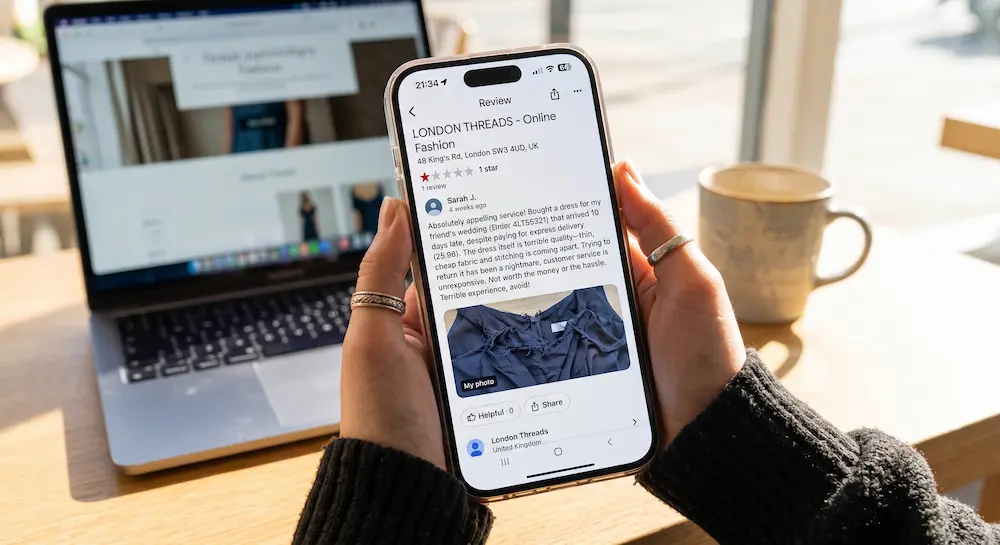
A bad review rarely costs you one sale. It costs you a slice of everyone who reads it before deciding, which is a much larger number and one you never see.
One poor experience rarely stays contained. It gets described to friends, quoted in a review, and remembered far longer than the ten good ones that came before it.
The underlying causes are measurable. In the same Loyoly study, 72% of consumers say a drop in quality breaks their loyalty to a brand, up 7 points on 2024, and reviews are usually where that drop becomes visible first.
Poor service compounds it. 33% of consumers walk away over unresponsive customer support, up 5 points on 2024, and a review page full of unanswered complaints is the visible version of exactly that.
Note what the expensive item is. It is not the negative review, it is the negative review nobody replied to, because that one tells a reader the problem is still there.
Customer service failures are the most expensive kind. They suggest something systemic, and readers assume that what happened once will happen to them.
Negative reviews also change the questions your customer service team receives. Every unanswered complaint becomes a doubt that someone has to answer later, usually at the worst moment.
Reputation also compounds over time. Ratings feed local search rankings, marketplace placement and your online visibility, so a bad month keeps costing you traffic long after the situation was fixed.
Great service is invisible until something breaks. That is why the response to a bad experience does more for you than any campaign about your values.
Your rating shapes what people are willing to pay. When two brands look alike, the one with better reviews wins the sale even at a higher price.
An unanswered complaint is a reputation cost you pay every month. It keeps surfacing in search results for your brand name long after the issue itself was closed.
💡 Our advice: track the share of negative reviews you answer, not just your average rating. It is the most important number you actually control.
The strategic importance of engaging with negative feedback
Negative feedback is research you never commissioned. Customers describe your service in their own words, name the exact step that failed, and do it for free.
Treat negative feedback as your cheapest customer research. A survey costs money and produces polite answers; a review costs nothing and produces honest ones.
Read feedback as a set, not one at a time. Three separate complaints about the same delivery problem in a month is a signal worth acting on; one is an incident.
The information has to reach the right team. Complaints about sizing belong with whoever owns the catalog, complaints about shipping with operations, and a review feed nobody routes anywhere is a suggestion box with the lid taped shut.
Negative feedback is a training asset too. It teaches a new team member exactly what good service looks like, in the customer's own words rather than in a manual.
Engaging also recovers customers. A complaint means someone cared enough to tell you rather than leaving quietly, and that gives you an opportunity most lost accounts never provide.
Some of your best decisions will start as one-star reviews. The customers who explain what failed are handing you a brief on what to improve, at no cost.
There is a management benefit too. Reading customer feedback every week keeps a team honest about quality in a way that no internal dashboard manages.
Businesses of any size can run this. A weekly pass over new reviews surfaces issues months before the support queue reveals them.
The feedback that stings is the feedback worth having. A positive review confirms what you already believe, where a negative one tells you something you had not seen.
Sorting feedback by theme is the most important hour of your month. It turns a stream of individual complaints into a short list of issues you can genuinely resolve.
The reviews that name a specific step are worth a second look. They tell you where the experience breaks, and that is information no satisfaction score will ever give you.
Customer feedback also shows which promises you are failing to keep. Compare the recurring issues to your own marketing claims and the gap is usually embarrassing.
👉 Note: the customers who complain are not your problem. The ones who leave without a word, and never come back, are the expensive ones.
Before you respond: essential groundwork
Step 1: Pause and stay calm
The worst responses in the world were written within four minutes of reading the review. Anger reads as anger on screen, however carefully you dress it up.
Give yourself a fixed delay. An hour is enough to lose the urge to defend yourself, and it is short enough that the customer does not feel ignored.
The best responses to a personal complaint come from someone else. Nobody writes a fair response about something they did themselves, so if a review names you, hand it over.
Set a house rule and share it with the team. Nobody answers a negative review inside the first hour, and nobody answers a serious one alone.
Step 2: Investigate the issue thoroughly
Find the order before you write a word. The order number, the dates, the shipping details and any prior contact with your support team change what you are allowed to say.
Pull the email history before anything else. Most disputes are settled by what was actually written to the buyer, and that is rarely what either side remembers.
Ask the people involved what happened. A one-line account from the team member who handled it is more help than any assumption you make from the review alone.
Check the customer's history as well. A first-time buyer and someone who has ordered thirty times are not the same situation, and the second deserves a phone call rather than a written response.
Sometimes the customer has the facts wrong. That still does not make a correction on the listing the right move, and knowing the facts simply helps you write something accurate and calm.
Step 3: Understand the customer's perspective
Separate the tone from the substance. An aggressive review can still contain an entirely fair complaint, and the tone usually measures how bad the experience was.
Identify what they actually wanted. A late parcel is rarely about the parcel; it is about a birthday, a trip, or a promise you made at checkout that they built a plan around.
Reconstruct the experience end to end. What they saw on the site, what they were told, what arrived, and where the gap between those three opened up.
⚠️ Careful: if you cannot name what the customer expected and did not get, you are not ready to write. Reread it until you understand what they expected.
Decide what a fair outcome looks like before you write. If you cannot name it, your response will hedge, and readers read hedging as guilt.
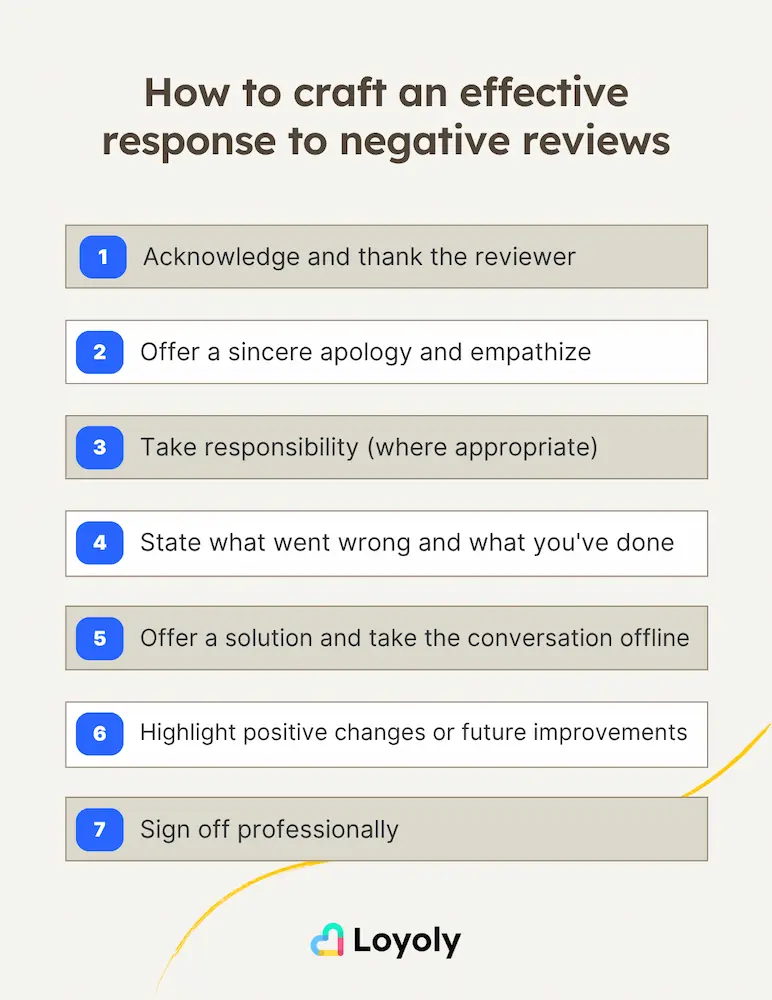
How to craft an effective response to negative reviews: a 7-step framework
Step 1: Acknowledge and thank the reviewer
Open with a thank you, and mean it. Someone spent their own time telling you something your analytics would never have surfaced.
Appreciate the effort out loud. Most unhappy buyers say nothing at all, so the ones who write are doing quality control for your business.
Use their name if the site shows it. A response that opens with a name is read as a message; one that opens with "Dear valued customer" is read as a form letter.
Keep the thanks to one line. Extended gratitude before an apology sounds like a stalling tactic, and readers notice.
The best opening is the shortest. Thank them, name the issue, and reach the apology before the reader loses interest.
Thank them for the detail, not for the rating. The details are what let you change anything at all, and saying so makes the appreciation sound real.
Better: "Hi Marc, thank you for taking the time to write this. I am sorry to hear the order arrived in that condition."
Step 2: Offer a sincere apology and empathize
Apologize for the experience, not for their feelings. "I am sorry you feel that way" is the single most damaging sentence in customer service, because it says the mistake was theirs.
Name what went wrong in their words. Saying "sorry to hear your order arrived two weeks late" proves you read the review, where "sorry for any inconvenience" proves the opposite.
One apology is enough. A second in the same response reads as anxiety and invites a longer exchange in the open than the complaint deserves.
Empathy is a sentence, not a paragraph. Apologize that the experience was frustrating, say you understand why, and move on to what happens next.
Apologize for the outcome even when the cause sat elsewhere. You chose the carrier, the supplier and the process, so the customer is entitled to hear it from you.
Weak: "We are sorry for any inconvenience caused."
Better: "Sorry to hear you waited three weeks for a refund. That is not the service we promise, and it is not what you should have had."
Step 3: Take responsibility (where appropriate)
If it was your mistake, say so plainly. A company that admits a specific failure gains more trust than one that produces a paragraph of careful non-admission.
Where the cause sits with a carrier or a supplier, own the outcome without naming a scapegoat. "We chose that carrier, so this is on us" is both accurate and better for your brand than blaming a third party.
Do not take responsibility for things that never happened. Blanket apologies for unverified claims create a permanent record you may regret, especially in regulated services.
Taking responsibility is not the same as accepting every claim. Acknowledge what you can verify, address the rest with a question, and keep the tone even.
Where the facts are genuinely unclear, say you are looking into it and give a date. Silence during an investigation is what turns one issue into two.
Step 4: State what went wrong and what you've done (or will do)
Give one concrete detail about the cause. Readers can tell the difference between a real explanation and a sentence engineered to say nothing.
Then say what changed. "We have moved to a carrier with tracking on every parcel" is a fix; "we will take your feedback on board" is a phrase that has never fixed anything.
Keep the explanation short. Two sentences on the cause, one on the remedy, and stop before it turns into a defense.
Give a date if you have one. "This changed in April" is information a reader can use, where a general promise to improve is not.
Where a remedy is not possible yet, say so. An honest "we are sorry, and we cannot solve this before the spring" earns more trust than another promise.
Better: "Two orders that week were packed with the wrong label. We have added a scan step at dispatch so it cannot happen the same way again."
Step 5: Offer a solution and take the conversation offline
Make the offer concrete and make it now. "Please contact us" puts the effort back on the customer, who has already done more than they wanted to.
Provide a real route: a named inbox, a phone number, or a direct message on the same site. The Loyoly study is useful here, because consumers are noticeably more open to a phone call when they are the ones initiating it, and email remains the dominant channel in both directions at 75%.
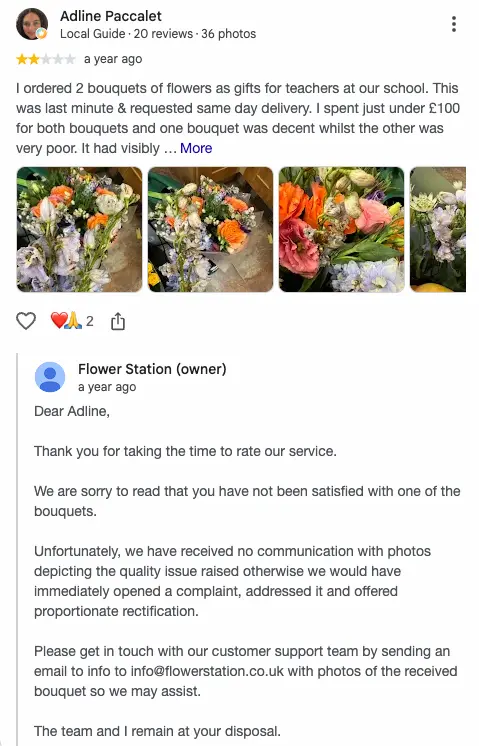
Take the specifics offline, and acknowledge the complaint where everyone can see it. Nobody needs to read the account number, and everybody benefits from seeing that you offered something.
The best solution is usually the obvious one. A refund, a replacement, or a second attempt at the service, offered before it has to be asked for.
Put the solution in the response itself, not after a phone call. A visible offer to put things right is the most persuasive thing a future reader can find on the whole feed.
Better: "I would like to put this right. You can reach me directly by email at claire@brand.com, or call the store, and I will handle the refund myself."
Make it easy to reach a person. An email address that a named colleague monitors beats a support form, and nobody should have to explain the same situation twice.
Step 6: Highlight positive changes or future improvements
Point to what is different now. A future reader wants to know whether the problem they just read about still exists.
Say what you have already put in place. A change that is already in place counts for more than a plan, and it gives the next reader a reason to trust the listing again.
Describe the new experience, not the new process. A reader wants to know what will happen to them, not how your warehouse is organized.
What you improve travels further than what you apologize for. Telling a reader that you now resolve refunds in 48 hours is a stronger signal than the number of times you apologize.
Be careful with promises. A commitment you cannot keep will come back as a second negative review, and it will quote you word for word.
Small, verifiable improvements land better than ambitions. "Our returns window is now 60 days" beats "we are committed to improving the customer experience" every single time.
Improvements only convince when they answer the complaint in front of you. A general commitment to a better customer experience persuades nobody, because every brand makes it.
Step 7: Sign off professionally
Sign with a real first name and a role. An anonymous response from "The Team" is the last thing a reader needs to conclude that nobody is accountable.
Close on the customer, not on your company. "I hope you will give us another chance" is fine; a closing line about your values is not.
Reread it once before it goes live. You are checking one thing: does this sound like a person who read the review, or like a template with the details swapped in?
Sign-offs matter more in service industries than anywhere else. A response signed by a manager reads as accountability; one signed by nobody reads as a form letter.
The examples in this section all follow the same sequence. Copy the structure, not the wording, because reused wording is exactly what makes a response look automated.
💡 Our advice: the whole response should fit in four sentences. Length reads as defensiveness, and nobody reads paragraph three.
What NOT to do when responding to negative reviews
Avoid being defensive or argumentative
Never argue the facts in public. Even when you are right, a company correcting a customer in front of an audience looks worse than the original complaint.
Watch for defensive tells: "as our policy clearly states", "as you were informed", "unfortunately, you". Each one turns a service issue into a dispute.
If the review is factually wrong, correct it once, neutrally, and move to a private channel. One calm reply is enough.
Defensive responses have a signature: they run on. If your draft runs past four sentences, something in it is there to defend you, not to help the customer.
Never insult or blame customers or employees
Blaming the customer ends the conversation and starts a screenshot. It is the fastest route from one complaint to a thread about your company.
Blaming a named employee is worse. It tells every reader how you treat your team, and it tells your team what happens when they make a mistake.
Handle individual performance internally. In the open, the answer is always "we" got it wrong.
This is where a bad response does more damage than the original complaint. Readers forgive a bad experience far more easily than they forgive contempt.
Don't use generic or robotic templates
Ten identical responses in a row show every future reader exactly how much attention you pay. A template is visible from the third occurrence.
Keep a structure, not a script. The seven steps above give you the skeleton, and the specifics of each situation supply the rest.
Vary the opening in particular. If every response on your page begins "We are sorry to hear that", the page reads as automated regardless of who typed it.
Generic responses waste the one advantage you have. A negative review is a rare moment when a customer is paying full attention to your brand.
Customers appreciate specifics far more than sympathy. Naming the exact issue does more for your reputation than three sentences of regret.
Keep a short set of examples for the team instead of a template. Examples help new people find the tone without producing ten identical answers.
The best examples are short, precise and slightly imperfect. Readers appreciate a response written by a person far more than one approved by three.
Notice what these examples avoid: policy quotes, blame, and any invitation to keep arguing. Taking the last word is the most expensive habit in review management.
Resist the urge to make excuses
An explanation tells the customer why it happened. An excuse tells them why it was not your fault, and readers separate the two instantly.
Staffing problems, supplier delays and busy periods are your business to manage. Mentioning them once is context; mentioning them twice is a complaint about your own operations.
Cut every sentence that starts with "unfortunately". It is almost always the beginning of an excuse.
Few readers feel better after an explanation. They feel better after a replacement, a refund, or a firm date by which the issue closes.
The reader does not need to understand your operations. They need to know that the issue was seen, taken seriously and taken care of.
Avoid engaging with trolls or malicious reviews
Some reviews are not feedback. Competitor attacks, extortion attempts and reviews from people who were never customers do not deserve the seven-step treatment.
Answer once, briefly and factually, then stop. A single neutral line tells other readers you saw it, and refusing to escalate is what makes the bad faith obvious.
Report it through the site's own process in parallel. That is the only route that can get the content removed.
Decide in advance who is allowed to respond to negative reviews. Leaving the judgment to whoever happens to open the reviews that day is how a bad situation becomes a thread.
Don't delete negative reviews (unless they violate guidelines)
On most sites you cannot delete a review anyway, and where you can, deleting is a mistake. Customers notice missing reviews, and a listing with nothing below four stars reads as filtered.
Removal is reserved for content that breaks the rules: personal information, abusive language, spam, or reviews with no connection to a real experience.
A handful of critical entries with calm, precise responses is a stronger asset than a wall of five stars. It gives every other review credibility.
Learning to respond to negative reviews well is your best available defense. A company with a visible record of putting things right is far harder to damage than one with an unblemished score.
⚠️ Careful: offering a discount in exchange for taking a review down breaches the rules of every major site, Yelp and Google included. It is also the single easiest thing for a customer to screenshot.
Industry-specific strategies for responding to negative reviews
Restaurants and food services
Complaints cluster on three parts of the experience: waiting time, temperature and a member of staff. All three are recoverable, and all three are visible to the next diner choosing between two places.
Speed is more important here than almost anywhere, because restaurant reviews are read within days of being written. A response two weeks later reaches nobody who was deciding.
Invite them back with something concrete. A table held at a quiet service, handled by the manager, does more than a voucher.
Thank people for detail, especially about food. A guest who tells you which dish arrived cold has given your kitchen more usable information than a month of table feedback.
Hospitality (hotels, travel)
Guests write long, detailed reviews and expect answers of the same depth. This is the one industry where a short response reads as dismissive.
Address each point in order. A guest who raised cleanliness, noise and breakfast will notice if you answer two out of three.
Name the change with a date where you can. "The rooms on that floor were refitted in March" is the kind of proof that converts a reader who was about to book elsewhere.
Guests describe the experience in sequence: arrival, room, service, breakfast, departure. Answering in the same sequence proves you followed their account rather than skimming it.
Retail and e-commerce
Most complaints are about the gap between the product page and the parcel. Sizing, color, condition on arrival and the returns terms account for the bulk of them.
Fix the page, then say you fixed it. If four customers describe the same item as smaller than expected, the honest response is a size note on the listing, not four apologies.
Refunds are where online brands lose the most goodwill. The best move is a refund processed before the customer chases it, which turns a negative review into a neutral one more often than any wording you choose.
Online buyers compare service across every brand they buy from, not just yours. The bar is set by whoever handled their last complaint best, and that is rarely a competitor in your sector.
Online brands live or die on this. Your customer service is the only human contact most buyers ever have with you, so it carries the whole relationship.
👉 Note: in the Loyoly study, 28% of consumers break with a brand after a change to its returns or exchange policy. Your returns terms are a retention lever, not a cost line.
Healthcare and wellness
Privacy is more important than anything else here. You cannot confirm that someone was a patient, and any detail you provide publicly is a potential breach.
The safe structure is short: thank them, apologize that their experience fell short, let them contact you directly by email, and stop.
Patients often describe a service experience rather than a clinical one: the wait, the tone at reception, the phone that rang out. Those you can address.
Have the response approved by whoever owns compliance. In this sector, the wrong sentence is a regulatory matter, not a marketing one.
Professional services (legal, financial, SaaS)
Confidentiality constrains what you can write, and reviewers understand that. Say so plainly rather than appearing evasive.
Keep the response about process, not about the case. "Our engagement terms set out the scope in writing before any work starts" answers the reader without touching the specifics.
In software, complaints often mention a missing feature. Say where it sits on the roadmap or say it is not planned, and either answer beats silence.
Respond to negative reviews here as you would to a client email: measured, precise and signed. The audience is other buyers of professional services, and they read tone closely.
Trust is the product in professional services, so answer criticism here with particular care. One prickly answer can cost you more than the client who wrote it.
Home services
Disputes here are about what was quoted, what was done and what it cost. Written records settle all three, so keep them from the first phone call.
Offer to return and finish the job. In trades, a company that comes back is worth more than a company that never made the mistake, and readers can tell.
Photographs help. If the work was done correctly, offering to share the site photos privately makes the point without contradicting the customer publicly.
Small operators have an advantage here. A response from the owner, by name, carries a weight that no national chain can manufacture.
Handling specific types of negative feedback
Dealing with fake, malicious, or unfair reviews
Establish whether it is fake before you act. No matching order, no visit on the date given, an account with a single review, or wording that matches other listings in your sector are the usual signs.
Genuine negative feedback and a malicious review read differently. Real customers describe a sequence of events, where fake ones describe a feeling and nothing else.
Report it through the official process, then respond once in neutral terms. Something like: "We have no record matching this. Please contact us directly so we can look into it."
Accept that most reports fail. Google removes content that breaches its policies, but it will not remove a review simply because you disagree with the account it gives.
Responding to reviews with profanity or abusive language
Do not quote it back. Repeating the language keeps it alive and drags your response down to the same register.
Do not answer in the moment. Abusive reviews are the ones most likely to produce a response you would want back, and there is no way to unsend it.
Report first, answer second. Abusive content usually violates the rules of the site, and reporting it is the only route to removal.
Keep any visible answer to two sentences. Thank them for flagging it, provide a contact route, and refuse the invitation to escalate.
Addressing vague or non-specific complaints
A one-star review with no text is still worth a response. It costs you nothing and it shows the next reader that you answer everything.
Vague negative feedback is usually about something small that snowballed. One open question is often enough to surface it.
It is also possible that nothing went wrong at all. Some low ratings are misdirected or mistaken, and a polite question is the only thing that will help.
Ask a question rather than guessing. "Sorry to hear this. Could you tell us what happened, so we can put things right?" is the whole response.
Some customers come back and add specifics. Others do not, and the response still did its job for everyone else who sees the thread.
Try one clarifying question and leave it there. A second request reads as pressure on someone who is already annoyed.
Even here, acknowledge it and thank them. A short response to a vague complaint tells every other reader that this company answers, and that is an opportunity worth two minutes.
Responding to reviews on different platforms
How to respond to Google reviews
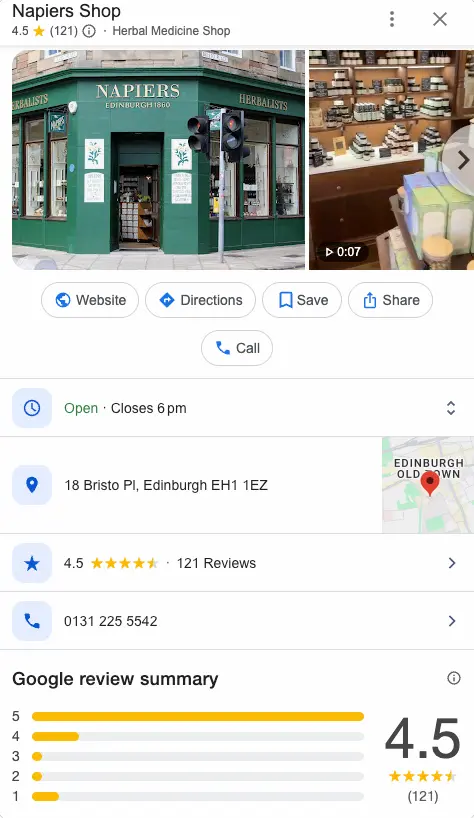
You answer from your Google Business Profile, and the response appears publicly under the review. Google notifies the reviewer, which is why the first line matters more than the rest.
Google is where most of your negative reviews will appear, and where the response is most visible. It is also indexed, so your answer becomes part of what people find when they search your name.
Every platform has its own rules, and mixing them up is how brands get into trouble. Read the guidelines of each platform you are listed on, one by one.
You cannot delete a Google review. You can flag content that breaches the Maps user generated content policy, which covers spam, conflicts of interest, off-topic content and abusive language, and Google decides.
Google explicitly prohibits offering incentives in exchange for posting, changing or removing a review. Offering a discount to take a bad one down is a policy breach, not a negotiating tactic.
💡 Our advice: keep Google responses shorter than you think necessary. They are read on a phone, inside a map card, where a dense block of text simply does not get read.
How to respond to Yelp reviews
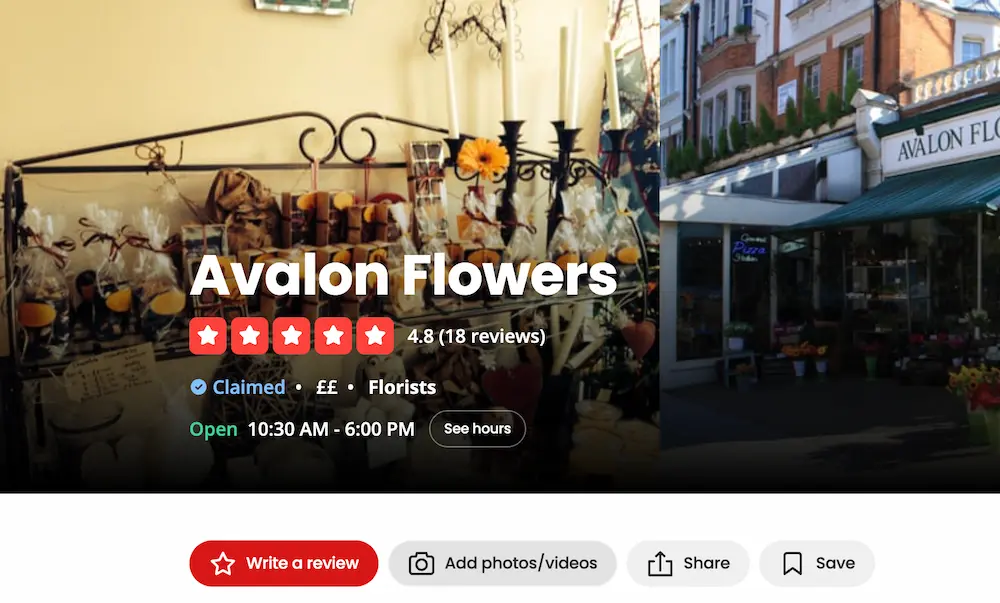
Yelp gives you two routes: a public comment visible to everyone, and a direct message that only the reviewer sees. Yelp recommends the public comment wherever possible, and the two can be combined.
Yelp is stricter than most on solicitation. Its guidelines tell businesses not to ask customers for reviews at all, and offering discounts, free items, payment or contest entries in exchange is treated as solicitation.
Yelp is the platform where good intentions most often breach the rules. Its guidelines are simple to apply once you have read them, and expensive to ignore.
Business owner comments are held to their own standard. Personal attacks, advertising and offering an incentive to change a review are all prohibited, and other users can report your comment.
Use the direct message for anything that needs details, and the comment for the record. That way the customer gets a real answer and the next reader gets the reassurance.
How to respond to Facebook reviews
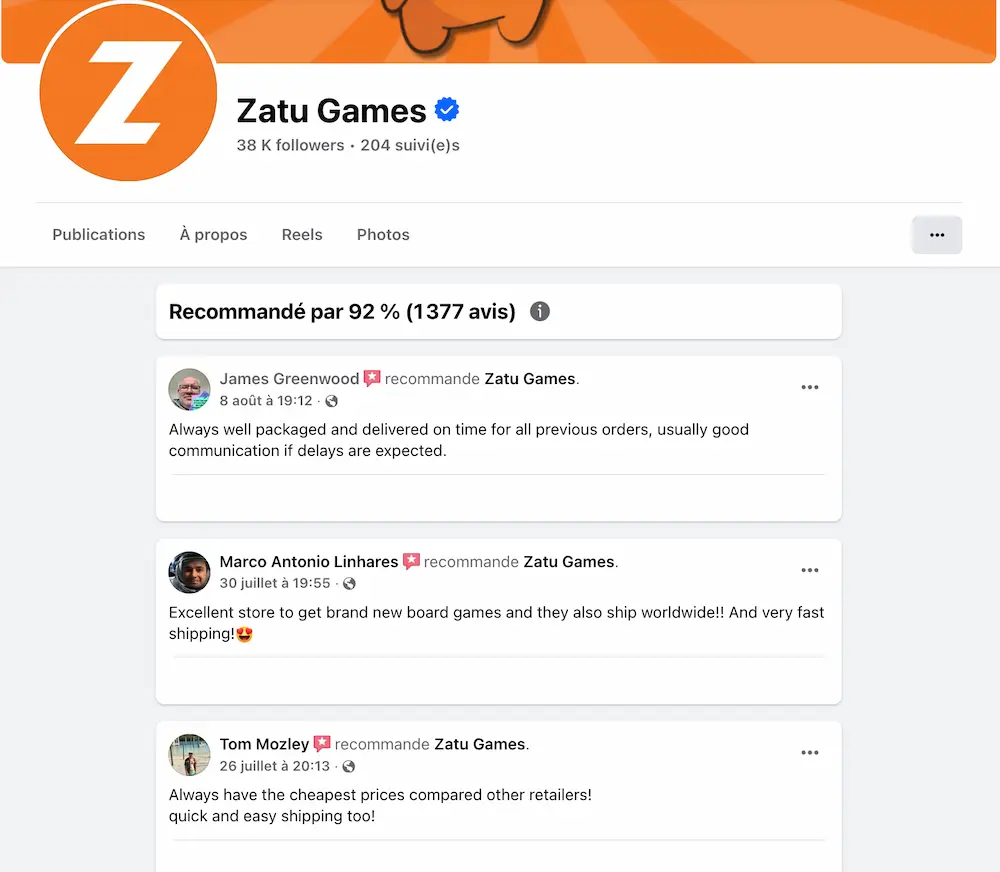
Facebook replaced star ratings with Recommendations, so what you are answering is a yes or no plus a comment. That format makes the written content the only thing that carries any nuance.
You answer as your Page, by commenting on the recommendation itself, and you manage the whole set from the ratings and reviews section of Meta Business Suite. Because it sits inside a social feed, your answer is visible to the reviewer's own network.
You cannot remove a recommendation yourself. Content that breaches the Facebook Community Standards can be reported through the menu on the post, and Meta decides from there.
Facebook reviews reach a different audience. Because the recommendation sits in a social media feed, your response is seen by people who were not looking for you at all.
Respond as the brand, never from a personal account. Facebook makes the distinction visible, and a personal account answering a business complaint looks amateurish.
👉 Note: on Facebook the comment thread stays open. Answer once, well, and take anything further into Messenger before it becomes a spectacle.
How to respond to app reviews
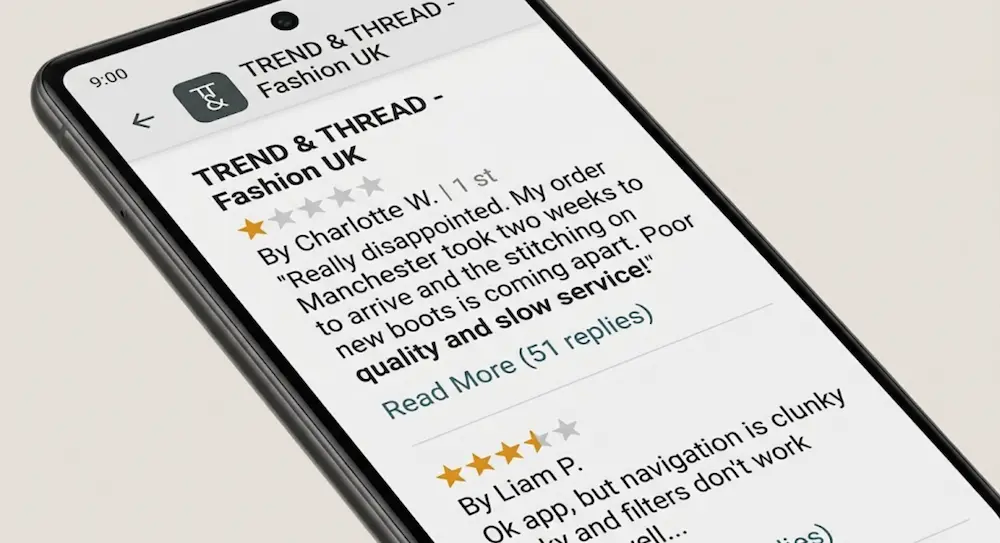
Apple states that you can respond to all reviews of your app, regardless of when they were written, from App Store Connect. Responses can be edited at any time, and only the latest version is shown.
The mechanism that makes this worth doing is unique to the app stores. In Apple's own words, when you respond, the reviewer is notified and has the option to update their review.
Google Play works the same way from the Play Console, with editable responses. On both sides, a fixed reply on a bug you already shipped a patch for is the highest-value response available to you.
For offensive content, Apple directs developers to the Report a Concern option under the review instead of responding to it. The user who wrote the review is not notified that you reported it.
App reviews are the one place where a good response can improve the rating. Group them by version first, because a complaint about a build from three releases ago calls for a different answer.
Leveraging negative reviews for business growth and improvement
Turning negative feedback into actionable insights
Tag every piece of feedback by cause. Delivery, quality, sizing, service, billing: five categories are enough, and the ranking will tell you where to spend next quarter.
Feedback only becomes useful when someone owns it. Share the review inbox with one named person who has the authority to change something, or the analysis stops at the spreadsheet.
Try one change per month rather than ten. Improve the most-mentioned issue first, then tell buyers directly that you did it: that beats a roadmap nobody outside the company ever sees.
Bring it to the monthly management meeting. A ranking by cause carries further than a single furious review passed around by email.
Close the loop when you act. Telling a customer that their complaint changed how you operate is the cheapest loyalty you will ever buy, and they tend to tell other people about it.
Share the tally beyond the customer service team. Marketing, operations and whoever owns the catalog all learn different things from the same feedback.
Encouraging customers to edit or update reviews
Never ask for the star rating to be changed. Ask whether the situation is now resolved, and let the customer decide what to do with that.
Solve the problem first. An update request that arrives before the refund lands will be read as pressure, and it is.
Mention it once, then let it go. Chasing an update is how a settled situation turns back into a complaint.
The app stores make this easiest, because Apple notifies the reviewer and offers them the option to update. Elsewhere, a satisfied customer usually has to be told the option exists at all.
A customer who upgrades a review beats a brand new one. The update is dated, it sits above the original, and it shows a reader exactly what happened next.
⚠️ Careful: the rules differ by site. Google prohibits incentives of any kind around reviews, and Yelp goes further by discouraging solicitation altogether, so read the terms of each one before you build any process on top of it.
Using negative reviews to proactively collect more positive feedback
A page dominated by complaints usually means only unhappy customers are writing. The answer is volume: your satisfied customers exist, they are simply not being asked.
Your happiest customers are the quietest. A good experience produces satisfaction rather than a written account, which is why review feeds skew negative unless you intervene.
Positive reviews are not a vanity metric. They are the context that makes a negative one survivable, and twenty recent positive entries change how the same complaint reads.
Time it for the moment things went right, in the channel the customer already uses. The Loyoly study found that 59% of consumers would leave a positive review in exchange for a reward, which tells you the willingness exists well before the mechanics do.
Build it into the post-purchase flow rather than running a campaign. A steady trickle of recent reviews does more for your rating than a burst, and it looks a great deal more natural.
Send it while the experience is still fresh. A request that lands a month later reaches someone who has already forgotten what went right.
Get the moment right and the response rate takes care of itself. Just after a delivery that went well, or a service call that did resolve the issue, is when they are most willing.
Keep it simple and make it possible on every channel. An email, a line on the receipt and a link in the delivery confirmation cover most of your buyers.
Check what each site allows before you reward anything. Rewarding a review on your own store is standard practice; doing the same for a Google review is not permitted.
Frequently asked questions about responding to negative reviews
How quickly should I respond to a negative review?
Within 24 to 48 hours for anything visible. Fast enough to look attentive, slow enough that you have investigated and calmed down. Restaurants and hotels should aim for the shorter end, since their reviews are read while people are still deciding where to go.
Is it ever okay to not respond to a negative review?
Rarely, and it is a deliberate choice rather than an oversight. Reviews with no text and no rating context, or an abusive post you have already reported, can be left alone. Everything else gets an answer, even a short one.
What if a negative review is on a third-party site where I have limited control?
Claim the listing first, because most sites only allow responses from a verified owner. Where responding is genuinely impossible, answer the same complaint somewhere you do control, so the pattern of care is visible.
Should I offer a discount or free item to every negative reviewer?
No. It trains customers to complain publicly, it costs you margin on issues that a good apology would have settled, and offering anything in exchange for an edited or deleted review breaches the rules on Google and Yelp alike. Fix the problem first.
Compensate only where real money was lost, and apologize everywhere else. That distinction is what protects your margin and your online reputation at the same time.




.webp)